

Posted by Sarah Collins
on October 05, 2026

You're standing in the oral-care aisle with a sharp jolt in your tooth from the cold drink you just bought. There are tubes for sensitive teeth, numbing gels, pain tablets, sprays, rinses, and “natural” options, yet the label that promises fast relief doesn't explain what kind of pain it addresses.
That distinction matters. A quick, electric zing from cold air isn't the same as a dull, persistent toothache, and neither is the same as tenderness after whitening or brushing. Tooth pain relief products work in different ways, so the most useful question isn't “Which product is strongest?” It's “What kind of discomfort am I trying to manage, and what does it need?”
The guide below separates temporary symptom control from longer-term sensitivity support. It also explains the main ingredients, what the evidence says, and where family safety boundaries matter.
| Product category | What it may help with | What it cannot do |
|---|---|---|
| Desensitizing toothpaste | Repeated sensitivity from cold, heat, sweets, or brushing | Resolve a cracked tooth, decay, or infection |
| Topical oral gel or liquid | Temporary surface numbing | Provide lasting relief from an underlying cause |
| OTC oral analgesic | Acute dental pain and, for some medicines, inflammation | Replace dental evaluation or treatment |
| Home comfort measure | Mild, short-term soothing while you arrange care | Treat the source of persistent pain |
| Professional dental treatment | The underlying dental problem | Serve as a substitute for everyday prevention |
Why Tooth Pain Relief Products Confuse So Many People
The same word, “toothache,” can describe several very different experiences. A person with exposed dentin may feel a brief, sharp response when cold water touches a tooth. Someone with a damaged filling may feel pain when biting. Another person may wake with a deep ache that doesn't disappear when the trigger is removed.
Those patterns call for different responses because the discomfort may arise from different structures. Desensitizing toothpaste is designed for repeated sensitivity, while an oral analgesic or topical gel is generally used for temporary relief from acute discomfort. Neither category should be treated as a diagnosis.
Two goals that are easy to mix up
The first goal is short-term numbing or pain control. Topical products act at the surface, while oral medicines work throughout the body. They can make a painful period more manageable, but the relief may fade while the original dental problem remains.
The second goal is longer-term management of sensitivity. Desensitizing formulas are used consistently to reduce the response to common triggers. Their purpose is not to numb the mouth immediately, but to influence the way stimuli reach or affect the tooth.
Dentin hypersensitivity is widespread, although estimates vary substantially by population and diagnostic method. Published reviews have reported figures from 3% to 98%, while more standardized summaries often place the global average around 25% to 33% of adults. One review estimated worldwide prevalence at 33.5%, with a 95% confidence interval of 30.2% to 36.7% (Frontiers in Oral Health review).
Practical rule: Match the product to the pattern of pain, not simply to the most dramatic promise on the package.
A useful starting point is to ask three questions:
- What triggers it? Cold, heat, sweets, brushing, biting, or no obvious trigger?
- How long does it last? A brief zing, or pain that continues after the trigger is gone?
- Is it changing? New swelling, worsening pain, or nighttime discomfort deserves more attention than occasional sensitivity.
That simple filter turns a confusing shelf into a decision. The aim isn't to find one universal product. It's to understand which option can serve as a reasonable bridge and when a dental visit matters more than another purchase.
The Five Main Types of Tooth Pain Relief Products
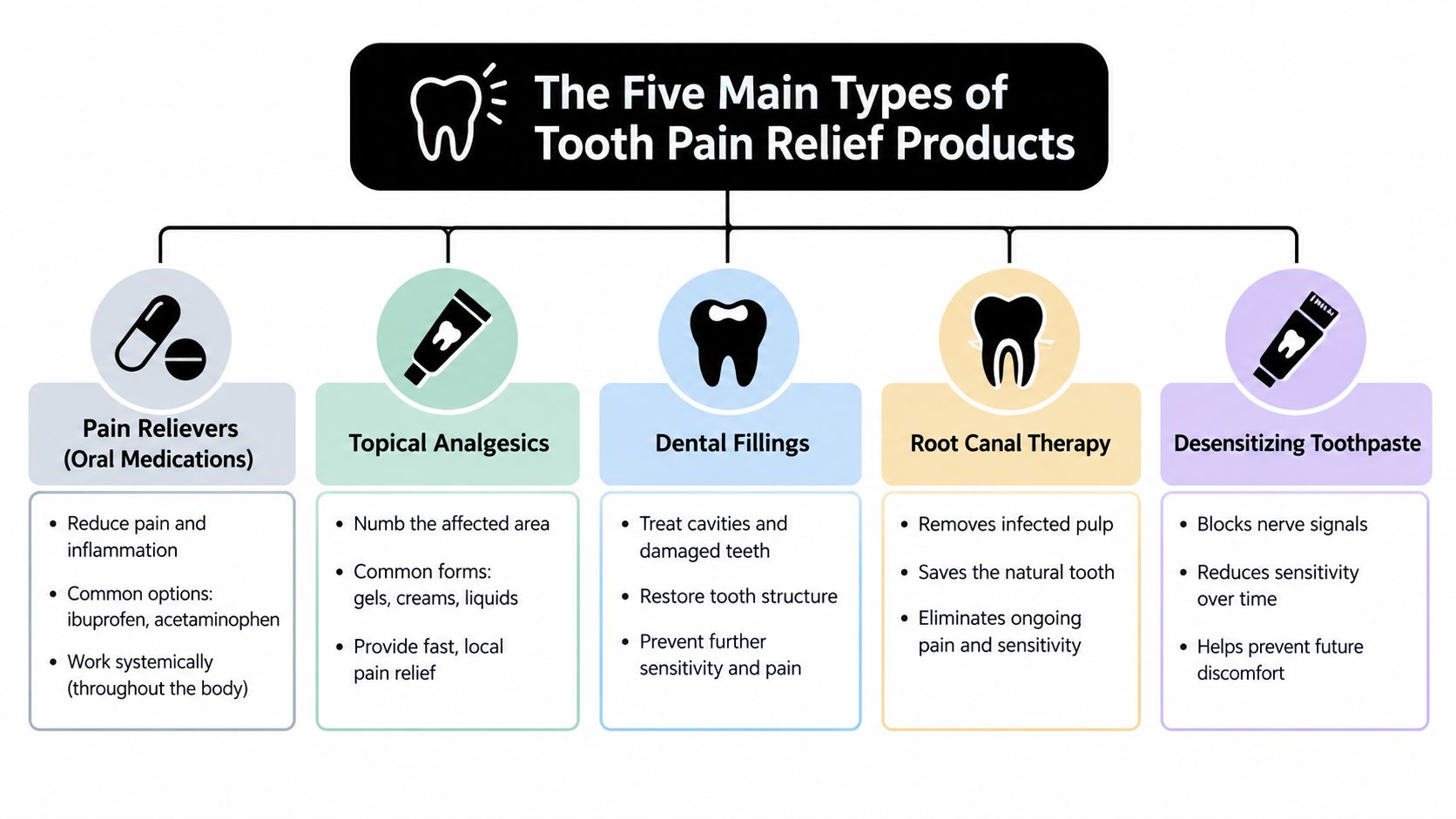
Tooth pain relief products fall into five broad groups. Each has a different role, and the categories shouldn't be treated as interchangeable.
1. Desensitizing toothpastes
These are intended for recurring sensitivity rather than a sudden, severe toothache. Common active approaches include potassium nitrate, stannous fluoride, and mineral-based ingredients such as hydroxyapatite. Used as part of a consistent brushing routine, they may help reduce reactions to cold, heat, sweet foods, or brushing.
2. Topical analgesic gels and liquids
Products containing ingredients such as benzocaine can temporarily numb the surface of the mouth. Eugenol-based preparations, often associated with clove oil, are another topical approach. These products can feel fast because they act locally, but they don't address problems beneath the surface.
3. OTC oral analgesics
Medicines such as ibuprofen and acetaminophen are taken by mouth rather than applied directly to the tooth. NSAIDs, including ibuprofen, are relevant when inflammation contributes to pain. ADA-endorsed guidance recommends NSAIDs as first-line therapy for acute dental pain because they're more effective at reducing pain than opioid analgesics (American Dental Association guidance).
4. Home comfort measures
Cold compresses, gentle saltwater rinses, and carefully used clove preparations are accessible options for temporary comfort. Readers looking more broadly at plant-based approaches can also consult this overview of natural pain relief products, while keeping in mind that “natural” doesn't automatically mean suitable for every age or situation.
5. In-office dental treatment
A dentist can examine the tooth and choose care that addresses the source, which may include a protective coating, bonding, a filling, or more involved treatment. A professional evaluation becomes particularly important when pain persists, follows damage, or appears with swelling or other warning signs.
The evidence also shows why ingredient labels deserve attention. In an 8-week randomized clinical trial, toothpastes containing potassium nitrate, stannous fluoride, and oxalate reduced dentin hypersensitivity more than a negative control at every measured time point. Stannous fluoride showed stronger cold-air relief than potassium nitrate by Week 2 and across the combined time points, and more participants achieved complete cold-air relief with stannous fluoride through Week 8 (randomized clinical trial).
How Desensitizing Toothpastes Actually Work
Desensitizing toothpaste isn't a single technology. Different active ingredients approach sensitivity through different pathways, and the formula needs consistent contact with the tooth to be useful.
Potassium nitrate and nerve response
Potassium nitrate is used in many sensitivity formulas. The basic explanation is that potassium ions move through the dentinal tubules and reduce the nerve's ability to fire in response to stimuli such as cold air or sweet foods.
That process isn't the same as instant surface anesthesia. It's better understood as a gradual reduction in the tooth's response with repeated use. A systematic review and network meta-analysis covering 125 randomized clinical trials found evidence supporting several active ingredients, including calcium sodium phosphosilicate, stannous fluoride, and potassium compounds paired with hydroxyapatite or stannous fluoride (systematic review and network meta-analysis).
The same review reported that potassium nitrate toothpaste improved air-blast sensitivity at 6 to 8 weeks, with a standardized mean difference of -1.25, 95% CI -1.65 to -0.851. That result describes a measured effect in the reviewed trials, not a guarantee for every person or product.
Nano-hydroxyapatite and mineral support
Nano-hydroxyapatite, often shortened to nHA, consists of synthetic crystals designed to resemble the mineral found naturally in teeth. In toothpaste, these particles may deposit on the tooth surface and help cover microscopic irregularities and dentinal tubules.
That mechanism appeals to people who want a mineral-based approach to daily oral care. It also explains why a toothpaste can be positioned as a sensitivity-support product without promising instant numbness. Mouthology is one fluoride-free toothpaste option that uses nano-hydroxyapatite; readers comparing formulas can review this guide to sensitive-teeth toothpaste active ingredients.
| Active ingredient | Mechanism | Typical onset | Best for |
|---|---|---|---|
| Potassium nitrate | Reduces the ability of the tooth nerve to respond to triggers | Gradual with consistent use | Repeated sensitivity from cold, sweets, or brushing |
| Stannous fluoride | Supports sensitivity reduction through a fluoride-based active approach | Gradual, with trial evidence showing differences across measured time points | Sensitivity routines where stannous fluoride is appropriate |
| Nano-hydroxyapatite | Deposits tooth-like mineral and may cover microscopic surface irregularities | Gradual with consistent use | People seeking mineral-based sensitivity support |
| Calcium sodium phosphosilicate | Supplies mineral ions that can contribute to tubule occlusion | Gradual | Formulas designed for sensitivity management |
Fluoride, arginine, and strontium salts also appear in some formulas. The ingredient list matters, but so does technique. Use a soft brush, avoid aggressive scrubbing at the gum line, and give a chosen formula enough consistent use to judge whether it suits you. Switching products repeatedly makes it difficult to know what's helping.
Topical Analgesics, OTC Pain Meds, and Home Remedies
A topical gel can feel like the quickest option because it's applied directly to the sore area. Benzocaine products are labeled for temporary relief of toothache and minor mouth or gum irritation, but the label matters: one FDA Drug Facts label permits use for adults and children 2 years and older, up to 4 times daily, and says not to use the product for more than 7 days unless directed by a dentist or doctor (DailyMed benzocaine label).
Oral medicines work differently. Ibuprofen and naproxen are NSAIDs that reduce pain and inflammation, while acetaminophen primarily provides pain relief. Follow the product label, check for interactions and health conditions, and ask a pharmacist or clinician if you're unsure which medicine is appropriate.
The shift away from relying on opioids is documented in U.S. emergency department data. For visits related to tooth disorders, nonopioid analgesics were the most frequently given or prescribed pain-relief medicines in 2020 to 2022, rising from 20.0% in 2014 to 2016 to 38.4% in 2020 to 2022. During the same periods, opioids used as the sole pain-relief drug fell from 38.1% to 16.5% (CDC National Center for Health Statistics).
How the common options compare
| Product type | Active ingredient | Onset and duration | Evidence level | Key safety note |
|---|---|---|---|---|
| Topical gel | Benzocaine or another local anesthetic | Usually temporary and surface-focused | Useful for labeled temporary relief | Follow the label and observe age restrictions |
| Oral NSAID | Ibuprofen or naproxen | Temporary systemic pain and inflammation support | ADA-endorsed first-line class for acute dental pain | Check medical conditions, medicines, and label directions |
| Oral pain reliever | Acetaminophen | Temporary pain relief | Established OTC pain-relief option | Avoid exceeding label directions or duplicating ingredients |
| Clove preparation | Eugenol | Temporary topical comfort | Some traditional and clinical support, but limited as a complete solution | Concentrated oil can irritate tissue and should not be swallowed |
| Saltwater rinse | Salt in water | Gentle, short-term soothing and cleansing | Common comfort measure | Spit it out and don't treat it as a substitute for care |
| Cold compress | Cold applied externally | Temporary numbing and comfort | Practical supportive measure | Use a cloth barrier and stop if skin becomes painful |
Clove oil, saltwater rinses, and cold compresses can be reasonable bridge measures for some people. Don't place aspirin directly on the gum, because it can injure oral tissue. For procedure-related questions, this Houston guide to extraction pain relief offers additional context, while this resource on immediate relief for tooth sensitivity focuses on the difference between acute comfort and ongoing sensitivity care.
Safe Tooth Pain Relief Products for Kids and Pregnant Users
Children and pregnant users need a narrower safety filter than the average adult shopping for a numbing gel. Age, body size, swallowing risk, current medicines, and medical history can all change what's appropriate.
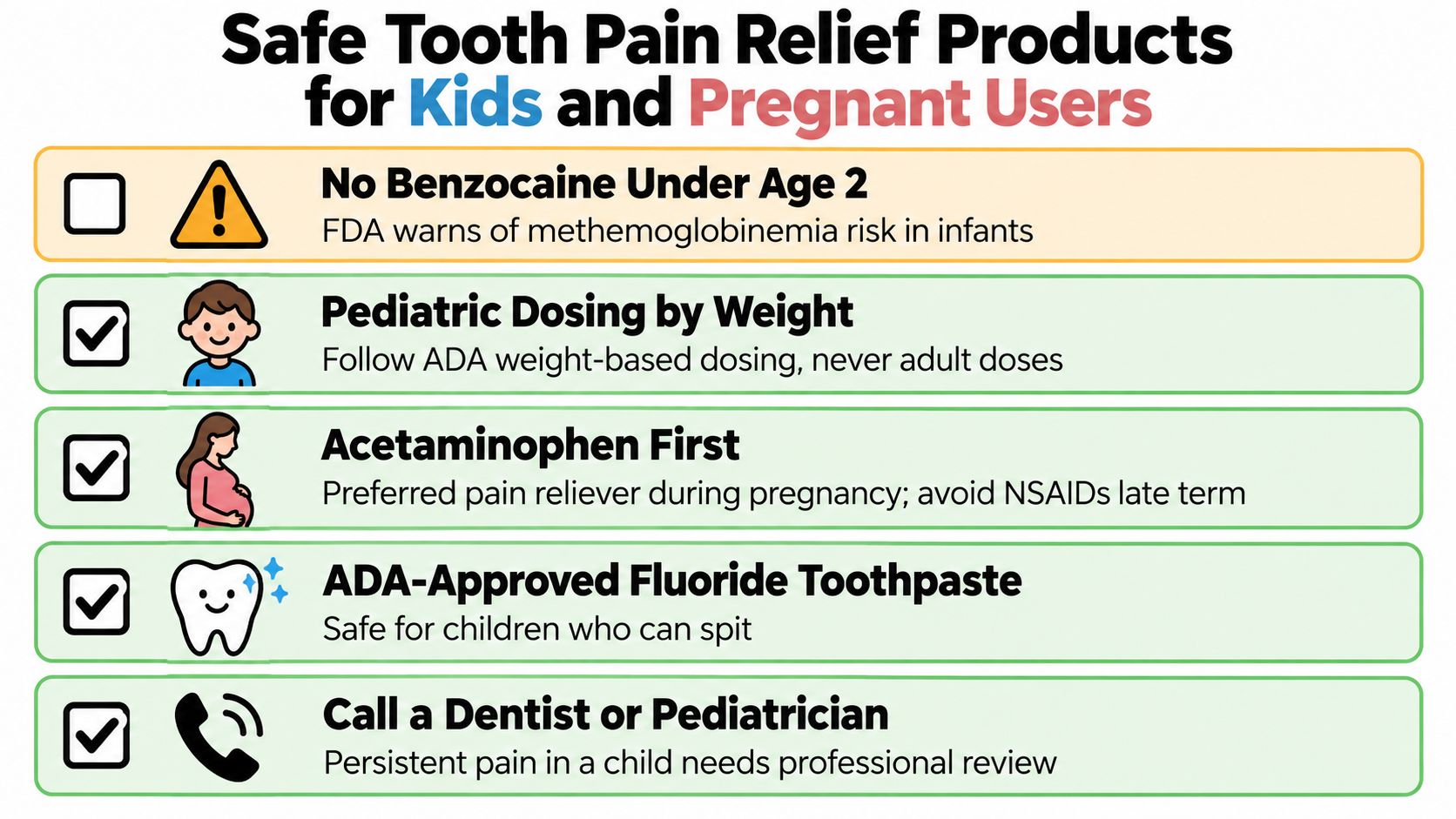
The clearest boundary concerns benzocaine. Mayo Clinic notes that benzocaine has been linked to methemoglobinemia, a rare condition that reduces the blood's oxygen-carrying ability, and advises against benzocaine products for children younger than 2 years (Mayo Clinic toothache first aid). The ADA also warns against topical benzocaine for infants and young children, and states that codeine and tramadol are contraindicated in children younger than 12 years (ADA pediatric pain guidance).
A safer family decision process
For a child with tooth pain, start with gentle cleaning, a cool compress against the cheek, and prompt communication with a pediatric dentist. Don't use an adult product just because it's available in the cabinet, and don't estimate a child's dose by eye.
Pregnancy adds another reason to avoid self-selection based on marketing language. “Natural,” “gentle,” and “chemical-free” don't tell you whether an ingredient is suitable during pregnancy. Ask an obstetric clinician, dentist, or pharmacist before using an oral analgesic, topical anesthetic, concentrated essential oil, or combination product.
A fluoride-free or mineral-based toothpaste may appeal to people who want a different daily routine, but the choice should still fit the user's dental needs and professional advice. For children, swallowing behavior and brushing supervision matter as much as the ingredient list. You can find further discussion in this guide to safe toothpaste for kids.
For families: Temporary relief is useful only when it helps you reach the right professional care safely.
Clove oil deserves particular caution around young children because concentrated preparations can irritate oral tissue and may be swallowed. A mild rinse or external cold compress is a more conservative bridge while a parent arranges dental advice. Persistent pain in a child shouldn't be managed indefinitely with home products, even if the child appears comfortable for a while.
Matching the Right Product to Your Type of Tooth Pain
The most practical way to choose among tooth pain relief products is to start with the symptom pattern. The product is a temporary tool, not proof of what is happening inside the tooth.
| Symptom | Possible explanation | Recommended product category | Urgency level |
|---|---|---|---|
| Brief sharp response to cold or sweets | Dentin sensitivity or another trigger that needs assessment if persistent | Desensitizing toothpaste with a suitable active ingredient | Routine dental review if it continues |
| Pain after biting or chewing | Possible damage, crack, or restoration problem | OTC pain relief according to the label, while arranging care | Prompt dental appointment |
| Dull or throbbing pain that lingers | A deeper dental concern may be present | Temporary OTC pain control, not repeated numbing alone | Urgent dental evaluation |
| Tender gums after brushing | Irritation, technique, or gum-related concern | Soft-bristle brush, gentle cleaning, and suitable rinse | Dental review if bleeding or soreness persists |
| Sudden pain from a chipped or cracked tooth | Structural damage | Temporary dental cement or protective wax where appropriate | Same-week dental care |
| Pain with facial swelling or fever | Possible infection requiring professional treatment | Do not rely on OTC products alone | Urgent or emergency care |
A cold-triggered zing that stops quickly may fit a sensitivity-focused routine. In that situation, choose a desensitizing toothpaste and use it consistently rather than expecting an analgesic gel to provide lasting change. Gentle brushing matters because forceful scrubbing can make the gum line more uncomfortable.
A dull ache after losing a filling is a different situation. An OTC analgesic may help you function while you arrange a dental visit, but a gel applied to the gum won't restore the missing protection. Avoid chewing on that side and keep the area clean without poking at it.
Treat warning patterns differently
Nighttime pain, worsening discomfort, swelling, fever, a bad taste, or difficulty swallowing should move the decision away from product comparison and toward professional help. A cracked tooth also deserves prompt attention because chewing can aggravate the damage.
Bleeding gums may call for a gentler brush and improved cleaning, but ongoing bleeding shouldn't be dismissed as a toothpaste issue. The product can support the routine, while a dental professional identifies whether the gums need further evaluation.
When to See a Dentist and a Practical Recommendation
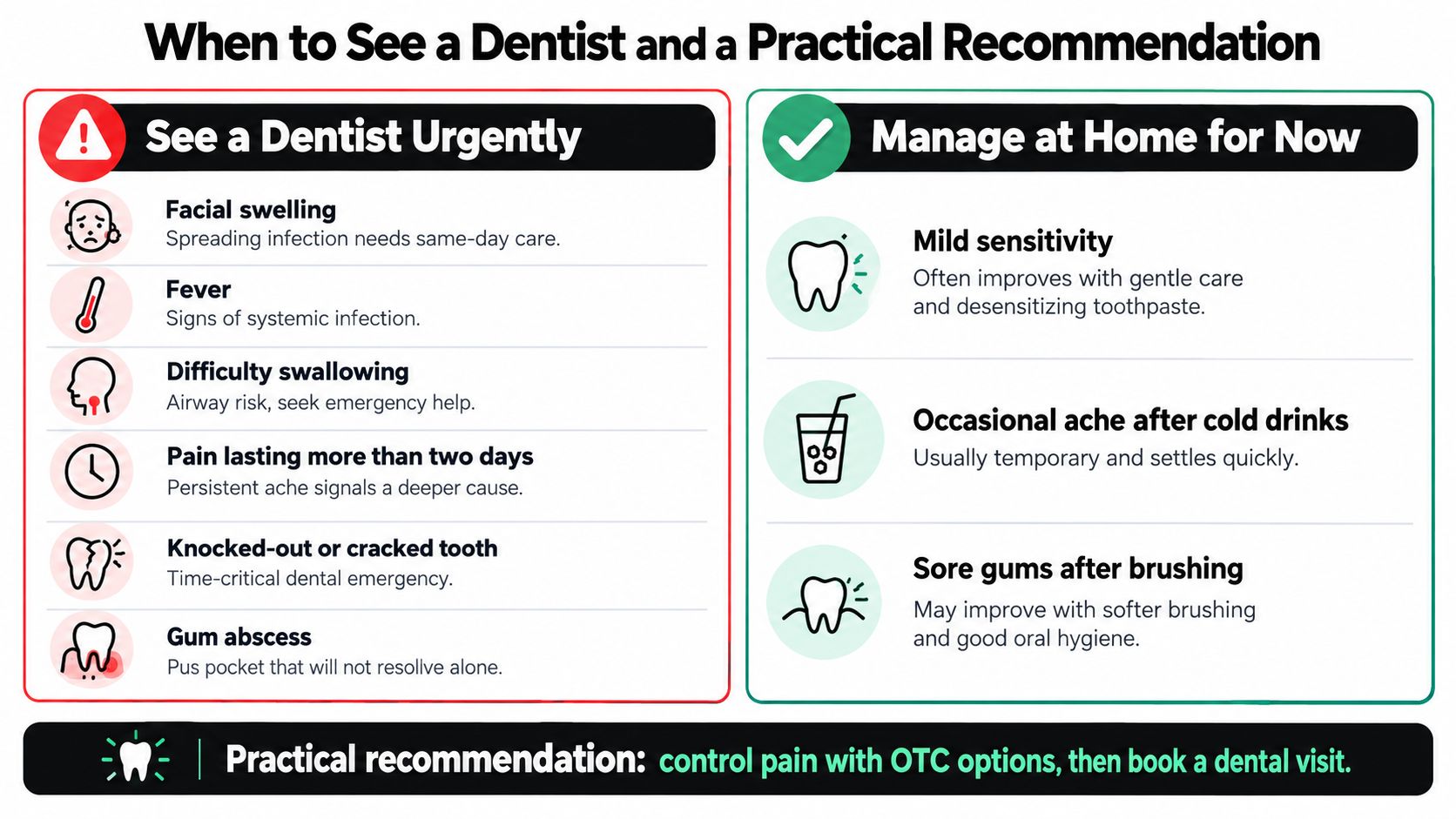
Tooth pain relief products are most useful as bridges. They can help you sleep, eat, or get through the time before an appointment, but they can't reliably determine why the tooth hurts or provide every treatment the tooth may need.
Arrange urgent dental care for facial swelling, fever, difficulty swallowing, pain lasting more than two days, a knocked-out or cracked tooth, or a gum abscess. Difficulty breathing or swallowing requires emergency attention. These signs shouldn't be managed by repeatedly applying numbing gel or increasing the amount of an OTC medicine.
A sensible product plan
For recurring, trigger-based sensitivity, choose a fluoride or nano-hydroxyapatite desensitizing toothpaste and use it twice daily consistently before deciding whether it's helping. The clinical evidence for sensitivity products develops over repeated use, not from a single brushing session.
For acute dental pain, acetaminophen or ibuprofen may be appropriate for some adults when used exactly as directed on the label. NSAIDs have a first-line role in ADA-endorsed acute dental pain guidance, but they aren't suitable for everyone. A pharmacist or clinician can help you account for pregnancy, allergies, ulcers, kidney concerns, liver concerns, blood thinners, and other medicines.
Use topical benzocaine sparingly and according to its label, and never give benzocaine-containing products to children younger than 2 years. A cold compress or carefully used clove preparation can provide temporary comfort, but concentrated oils should be kept away from children and never treated as a replacement for dental care.
The best long-term relief usually comes from matching the symptom to an examination, not from escalating products.
Start by identifying whether your pain is brief sensitivity or persistent toothache. Choose a product that fits that pattern, follow its instructions, and book a dental appointment if the discomfort continues or any warning sign appears. If you're dealing with sensitivity today, compare the active ingredients in a desensitizing toothpaste, use a soft brush, and contact a dentist when the pattern doesn't settle.
If tooth pain is interfering with sleep, eating, or daily activities, schedule a dental evaluation rather than continuing to rotate through tooth pain relief products. For immediate home support, follow the product label, avoid unsafe topical applications, and write down what triggers the pain so you can give the dentist a clear description.
