

Posted by Sarah Collins
on September 03, 2026

You take a sip of iced water on a hot afternoon, and one molar answers with a sharp electric jolt. You wince, probe the spot with your tongue, and decide that room-temperature drinks are safer.
The tube on your bathroom shelf is supposed to help, but its label may not tell you which sensitive teeth toothpaste active ingredient is doing the work, or whether that ingredient matches your trigger. Sensitivity after acidic drinks, an exposed gumline, and post-whitening discomfort can involve different pathways. The useful question isn't “Which toothpaste is for sensitive teeth?” It's “Which mechanism fits my kind of sensitivity?”
That First Sip of Cold Water and Why Your Tooth Just Zinged
Tooth sensitivity often feels sudden, but the surface changes behind it can develop gradually. Acid exposure, gumline recession, enamel wear, aggressive brushing, and whitening can leave dentin less protected. Dentin contains tiny channels, called tubules, that connect the outer tooth surface with the nerve-containing pulp.
When cold water reaches an exposed area, fluid can move through those tubules. That movement can stimulate the nerve and create the quick, piercing sensation many people recognize as a “zing.” The toothpaste sitting beside your sink may help, but only if its active ingredient targets the pathway involved.
One symptom, several possible mechanisms
A potassium-based formula approaches sensitivity by calming nerve excitability. A stannous fluoride or arginine formula can focus more on reducing fluid movement by helping block exposed tubules. Nano-hydroxyapatite works through mineral-based surface support and tubule occlusion, which can be relevant when enamel or dentin has lost some of its protective mineral structure.
That difference matters at the store. Two tubes can both use “sensitivity relief” language while relying on different chemistry. One may suit repeated cold-triggered nerve responses, while another may make more sense when exposed dentin needs a physical barrier.
The practical question: Don't choose an active ingredient only because the package says “sensitive.” Match the ingredient to what makes the tooth react.
The sections ahead decode the major ingredients in plain language, including their mechanisms, evidence, limitations, and best-fit situations. By the time you compare your next tube, you should be making a deliberate choice rather than guessing from the front label.
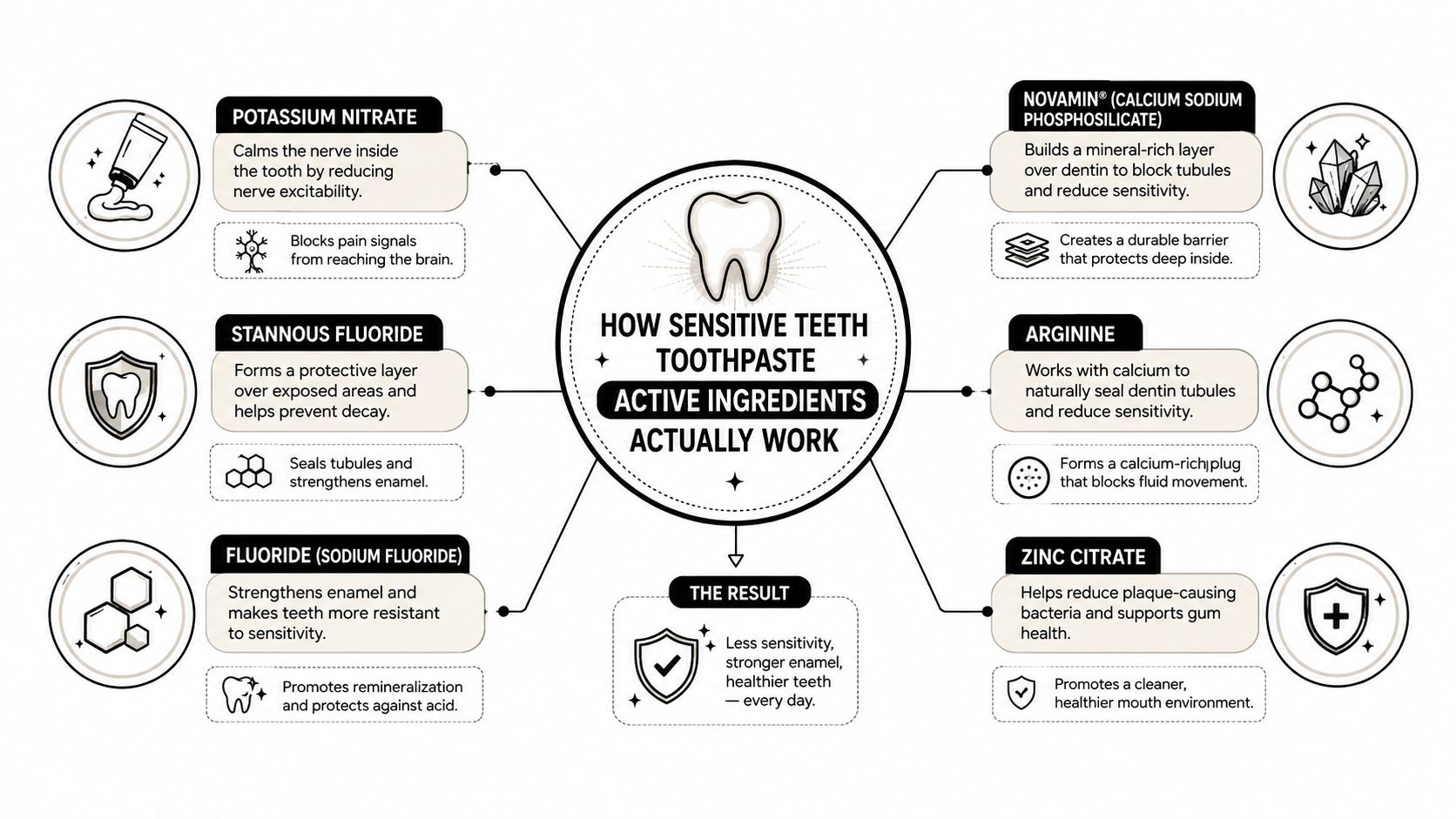
How Sensitive Teeth Toothpaste Active Ingredients Actually Work
Most desensitizing formulas use one or more of three related strategies. Think of a sensitive tooth as a house with an exposed alarm system and tiny open passageways leading toward the alarm.
Nerve calming
Potassium nitrate works primarily by reducing pulpal nerve excitability. Instead of building a physical plug over every opening, it makes the nerve less likely to fire in response to a stimulus. The everyday analogy is a microphone with its sensitivity turned down. Cold air may still reach the area, but the signal is less likely to become a painful burst.
This mechanism helps explain why potassium nitrate usually requires consistent, repeated use. It isn't designed as an instant wall over an exposed tubule. Its effect depends on continued contact with the tooth surface and gradual nerve desensitization. A clinical study using a 5% potassium nitrate toothpaste reported a statistically significant decrease in dentinal hypersensitivity scores, while also reporting that a 3% potassium nitrate mouthwash was effective, with no statistically significant difference between the groups (clinical study of potassium nitrate toothpaste and mouthwash).
Tubule sealing
Tubule-sealing ingredients work more like a draft stopper pushed under a door. They deposit material over or inside exposed dentinal tubules, reducing the fluid movement that can trigger the nerve.
Arginine with calcium carbonate, stannous fluoride, calcium sodium phosphosilicate, and nano-hydroxyapatite can all be discussed within this barrier-building family, although their chemistry differs. The result consumers care about is similar: fewer open routes for temperature, air, or touch to disturb the nerve.
For readers comparing tools that support a careful routine, Avistar single-use dental items can be a practical resource for keeping oral-care supplies clean and organized, especially when sensitivity makes gentle technique important.
Mineral support
The “half” mechanism is remineralization. Fluoride-based ingredients and hydroxyapatite-related materials support the mineral structure of enamel and dentin, helping strengthen or cover vulnerable surfaces. That doesn't mean a toothpaste instantly reverses every form of wear. It means the formula can support the tooth's mineral environment while reducing pathways that contribute to sensitivity.
A clear explanation of the underlying process is available in this guide to tooth remineralization. The practical takeaway is simple: identify whether your formula mainly calms the nerve, seals tubules, or supports mineral repair, then set expectations around that mechanism.
The Three Legacy Actives Most Sensitive Teeth Toothpastes Still Rely On
The history of desensitizing toothpaste is a history of multiple mechanisms, not one universally superior ingredient. A 2022 scoping review of randomized clinical trials found that formulations had expanded steadily since 1968, with the largest increase after 2010. Among 364 individual active-ingredient entries, potassium compounds were most common at 68 entries, or 19%, followed by calcium sodium phosphosilicate at 37, or 10%, arginine at 29, or 8%, strontium compounds at 28, or 8%, and stannous fluoride at 21, or 6% (2022 scoping review of desensitizing toothpaste trials).
Potassium nitrate
Potassium nitrate is the classic nerve-calming option. The commonly accepted concentration in sensitive-tooth formulas is 5%, and a systematic review and meta-analysis found a clinically favorable effect versus placebo, with an SMD of -1.28 and a 95% confidence interval of -2.05 to -0.51 (systematic review of potassium-containing toothpastes).
Its best fit is repeated, stimulus-related sensitivity, especially cold-triggered discomfort. The tradeoff is timing. Because it modulates nerve response rather than creating an immediate barrier, you need steady use and shouldn't judge it after a single brushing.
Stannous fluoride
Stannous fluoride offers a broader mechanism. Reviews and clinical summaries describe it as helping reduce oral biofilm viability, supporting remineralization, and occluding dentinal tubules. A 2024 study of 0.454% stannous fluoride toothpaste reported a 79.8% reduction in tactile hypersensitivity and a 47.1% reduction in air-blast hypersensitivity after 7 days (2024 study of stannous fluoride toothpaste).
Its best fit is someone who wants sensitivity support alongside fluoride-based enamel and cavity protection. Earlier stannous fluoride formulas were associated with taste and staining concerns, although newer stabilized formulas are designed to address those drawbacks. Product tolerance still varies, so flavor and mouth feel matter if they affect how consistently you brush.
Strontium compounds
Strontium chloride and strontium acetate were early tubule-plugging approaches. They remain part of the historical development of sensitivity toothpaste, but modern evidence and product availability have shifted attention toward potassium, fluoride, arginine, calcium sodium phosphosilicate, and hydroxyapatite-based systems.
Their best fit is mainly historical or formulation-specific rather than a default recommendation. A reader choosing among current products will usually find more relevant evidence around the newer active families.
| Active Ingredient | Mechanism | Typical Concentration | Evidence Strength | Best For | Main Drawback |
|---|---|---|---|---|---|
| Potassium nitrate | Nerve calming | 5% commonly accepted | Clinically favorable evidence versus placebo | Repeated cold-triggered sensitivity | Relief depends on consistent use |
| Stannous fluoride | Tubule occlusion, remineralization, biofilm support | 0.454% in the cited study | Recent clinical evidence supports sensitivity benefits | Sensitivity plus fluoride-based protection | Taste and staining concerns may affect product choice |
| Strontium compounds | Tubule plugging | Not specified in the verified data | Older approach with less emphasis in current evidence | People using a specific compatible formula | Less prominent in modern formulations |
The decision isn't “old equals bad” or “new equals best.” Choose potassium nitrate when nerve calming fits the pattern, stannous fluoride when you want a multi-action fluoride formula, and consider other options when exposed dentin or fluoride avoidance points toward a different mechanism.
Modern and Fluoride-Free Active Ingredients Worth Knowing
The newer generation of desensitizing formulas focuses heavily on tubule occlusion and mineral support. That makes them especially interesting for people with exposed dentin, enamel erosion, or discomfort after whitening.
Nano-hydroxyapatite
Nano-hydroxyapatite, often abbreviated n-HAp, resembles the mineral family found naturally in teeth. It can deposit on vulnerable surfaces and help reduce exposure around dentinal tubules. A 2023 review reported that toothpaste containing either 10% or 15% nano-hydroxyapatite, used at least twice daily, was clinically as effective as calcium sodium phosphosilicate for relieving dentine hypersensitivity symptoms. Another summarized study reported sensitivity in 29% of the nHA group versus 51% of the non-nano-hydroxyapatite group (review of potassium nitrate dentifrice and sensitivity ingredients).
The fluoride-free appeal is clear, but the evidence needs careful framing. A 2025 review described hydroxyapatite evidence as promising, while noting that superiority over fluoride for remineralization hasn't been settled and that longer-term research with standardized outcomes is still needed (2025 review of hydroxyapatite and oral health). That makes n-HAp a credible option for fluoride-averse users, not a reason to make sweeping claims about every formula.
Arginine and calcium carbonate
An 8% arginine-calcium carbonate system can bind to the negatively charged dentin surface and form a calcium-rich plug over exposed tubules. The mechanism is physical and chemical at once. Arginine helps attract the ingredients to the surface, while calcium carbonate contributes to the mineral-rich deposit that limits fluid movement (study of arginine-calcium carbonate toothpaste).
This combination makes sense for exposed root surfaces and localized gumline sensitivity. It may also serve as an alternative for someone who doesn't respond comfortably to a potassium-centered product.
Calcium sodium phosphosilicate
Calcium sodium phosphosilicate, often called bioactive glass or Novamin in product contexts, releases ions that can form a hydroxyapatite-like layer on the tooth surface. It has a clear tubule-sealing rationale and appeared as the second-most common active category in the scoping review cited above.
Some products use it in professional or specialty settings, while retail availability depends on the market and formulation. The important distinction is mechanism, not marketing language. It belongs on the shortlist when a reader wants a mineral-based barrier approach.
Other fluoride-free ingredients, including theobromine and potassium citrate, appear as emerging alternatives, but the evidence base is more limited. A fluoride-free choice should still be assessed for the complete formula, consistency of use, and cavity-prevention needs. For a focused discussion of the tradeoffs, see this guide to fluoride-free toothpaste for sensitive teeth.
| Active Ingredient | Mechanism | Typical Concentration | Evidence Level | Best For |
|---|---|---|---|---|
| Nano-hydroxyapatite | Mineral deposition and tubule occlusion | 10% or 15% in cited clinical review | Promising clinical evidence, with long-term comparisons still developing | Fluoride-free routines and exposed dentin |
| Arginine plus calcium carbonate | Calcium-rich tubule plug | 8% arginine system | Clinical evidence for occlusion-based relief | Gumline and root exposure |
| Calcium sodium phosphosilicate | Bioactive mineral-like layer | Not specified in the verified data | Established presence in the historical trial evidence | Mineral barrier support |
| Theobromine | Emerging mineral-support approach | Not specified | Limited evidence | People exploring newer fluoride-free options |
| Potassium citrate | Emerging nerve-related approach | Not specified | Limited evidence | Alternative formulations |
Matching the Active Ingredient to Your Type of Sensitivity
The trigger gives you a useful starting point. Cold sensitivity after an acidic drink suggests a different first experiment from discomfort that appears only after whitening.
Read the pattern, not just the symptom
Acid exposure can soften or demineralize exposed surfaces, while gumline recession can uncover root dentin. In those situations, a tubule-sealing or mineral-support ingredient such as stannous fluoride, nano-hydroxyapatite, arginine-calcium carbonate, or calcium sodium phosphosilicate may make more sense than relying only on nerve calming.
Post-whitening sensitivity often behaves differently. The teeth may react broadly to cold or air, so potassium nitrate is a logical option when the goal is to reduce nerve excitability over consistent use. That doesn't mean it addresses every cause of sensitivity, but its mechanism matches this particular pattern.
| Sensitivity Trigger | Primary Pick | Why It Works | Adjunct Option |
|---|---|---|---|
| Cold sensitivity after acidic drinks | Stannous fluoride or nano-hydroxyapatite | Supports a physical barrier over vulnerable tubules | Potassium nitrate |
| Twinges along a receded gumline | Arginine plus calcium carbonate or nano-hydroxyapatite | Encourages mineral-rich coverage of exposed dentin | Stannous fluoride |
| Lingering post-whitening sensitivity | Potassium nitrate | Calms nerve excitability with repeated use | Nano-hydroxyapatite |
| Fluoride-averse household routine | Nano-hydroxyapatite | Offers a fluoride-free mineral-based approach | Arginine-calcium carbonate |
Children, pregnant patients, and fluoride-averse users may prefer fluoride-free n-HAp formulas, but preference doesn't remove the need to consider cavity prevention and professional guidance. The evidence for hydroxyapatite sensitivity support is encouraging, while comparative long-term cavity evidence remains an evolving area, so the decision should be individualized rather than framed as a universal replacement.
Combination formulas are common because sensitivity rarely has only one layer. A product may calm the nerve while also helping cover tubules or support mineral deposition.
Safety boundary: Severe, spontaneous, lingering, or worsening pain isn't a toothpaste-selection problem. A dentist should evaluate it, particularly when one tooth reacts differently from the surrounding teeth.
How to Choose and Use a Sensitive Teeth Toothpaste That Works
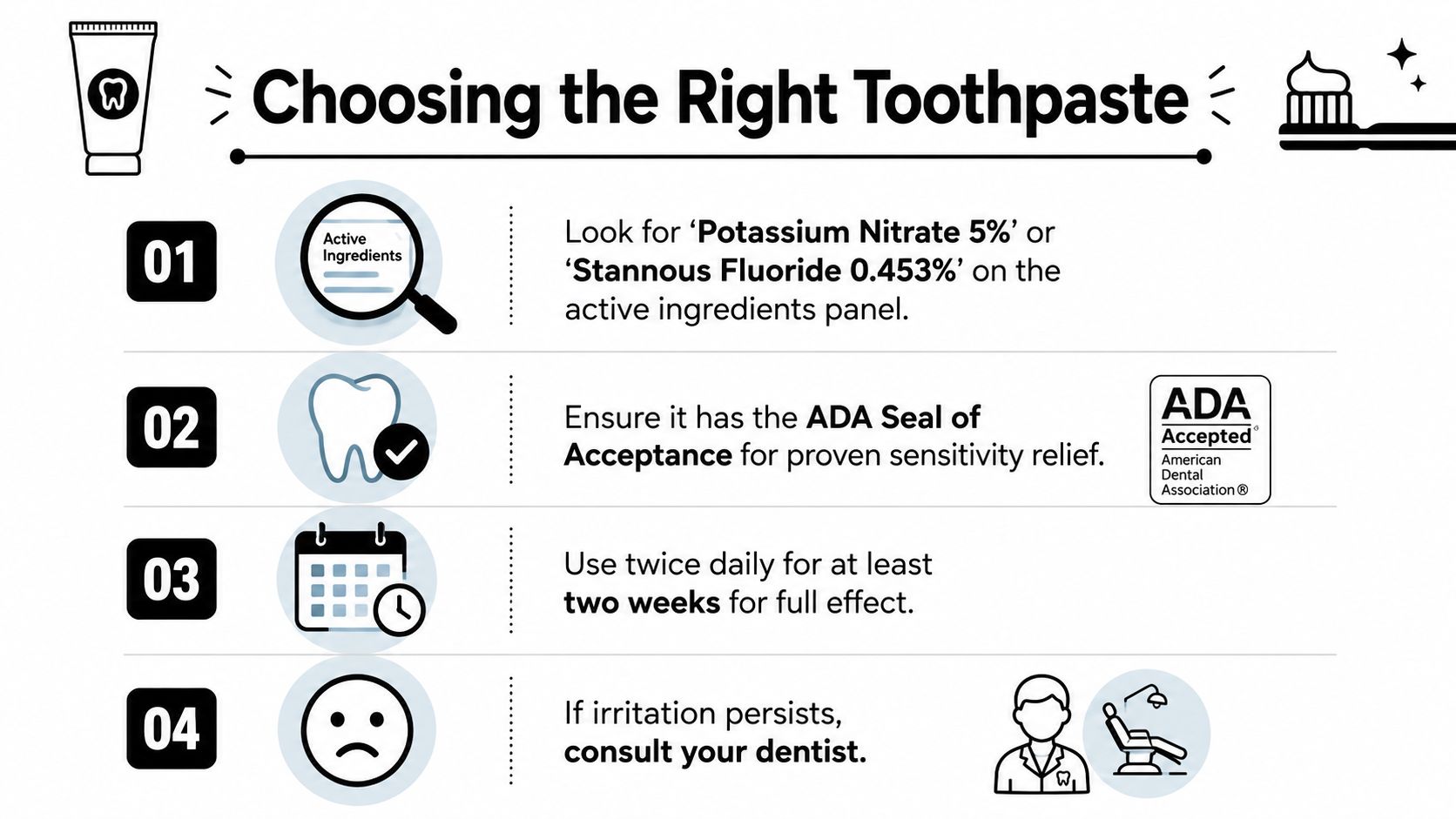
Start with the active-ingredient panel, not the flavor name or the front-of-pack promise. Look for the exact ingredient and concentration, such as 5% potassium nitrate, 0.454% stannous fluoride, or a clearly stated nano-hydroxyapatite concentration. Check whether the product's fluoride status matches your priorities, and look for an ADA Seal of Acceptance or equivalent national endorsement when available.
Give a new formula a fair trial. Use it twice daily and allow roughly 2 to 4 weeks before deciding that it isn't helping, especially when you're testing potassium nitrate. Relief can build gradually rather than arriving after the first brushing.
Small technique changes matter
Use lukewarm water if cold rinsing triggers a jolt. After brushing, avoid rinsing immediately if the product directions allow it, so the active has more contact with the tooth surface. Some people also dab a small amount directly onto the most sensitive spot before bed, but stop if the area becomes irritated.
Families comparing age-appropriate oral-care options can browse NINI and LOLI oral care, while readers wanting a deeper ingredient-selection framework can use this guide to the best toothpaste for tooth sensitivity.
Pain that lasts beyond the brief stimulus, swelling, or sensitivity spreading across several teeth deserves dental assessment. If one mechanism fails, switch thoughtfully, for example from a nerve-calming formula to a tubule-sealing formula, rather than cycling randomly through flavors.
Smarter Daily Habits and Where Sensitivity Care Is Heading Next
Toothpaste works within a routine, and routine can either support or undermine it. Wait 30 minutes after acidic meals before brushing, choose a soft-bristled brush, reduce repeated whitening use, and avoid brushing immediately after acid exposure. Gentle pressure matters because scrubbing harder doesn't make exposed areas safer.
Sensitivity care is also moving toward more targeted materials. Bioactive glass particles, self-assembling peptide matrices, longer-acting tubule sealants, and diagnostic tools that identify exposed tubules could make future recommendations more individualized. The direction is encouraging because it treats sensitivity as a mechanism-matching problem rather than a single symptom with one universal ingredient.
Choose your next tube by asking three questions: What triggers the pain? Which mechanism matches that trigger? Does the formula fit your broader cavity-prevention preferences? If symptoms persist, let a dentist identify the cause instead of asking toothpaste to solve a problem it wasn't designed to handle.
Check your current tube tonight. Find the active ingredient and concentration, compare it with your trigger, and bring the label to your next dental appointment if the sensitivity continues or changes.
