

Posted by Sarah Collins
on October 06, 2026

Does a “cruelty-free” label tell you everything you need to know about dental floss? Not quite. A spool can avoid animal testing while still containing an animal-derived fiber, and a vegan floss can still leave questions about PFAS, packaging, manufacturing, or disposal.
That doesn't make ethical shopping impossible. It means you need to read the labels in layers. Cruelty-free, vegan, PFAS-free, biodegradable, and environmentally responsible describe different qualities. Once you know what each term covers, choosing cruelty free dental floss becomes much more straightforward.
What Cruelty Free Actually Means for Floss
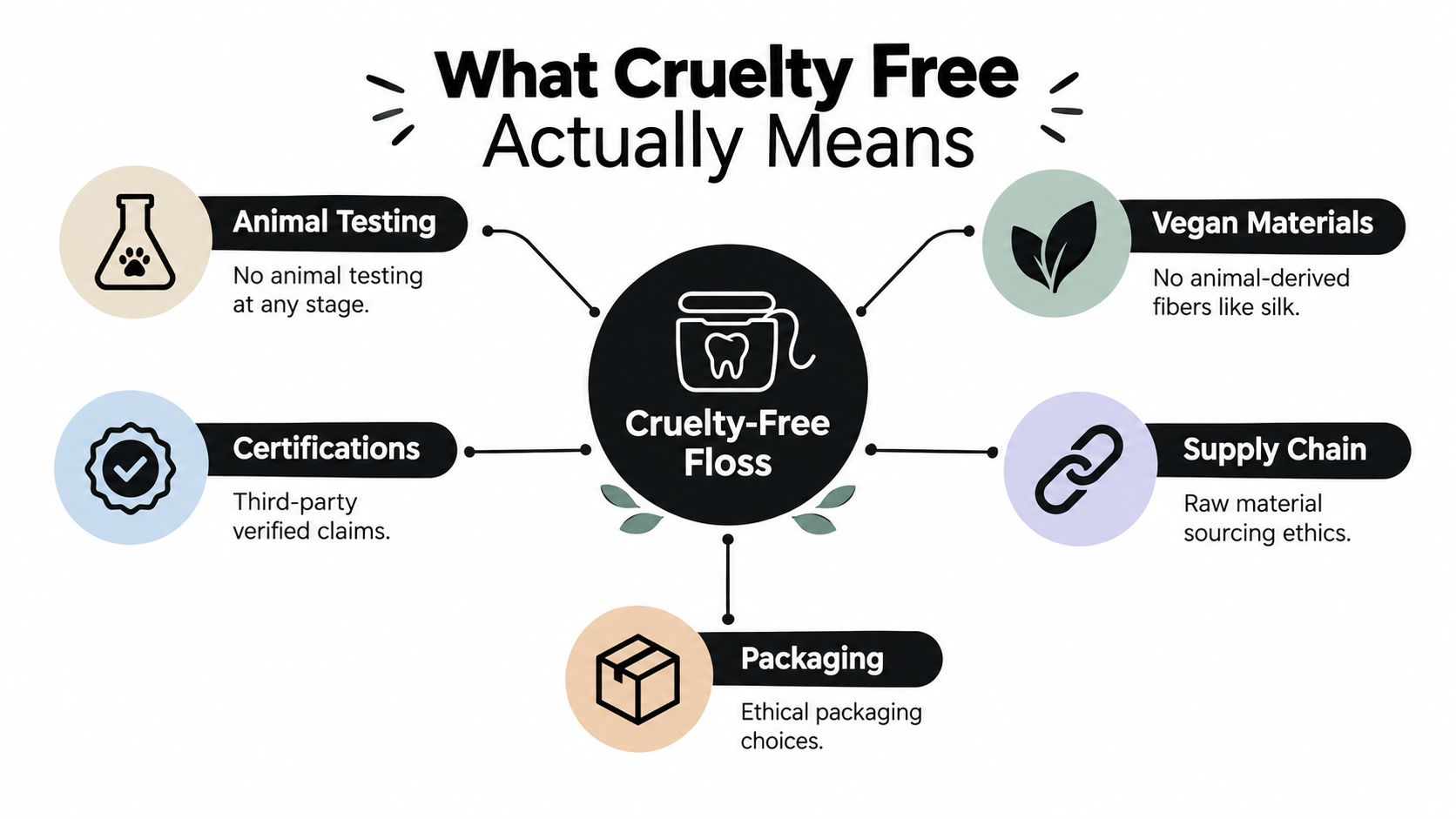
A shopper sees “cruelty-free dental floss” on a package and reasonably assumes the product has no connection to animal harm. The label, however, usually addresses animal testing, not every ingredient or environmental choice involved in making the floss.
A cruelty-free claim should mean that the finished product, its ingredients, and the relevant supply chain weren't subjected to new animal testing. That includes more than the filament itself. Waxes, flavorings, dyes, adhesives, and raw materials may come from different suppliers, so a brand needs a policy that reaches beyond the finished spool.
A floss made with synthetic nylon could be free from animal-derived material, but that fact alone doesn't prove that its ingredients or manufacturing process meet a cruelty-free standard. The opposite can also happen. A product might avoid animal testing but use beeswax or silk, which means it isn't vegan.
Why supply-chain detail matters
A simple brand statement is difficult to evaluate if it doesn't explain its scope. Ask whether the policy covers:
- Raw materials: Does it include the filament, coating, flavor, dye, and adhesive?
- Manufacturing partners: Does the brand require suppliers and factories to follow the same policy?
- Testing dates: Does the company prohibit new animal testing after a defined cut-off date?
- Verification: Does an independent organization review the claim?
- Documentation: Can the company explain its certification scope and renewal process?
The Leaping Bunny certification framework offers a useful example of a more demanding approach. Participating companies obtain commitments from ingredient suppliers and manufacturers, accept independent audits, agree not to conduct new animal testing after a defined cut-off date, and renew their commitments annually.
That standard still needs to be read carefully. It represents freedom from new animal testing, not a universal guarantee about every environmental or chemical attribute.
The European Union's animal-testing history also shows why the wording matters. The EU prohibited testing finished cosmetic products on animals from 11 September 2004, and testing cosmetic ingredients or ingredient combinations from 11 March 2009. Its final marketing prohibition for several complex endpoints took effect on 11 March 2013, even when validated alternative tests weren't available, according to the European Commission's cosmetics animal-testing timeline. Dental floss generally falls under oral-care or medical-device rules rather than conventional cosmetics, but the timeline illustrates the wider move toward alternative safety assessment and supply-chain accountability.
Practical rule: Treat “cruelty-free” as a testing-policy claim first. Then check the material, coating, chemical, packaging, and disposal claims separately.
Cruelty Free vs Vegan vs PFAS Free
These labels answer different questions. Cruelty-free asks how a product was tested. Vegan asks what animal-derived materials it contains. PFAS-free asks whether it contains a particular family of fluorinated chemicals.
Those categories can overlap, but none automatically proves the others.
A vegan floss contains no animal-derived ingredients or materials. Silk is therefore not vegan because it comes from silkworm cocoons. Beeswax also needs explicit disclosure. A plant-based coating such as candelilla or carnauba wax can support a vegan specification, but the brand still needs to explain the rest of its formulation and testing policy.
Cruelty-free status doesn't automatically make floss vegan. A company may prohibit animal testing while using silk or beeswax. Likewise, vegan status doesn't automatically establish cruelty-free status. A synthetic product can contain no animal-derived ingredients and still lack a documented animal-testing policy.
PFAS-free belongs to a different category again. PFAS are fluorinated chemicals, and some floss products use PTFE, a fluorinated polymer, to reduce friction. In a 2019 investigation of 18 floss products, researchers detected high fluorine, an indicator of fluorinated chemistry, in six products. The investigation also reported a statistically significant association between women who used Oral-B Glide and higher blood concentrations of PFHxS, but it didn't establish that flossing caused those higher concentrations. The Silent Spring Institute FAQ on the dental-floss study presents the findings with that important limitation.
Independent testing commissioned by Mamavation found indications of PFAS in 33% of 39 dental-floss products tested. That screening result doesn't establish the same exposure or health risk for every product, but it does show why shoppers shouldn't infer PFAS status from a cruelty-free, vegan, or “natural” label. The published PFAS dental-floss testing report is useful background for understanding that distinction.
| Claim | Main question | What it does not prove |
|---|---|---|
| Cruelty-free | Was animal testing prohibited across the relevant supply chain? | That the floss is vegan, PFAS-free, or low impact |
| Vegan | Does the product avoid animal-derived materials? | That no animal testing occurred |
| PFAS-free | Has the product been shown to avoid fluorinated chemistry? | That it is cruelty-free, vegan, or biodegradable |
For a careful purchase, look for the combination that matches your priorities. Someone avoiding animal testing may prioritize independent certification. Someone avoiding animal-derived materials should inspect the fiber and coating. Someone concerned about fluorinated chemistry should seek an explicit PFAS-free statement backed by transparent materials information or third-party testing.
Comparing Floss Materials and Sources
The fiber affects how floss feels between teeth, how it handles tight contacts, and which ethical questions you need to ask. Silk, nylon, PTFE, and ultra-high-molecular-weight polyethylene, or UHMWPE, all appear in different floss products, as documented in this peer-reviewed comparison of floss materials.
Silk is the clearest example of why material claims need their own check. It's animal-derived because it comes from silkworm cocoons. Silk may appeal to shoppers looking for a biodegradable fiber, but it doesn't fit a vegan specification. Its presence also means a cruelty-free shopper should ask whether the product's claim concerns testing only or includes a broader animal-welfare policy.
Nylon and UHMWPE are synthetic fibers, so they aren't made from silkworm fiber. That makes them compatible with a vegan materials claim, but synthetic doesn't automatically mean cruelty-free. The brand still needs to address animal testing throughout development and production.
PTFE is also synthetic and can provide a smooth glide. It belongs to the PFAS family, so shoppers who want to avoid fluorinated chemistry should look for a clearly identified filament and coating rather than relying on the word “vegan.” The Silent Spring findings described earlier support asking for PFAS or organic-fluorine testing when that concern matters to you.
Plant-based floss products introduce another layer. A plant-derived coating can support a vegan specification, while a plant-based or biodegradable filament may reduce reliance on certain conventional plastics. Yet “plant-based” isn't a complete environmental assessment. Packaging, manufacturing, durability, and end-of-life handling all influence the result.
Floss Material Comparison
| Material | Animal-Derived | Cruelty-Free | PFAS-Related |
|---|---|---|---|
| Silk | Yes, produced from silkworm cocoons | Requires a separate testing-policy check | Requires a separate coating check |
| Nylon | No | Requires supply-chain verification | Requires a coating and treatment check |
| PTFE | No | Requires supply-chain verification | It's a fluorinated polymer in the PFAS family |
| UHMWPE | No | Requires supply-chain verification | Requires a coating and treatment check |
| Plant-based options | Depends on the fiber and coating | Requires supply-chain verification | Requires explicit materials disclosure |
The package should identify more than the broad marketing category. Look for the filament, coating, flavoring, and dispenser materials. If you're comparing low-plastic alternatives, Mouthology's guide to non-plastic dental floss materials can help frame the material questions without treating one attribute as proof of every other claim.
How to Verify Floss Certifications
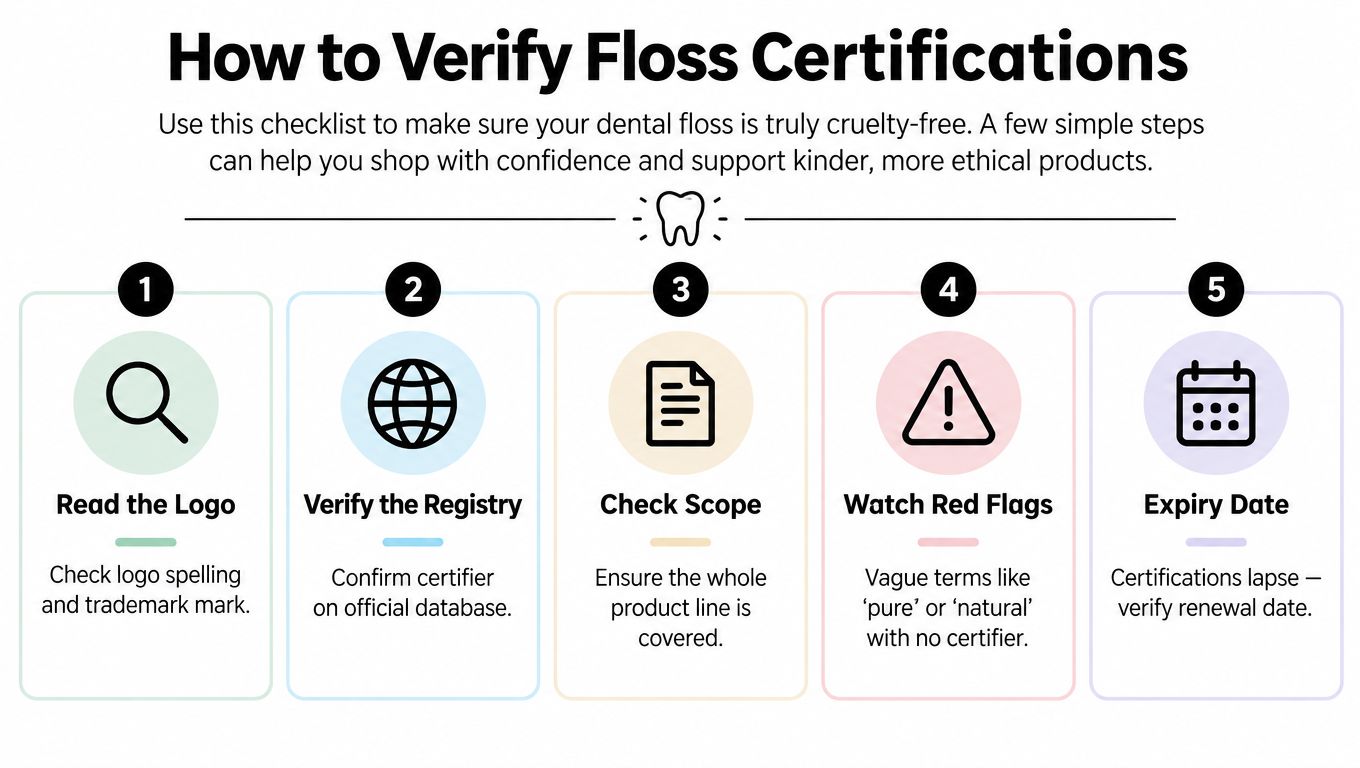
Certification logos can make a package feel trustworthy, but a logo isn't evidence until you can identify who administers it and what it covers. Start with the certifier, not the product description.
A practical verification process
- Read the logo carefully. Check the spelling, trademark details, and exact name of the organization. A brand-created bunny or leaf symbol may communicate a value, but it isn't the same as independent certification.
- Find the certifier's official registry. Search the organization's own website and confirm that the company or product appears there. Don't rely only on a logo printed on a package or a retailer's product page.
- Check the scope. Does the certification cover the entire company, a specific product, a product line, or only selected ingredients? A certification for a brand's cosmetics may not automatically cover its dental floss.
- Look for supply-chain coverage. Stronger programs address ingredient suppliers, raw materials, manufacturers, and the finished product. Ask whether the policy includes coatings, flavorings, dyes, packaging adhesives, and contract factories.
- Confirm the timing. Find out whether the company must renew its commitment and whether audits are part of the program. A certification can have a defined validity period, so current status matters.
A brand that can answer these questions clearly is easier to assess than one that offers only broad language such as “pure,” “conscious,” or “kind.” Those words may express a philosophy, but they don't identify a testing standard or audit process.
Questions to send before buying
You can contact the manufacturer with a short, specific message:
- Does the floss contain silk, beeswax, or another animal-derived material?
- What are the filament and coating made from?
- Is the product tested for PFAS or organic fluorine?
- Does the cruelty-free policy cover all raw-material suppliers and manufacturing sites?
- Which independent organization administers the certification?
- What evidence supports the claim, and how often is it reviewed?
The FDA classifies dental floss in the United States as a Class I medical device under 21 CFR §872.6390, and the applicable federal regulation defines it as a string-like device made from cotton or other fibers for removing plaque and food particles between teeth. That regulatory classification doesn't create a cruelty-free approval category. In other words, FDA device status and animal-welfare certification answer different questions.
Environmental Impact of Floss Formats
Animal welfare is only one part of responsible product design. The format you use can also affect the product's environmental burden, especially when a disposable handle is involved.
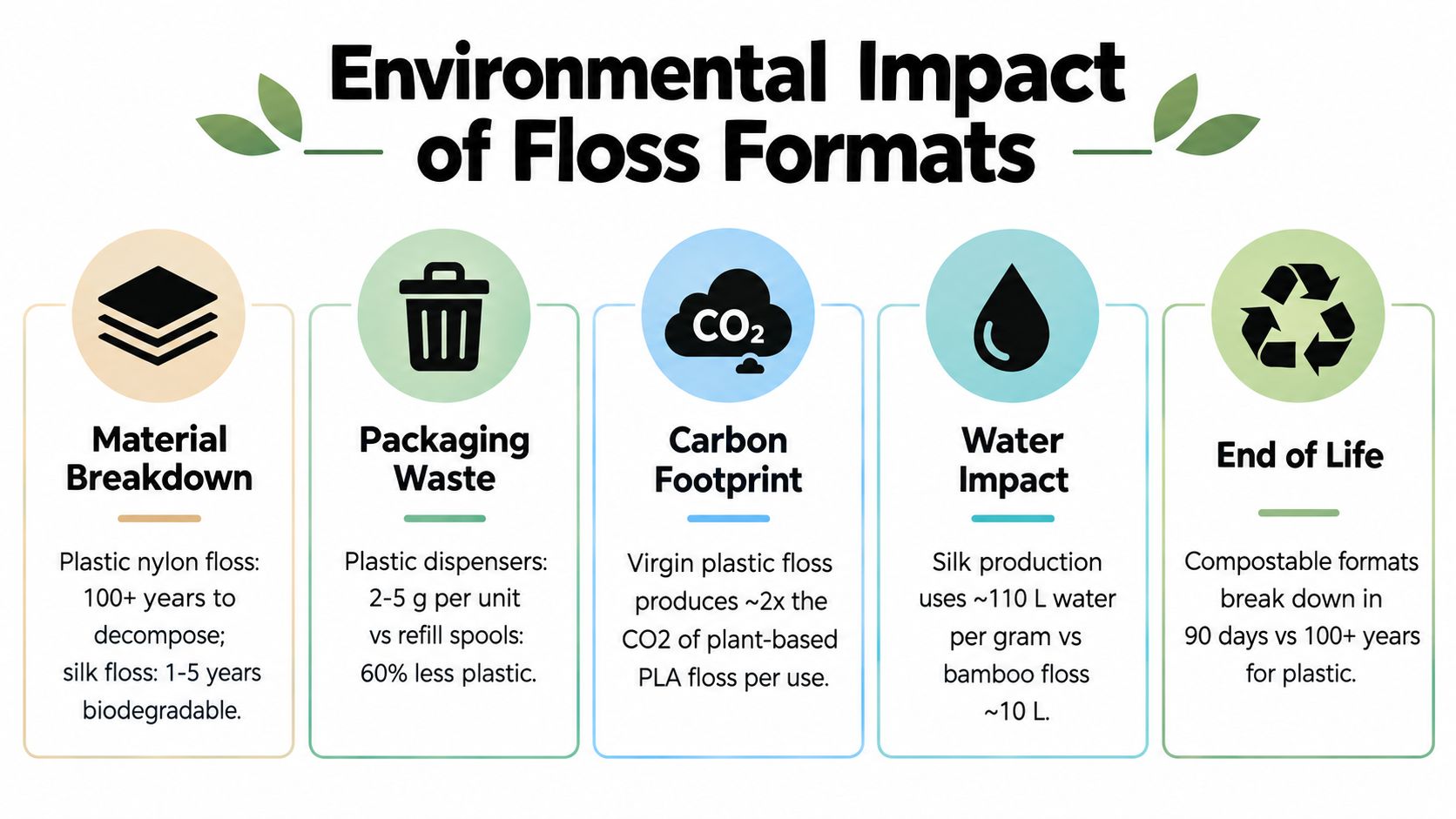
A 2023 comparative life-cycle study evaluated eight interdental-cleaning aids available on the UK market and modeled daily use by one person over five years. Floss picks produced the largest environmental footprint in 13 of the study's 16 impact categories, while the polypropylene handle accounted for 49% of their carbon footprint. The peer-reviewed life-cycle study provides a useful comparison between loose floss and handled formats.
Regular floss had the smallest footprint in three categories. Bamboo floss had the smallest footprint in one category, while bamboo interdental brushes had the smallest footprint in five categories, including climate change, freshwater eutrophication, fossil-resource use, and mineral and metal use.
Why the format can matter more than the label
A spool of loose floss and a plastic floss pick perform a similar oral-hygiene task, but they don't use the same amount or type of material. A handle adds a component that's discarded after each use, so the environmental comparison can shift even when the floss filament itself looks similar.
That doesn't mean every plant-based or biodegradable floss is automatically the better choice. Life-cycle results vary by material, packaging, manufacturing, transport, product durability, and disposal pathway. A compostable claim is only useful if the product reaches a disposal system that can process it as intended.
The same balanced approach applies to silk. Its animal-derived origin raises a vegan and animal-welfare question, while its end-of-life characteristics represent a separate environmental consideration. You don't have to collapse those questions into one label.
A responsible comparison asks two questions at once: What does this product mean for animal welfare, and what happens to its materials after use?
For shoppers trying to reduce waste, compare refillable or loose-floss formats with disposable picks, then inspect the dispenser and outer packaging. The guide to whether dental floss is biodegradable can help you investigate the difference between a material being technically biodegradable and a product having a realistic end-of-life route.
The most defensible choice depends on your priorities and local disposal options. A product can be cruelty-free and still use a high-impact format. Another can use plant-derived materials and still lack transparent animal-testing documentation. Product design, not one ethical label, determines the broader footprint.
Choosing Safe Floss for Different Users
The most ethical floss is still a poor fit if it shreds, snaps, or feels too harsh for the person using it. Choose based on the mouth in front of you, then verify the claims that matter to your household.
For children
Children often need a flossing tool that's easy to hold and simple to guide. A handle may improve control, but it also creates a disposable plastic component, so families can weigh convenience against waste. Look for clear material information, a comfortable shape, and instructions appropriate for the child's age.
A parent should check whether the product contains silk or beeswax if the household follows a vegan specification. If the family also wants to avoid fluorinated chemistry, the package should identify the filament and coating rather than relying on “natural” or “plant-based” language.
For sensitive gums
A floss that catches or breaks can make interdental cleaning frustrating. Smoothness, flexibility, and resistance to shredding matter more than a fashionable material label. Use gentle pressure, guide the floss between the teeth instead of forcing it, and curve it around each tooth so it cleans the side rather than snapping into the gum tissue.
If a flavoring or coating causes discomfort, stop using that product and discuss alternatives with a dental professional. A PFAS-free claim addresses fluorinated chemistry, not every possible source of irritation, so it shouldn't be treated as a universal sensitivity guarantee.
For enamel concerns
Floss removes plaque and food particles from between teeth, but it isn't a replacement for brushing, professional care, or individualized dental advice. People managing sensitivity or enamel concerns should prioritize a texture they can use consistently and without aggressive pressure.
Choose the material you can use gently and regularly, then verify the ethical claims separately.
A family may prefer vegan, cruelty-free, PFAS-free floss with minimal packaging. Another household may prioritize a certified animal-testing policy and a format that's easy for a child to handle. Both can make a thoughtful choice if they understand what the evidence supports.
Practical Tips for Daily Flossing Success
A carefully sourced spool won't help much if it stays in the bathroom drawer. The habit becomes easier when you remove small points of friction, such as using too little floss, sawing aggressively, or waiting until the end of an exhausting day.
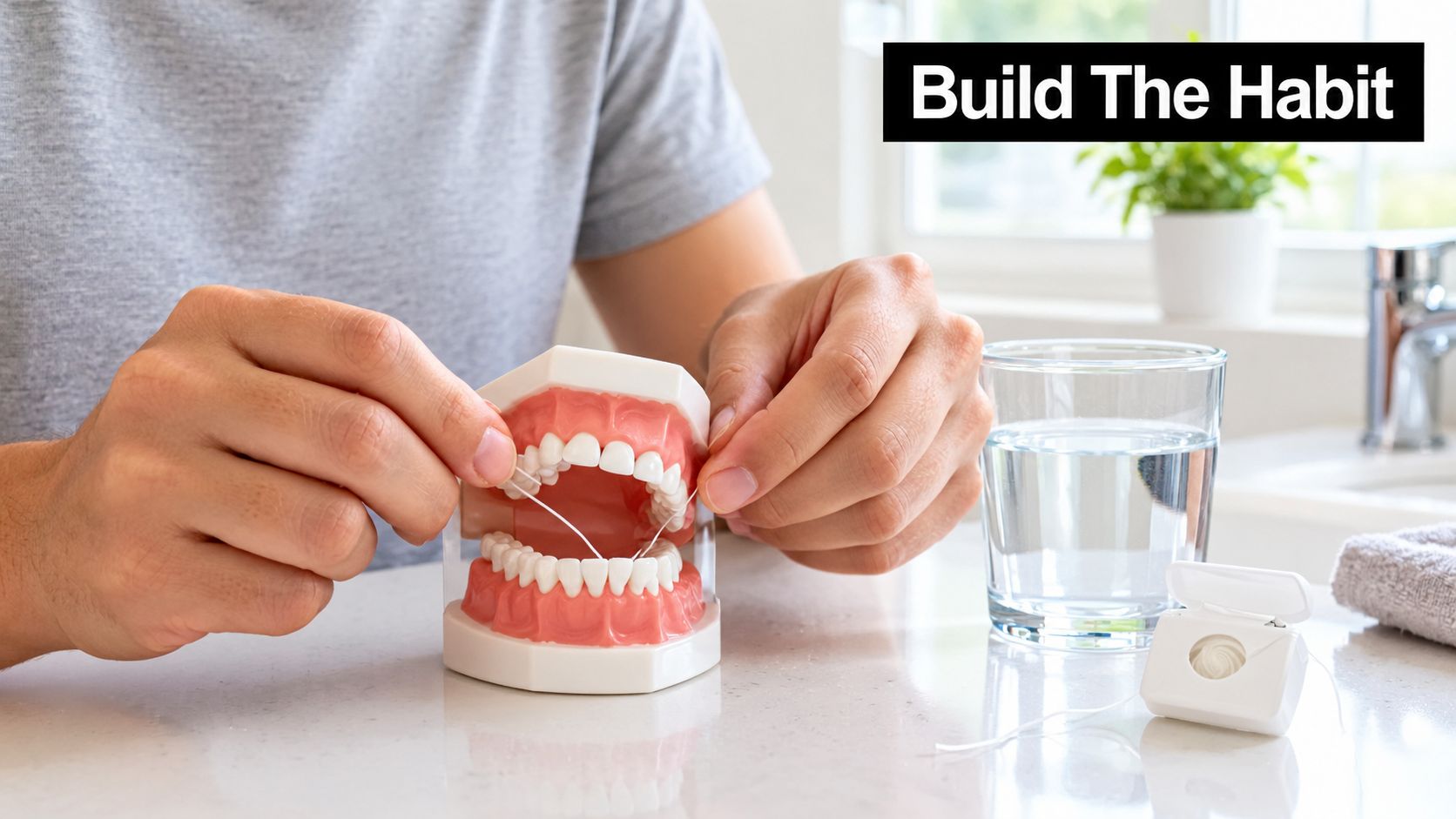
Start with a piece long enough to give you a clean section for each space. Wind most of it around one finger on each hand, leaving a workable span between them. Ease the floss through the contact point with a gentle back-and-forth motion, then curve it around one tooth and move it up and down before cleaning the neighboring tooth.
Make the routine easier to keep
- Pick a reliable cue: Floss after brushing at the same point in your evening routine, or keep the container beside the toothbrush.
- Use a gentle grip: Let the floss do the cleaning. Forcing it into tight spaces increases the chance of discomfort or breakage.
- Change sections: Move to a fresh part of the floss as you work around the mouth, so you're not transferring material from one area to another.
- Adjust when it fails: If the floss repeatedly shreds or won't pass through a contact, try a different texture and ask a dental professional for guidance.
- Keep the goal manageable: Consistency matters more than making the routine elaborate.
The guide to flossing properly can help you review the hand position and movement. If you're choosing for a family, let each person test the handling and texture while you separately check whether the product is cruelty-free, vegan, PFAS-free, and suitable for your disposal options.
Read the package before you buy, then contact the manufacturer when the wording is vague. Choose a cruelty free dental floss with a verifiable testing policy, clearly disclosed materials, and a format that you'll use consistently. That simple checklist turns ethical oral care from a marketing promise into a practical daily decision.
