

Posted by Sarah Collins
on September 26, 2026

You pull a strand of floss from its dispenser, use it for a few seconds, and throw it away. That small routine can raise a surprisingly large question: does dental floss have to be made from plastic?
The Surprising History of Natural Floss
The first widely documented dental floss wasn't nylon or PTFE. It was waxed silk. In 1819, New Orleans dentist Levi Spear Parmly recommended silk thread for removing debris between teeth, long before modern plastic products appeared. By 1882, the Codman and Shurtleft company was commercially producing unwaxed silk floss, and in 1898, Johnson & Johnson received the first dental-floss patent for floss made from the same silk material used in surgical stitches. The history of dental floss shows that natural-fiber interdental care came first.
That timeline changes how we think about non plastic dental floss. Choosing silk today isn't an attempt to invent an untested bathroom novelty. It's a return to the material roots of floss, refined with modern dispensers, coatings, and manufacturing standards.
Why nylon became standard
Floss use remained relatively low before World War II. During the war, silk was diverted for military needs, so manufacturers turned to nylon. Nylon offered practical advantages: it resisted shredding, could be produced in long lengths, and came in different sizes. Those qualities helped synthetic floss become the mass-market standard.
The shift made sense from a manufacturing perspective, but it also created a lasting dependence on plastic-based fibers. Natural floss didn't disappear because it had no place in oral hygiene. It was displaced by a material that was easier to produce at scale and more resilient during use.
Historical perspective: Plastic-free floss is less a rejection of dental hygiene technology than a reconsideration of the material used to deliver it.
Today's interest in silk, bamboo fiber, and other biodegradable materials connects two periods of innovation. The original floss was natural, while modern alternatives add lessons learned from decades of synthetic-floss production. Waxing can improve handling, refillable dispensers reduce packaging, and clearer ingredient labeling helps shoppers distinguish a genuinely natural strand from a product that only looks sustainable.
The broader dental floss market remains substantial, with a projection of US$751.7 million in 2026 and US$1,086.2 million by 2033, representing a projected 5.4% CAGR, according to market data summarized by Consumer Reports. Even a modest place for biodegradable products within that category represents meaningful potential for natural-fiber oral care.
Exploring Biodegradable Floss Materials
Walking through sustainable oral-care products can be confusing because the word “natural” may describe the packaging, coating, or marketing rather than the strand itself. Start with the material list, then consider how the floss feels between your teeth and whether the format suits your routine.
Silk is the clearest traditional option. It's a natural protein fiber and can be biodegradable. Silk floss often has a textured feel, especially when compared with ultra-slick synthetic products. That texture may appeal to people who want tactile contact with the tooth surface, although it can require a gentler technique around tight contacts.
Bamboo fiber and plant-based strands need closer inspection. Some products use plant materials, plant waxes, or bamboo-derived ingredients, but the name alone doesn't establish that the entire strand is plastic-free. Bamboo floss may be blended with other fibers to create a continuous, usable thread. PLA, sometimes marketed as “corn floss,” is renewable-source bioplastic, but it remains polymer-based rather than completely plastic-free.
Compostable floss picks can be convenient for travel, school bags, or days when handling a spool is difficult. Their environmental profile depends on the pick material, the floss strand, the coating, and local disposal facilities. “Compostable” should describe the specific component and disposal route, not just the product's overall branding.
For technique and tool selection, readers can also consult guidance on interdental care from Katy TX dentists. A useful companion explainer is this guide to whether floss is biodegradable, especially when you're comparing the strand with its dispenser.
Comparing non-plastic floss materials
| Material Type | Texture and Glide | Best For |
|---|---|---|
| Silk | Naturally textured, with a softer and less synthetic feel | People seeking a traditional natural fiber and biodegradable strand |
| Bamboo or plant-based fiber | Varies widely by blend, coating, and construction | Shoppers who will verify the full material list and want plant-derived options |
| Compostable floss picks | Familiar pick format, with performance depending on the attached floss | Travel, quick routines, and users who find a spool difficult to handle |
The most important distinction is between material claims and verified construction. A cardboard dispenser doesn't make a polyester strand plastic-free, and a bamboo label doesn't explain whether the thread contains nylon. Look for the fiber, coating, pick material, and disposal instructions together.
Vegans should also know that silk is an animal-derived material. Plant-based alternatives may be preferable ethically, but they require particularly careful label reading because a plant reference doesn't automatically rule out synthetic polymers.
Performance and Enamel Safety
The practical concern is easy to understand. If natural floss feels rougher or breaks more readily, could it wear enamel or fail to clean effectively?
A 2023 comparative study measured surface roughness across several floss materials. Silk had the highest reported roughness, Ra 0.304±0.025 µm, while PTFE had the lowest, Ra 0.048±0.003 µm. Yet in-vitro abrasion testing found no significant differences in enamel wear across PTFE, nylon, silk, and UHMWPE flosses. The comparative study suggests that a more textured sensation doesn't automatically mean greater enamel damage in the tested conditions.
That distinction matters. Your fingers may notice glide and texture immediately, while enamel wear depends on more than how smooth the thread feels. Pressure, technique, contact with the tooth surface, and repeated movement all influence the experience.
Strength and handling
Mechanical testing shows a different tradeoff. In one comparative study, Thai silk floss recorded a maximum load of 23.70 N and elongation of 16.44%, both lower than the nylon-based flosses tested. Wax increased elongation but didn't significantly change maximum load. The material-testing research supports a practical conclusion: waxed silk may handle tight contacts more comfortably, even though it doesn't become identical to nylon.
Silk can therefore be strong enough for interdental cleaning while remaining less elastic and more likely to fray or disintegrate under force. Treating it like stretchy nylon is the common mistake. Use controlled movement rather than pulling hard.
Practical rule: If a natural strand catches, slow down and guide it through. More force isn't a better cleaning method.
The right floss is also personal. Very tight contacts may favor a thinner, well-waxed strand. Wider spaces may tolerate a thicker natural fiber. Sensitive gums generally benefit from a gentle technique and light pressure, regardless of the material. If floss consistently catches on a filling, crown, retainer, or unusually rough edge, ask a dental professional to assess the contact rather than repeatedly forcing the thread.
Avoiding Hidden Plastics and PFAS
A floss package can look beautifully minimal while the strand inside remains synthetic. Terms such as “smooth,” “easy glide,” or “silky” describe the user experience, not necessarily the fiber or coating.
PTFE, or polytetrafluoroethylene, is a fluorinated material used in some floss products. One independent consumer test found 17 of 67 floss products contained PFAS in the form of PTFE, and the testing guidance recommends checking packaging for PTFE because PFAS may not always be clearly identified. The Danish Consumer Council's floss guidance offers a useful reason to treat “glide” claims with curiosity rather than assumption.
A separate consumer lab review of PFAS in dental floss lists nylon, polyethylene, ultra-high-molecular-weight polyethylene, silk, and bamboo fiber among floss materials. It notes that non-PTFE materials would not be expected to contain PFAS, while PTFE floss is designed to reduce friction.
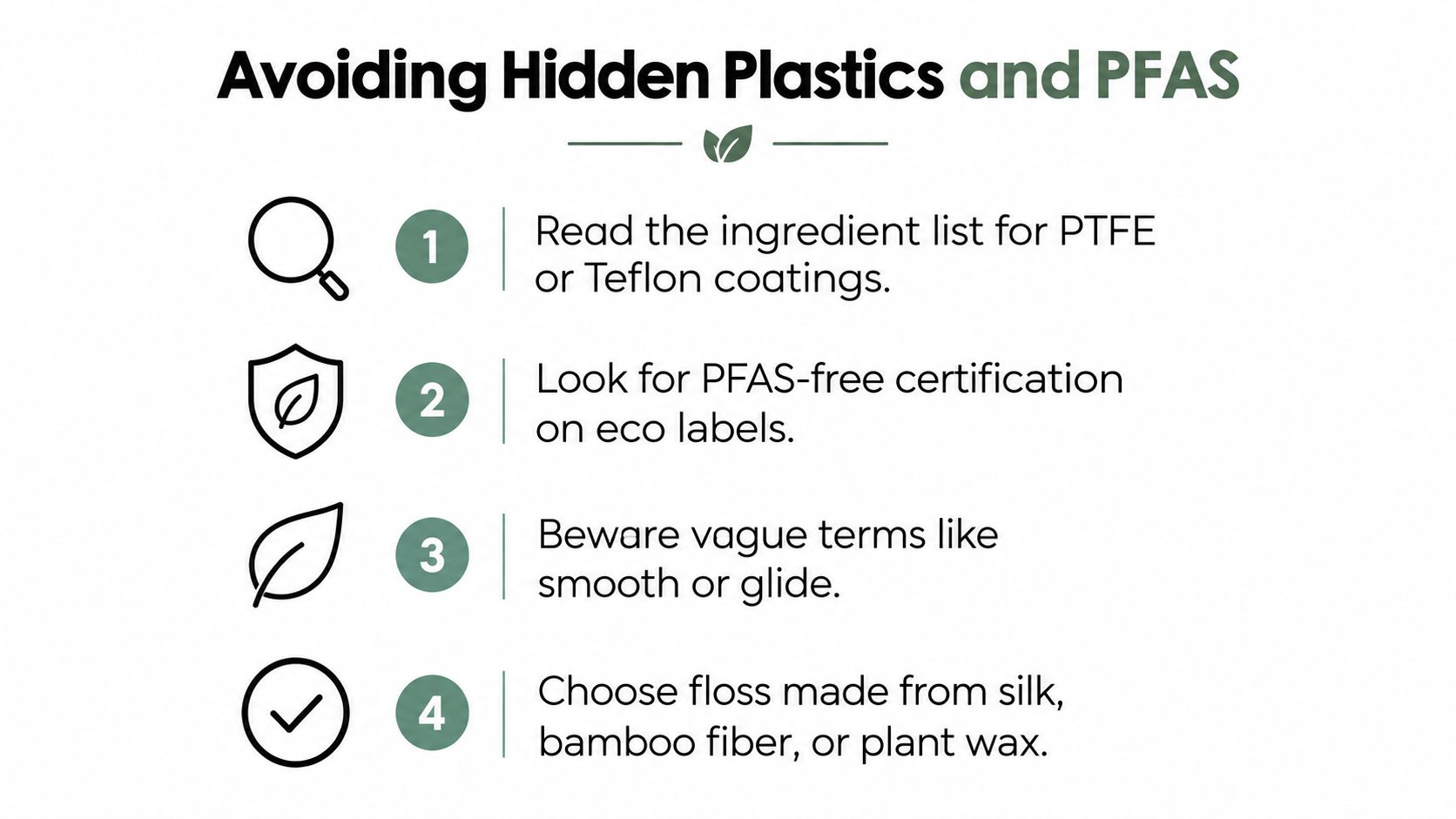
A simple label checklist
- Read the strand material: Look for silk, clearly identified plant fiber, or another specific material. Avoid relying on “eco” alone.
- Check the coating: PTFE and Teflon are important terms to notice. Plant waxes should be named where possible.
- Question vague glide language: “Smooth” describes performance, not proof of a plastic-free construction.
- Inspect the dispenser: Glass, metal, and paper packaging may reduce plastic, but they don't confirm the floss itself is natural.
PFAS awareness belongs within a broader habit of reading materials carefully. The same principle applies to other everyday products, including making more informed choices about better cups with Nothing. Clear composition and end-of-life information are more useful than broad environmental language.
For practical guidance on choosing and using floss, see this resource on dentist-recommended floss. If a label doesn't identify the strand, coating, and disposal route, contact the manufacturer or choose a product with more complete information.
Transitioning Your Daily Flossing Routine
Switching from nylon to natural floss usually requires a technique adjustment, not a complete change in your oral-care habits. The goal is to let the strand move around the tooth instead of forcing it through the contact point.
A gentler method
- Cut a manageable length. Use enough floss to keep a clean section available for each space. Wrap it securely around your fingers or use the dispenser's intended grip.
- Guide the contact point. Move the thread with a gentle sawing motion until it passes between the teeth. Don't snap it straight downward.
- Form a C shape. Curve the floss around one tooth, slide it gently below the gumline, and move it up and down against the tooth surface. Repeat on the neighboring tooth.
- Use a fresh section. Shift the floss between spaces so you don't carry loosened debris from one area to another.
- Slow down at rough areas. Fillings, crowns, retainers, and crowded contacts may need smaller movements and less tension.
The C-shape matters because floss works along the side of each tooth, not only through the gap. A strand that pops between teeth and comes straight back out may miss the curved surfaces where debris collects.
Small adjustment, better experience: Let the floss follow the contour of the tooth. Don't use extra force to compensate for a less elastic fiber.
Floss picks can simplify the routine when finger-wrapping feels awkward. They're useful for travel and for people who struggle with spool control, but the same label questions still apply. Check whether the pick is made from a biodegradable material, whether the floss strand is separately identified, and whether the product has a local composting route.
For a detailed refresher on technique, use this guide to how to floss properly. If you're concerned about oral habits beyond flossing, a discussion of mouth breathing and oral health can provide useful context, though persistent concerns should be discussed with a qualified clinician.
Disposal is part of the choice
Don't flush dental floss. Independent disposal guidance recommends placing used floss in general waste because it can contribute to plumbing problems and isn't easily sorted or recycled. If a dispenser separates cleanly, its plastic component may be recyclable depending on local rules. Disposal guidance from Burrtec explains why the strand and container should be considered separately.
Compostable labeling also needs local context. Silk is identified as a natural biodegradable option, while bamboo floss may be suitable for home composting, and nylon currently can't be recycled through ordinary systems, according to Suffolk Recycling guidance. Follow the product's instructions and your local composting rules rather than assuming every “compostable” item belongs in a household compost bin.
Building a Holistic Plastic-Free Smile
A floss upgrade works best when it fits into a routine you can maintain. The most sustainable oral-care product is one you use correctly and replace responsibly, not one that looks ideal but frustrates you after a few days.
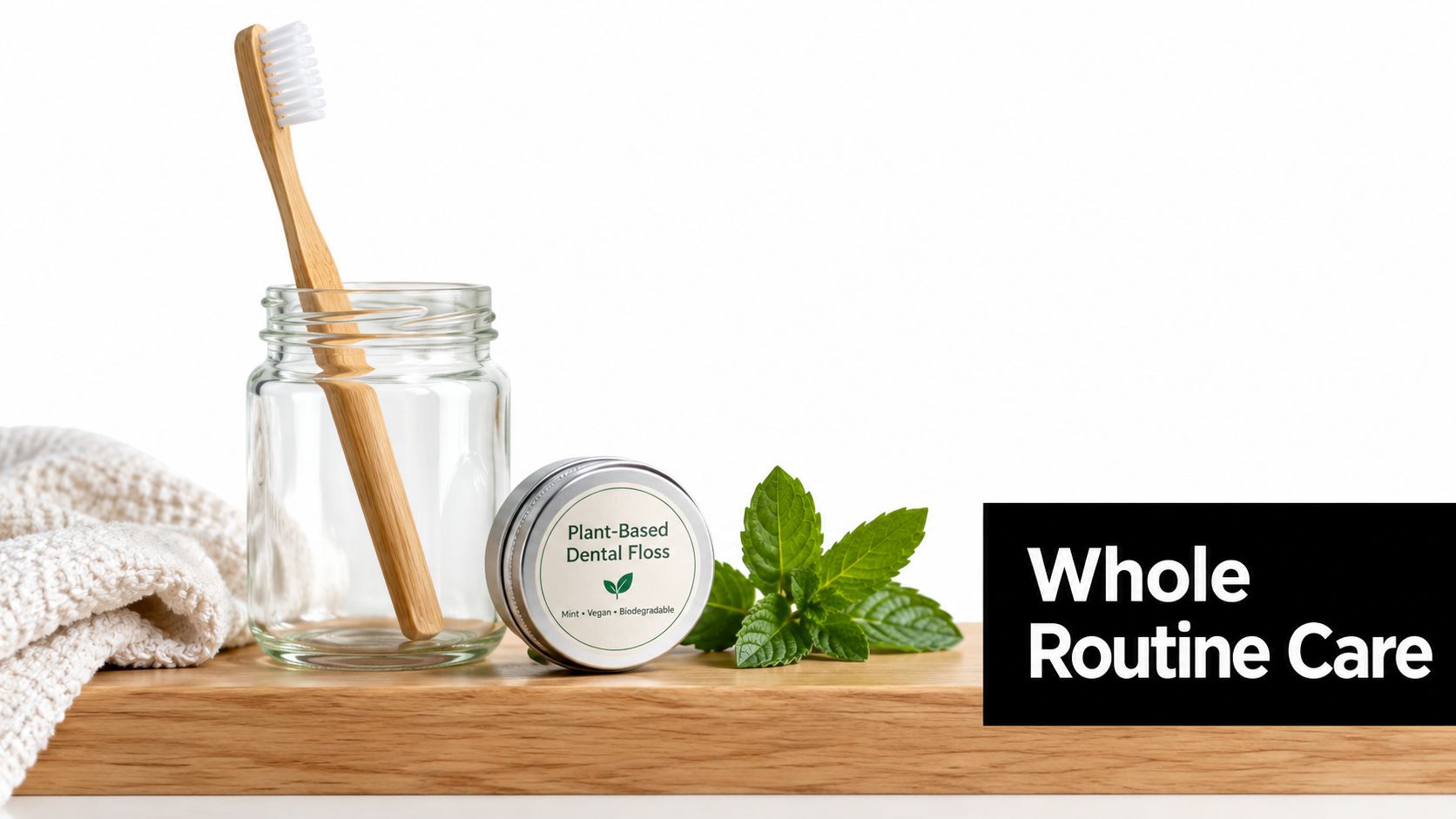
A practical plastic-conscious routine might combine a natural or clearly verified floss strand, a durable toothbrush handle, a reusable dispenser, and toothpaste packaging that suits your local disposal options. These choices don't need to happen all at once. Replacing one item as it runs out is often easier than rebuilding the entire bathroom cabinet in a single shopping trip.
Pairing materials with oral-care goals
Floss addresses the spaces between teeth, while brushing supports the exposed tooth surfaces and gumline. Some people choose fluoride-free toothpaste containing nano-hydroxyapatite, a mineral ingredient studied for its relationship to tooth-surface mineral structure and sensitivity support. Mouthology offers fluoride-free toothpaste formulated with 10% nano-hydroxyapatite, alongside biodegradable floss picks, as one example of a routine that combines mineral-based toothpaste with a lower-plastic interdental format.
That pairing isn't a substitute for professional dental advice. People with orthodontic appliances, restorations, bleeding gums, or persistent sensitivity may need a specific floss type or interdental brush recommended by a dental professional.
The useful mindset is thoughtful upgrading. Choose a strand you can use gently, verify what it's made from, keep realistic disposal expectations, and maintain the brushing and interdental habits that support your smile.
If you're ready to make the switch, begin with your next floss purchase. Compare silk and clearly documented plant-based options, check the coating and dispenser materials, and select the format you'll use every day.
