

Posted by Sarah Collins
on August 29, 2026

Most conventional dental floss is not biodegradable because it's made from synthetic polymers like nylon or PTFE. Biodegradable alternatives made from silk or plant fibers do exist, but whether they break down in practice depends on the material, coating, packaging, and disposal route.
If you're asking is floss biodegradable, you may expect a simple yes-or-no answer. The more useful answer starts with a different question: what is your floss made of, and where will it go after you use it?
A tiny strand can contain a very different material story from another tiny strand. A nylon thread, a silk fiber, and a plant-derived polymer may all look similar in your hand, yet they behave differently after disposal. Even a floss labeled biodegradable may not belong in your home compost, plumbing, or recycling bin.
The Short Answer on Floss Biodegradability
Most mass-market dental floss is not biodegradable. Conventional products are typically made from synthetic polymers such as nylon, polyester, PTFE, or polyethylene, materials selected for strength, smoothness, and durability rather than microbial breakdown. A peer-reviewed paper available through PubMed Central's review of dental floss materials describes the vast majority of commercially available floss as synthetic and identifies its disposal as a serious challenge because these materials aren't biodegradable. Consumer Reports also identifies nylon and polyester as common floss materials.
That doesn't mean every strand of floss creates a major environmental burden on its own. The strand is small. The issue is that conventional floss is designed to remain mechanically stable, so ordinary soil and compost microorganisms can't readily return it to natural materials. Independent environmental writing puts nylon floss decomposition at 20 to 80 years in some conditions, while also noting that nylon doesn't biodegrade in landfills. Read that estimate in context, since real-world conditions vary, but the practical conclusion is clear: nylon floss isn't a short-lived organic waste item. The environmental discussion from Calcium Clinics explains this persistence.
The natural-material exception
Silk floss is the main established biodegradable category. Silk is a natural protein fiber, rather than a petroleum-derived synthetic polymer, and it's often coated with beeswax or plant-derived waxes such as candelilla. Vendor descriptions distinguish silk from nylon and label natural silk versions biodegradable or compostable, as shown by this silk floss product description.
Plant-based options are also developing. Bamboo floss may refer to a natural fiber, but the label alone doesn't tell you enough. Some products use a plant-derived polymer, while newer research has examined natural fibers such as Chambira palm. A 2025 Ecuadorian Amazon study concluded that Chambira palm floss treated with natural wax was technically feasible and commercially sustainable as a locally sourced biodegradable alternative, contrasting it with nylon, Teflon, and polyethylene floss. The study is available through the Universidad Nacional de Chimborazo repository.
So, the short answer is usually no for conventional floss, potentially yes for clearly identified natural-fiber floss. The important next step is learning to read the material list instead of relying on words such as “green,” “eco,” or “plant-based.”
What Your Floss Is Made Of
Manufacturers choose different fibers for different reasons, including tensile strength, smooth movement between tight contacts, resistance to shredding, and production cost. The thread's raw material also affects what happens after disposal.
Nylon and polyester
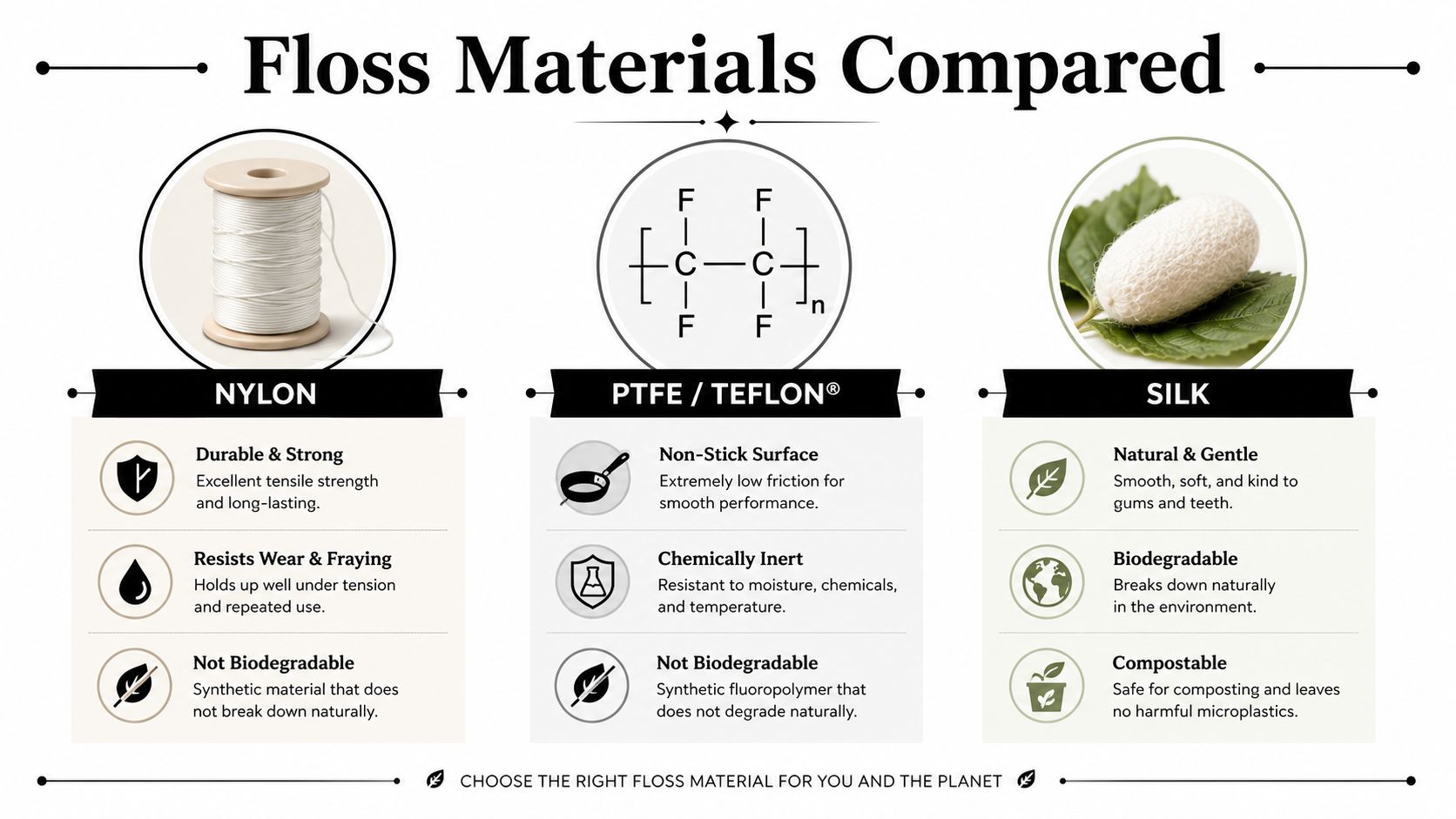
Nylon is a synthetic polymer and one of the most familiar materials in conventional floss. It is durable, can be made into a thin, strong thread, and holds up during cleaning. Those same qualities mean microorganisms do not readily break it down after disposal.
Polyester is another synthetic material used in floss. Like nylon, it belongs to the plastic-derived side of the category. A paper carton does not make a synthetic thread biodegradable, so check the material list rather than judging the product by its packaging. The Consumer Reports guide discussed earlier can help distinguish nylon, polyester, and PTFE.
PTFE, sometimes called Teflon
PTFE floss has a smooth, low-friction feel. That can help people with very tight spaces between their teeth, but the material remains synthetic and not biodegradable. Terms such as “smooth” and “glide” describe how the floss performs, not how it breaks down after disposal.
Floss picks require the same careful check. Their handle may use one material while the thread contains nylon or another synthetic polymer. Inspect both components, because the handle and thread can have different environmental properties.
Silk and plant fibers
Silk floss is a natural-fiber alternative. Its thread can biodegrade biologically, particularly when its coating is also made from a natural wax. Beeswax means the product is not vegan, while plant-derived waxes may suit people avoiding animal-derived ingredients. A useful label identifies both the thread and its coating instead of relying on broad sustainability language.
Research has identified silk wax floss and silk-beeswax floss as completely biodegradable alternatives. The finding supports silk as an established natural-fiber option, although synthetic floss remains common. For help comparing texture, handling, and product construction, see this guide to find dentist-recommended floss.
Plant-based materials need closer inspection. “Bamboo” may describe a natural fiber, a plant-derived polymer, or a blend containing synthetic components. “Bamboo” doesn't identify the full construction. Check the exact thread material, wax, and dispenser materials before deciding how sustainable the product is in practice. Disposal conditions matter too, because a natural fiber breaks down more readily in suitable environments than when sealed in ordinary waste.
The Real Environmental Footprint of Flossing
Biodegradability answers an end-of-life question, but it doesn't describe the whole environmental footprint. Manufacturing the thread, producing the dispenser, transporting the product, and handling the waste all matter. That's why a biodegradable product isn't automatically the lowest-impact choice in every assessment.
A 2023 environmental impact study of interdental cleaning aids found meaningful differences between regular floss, floss picks, and bamboo floss. In its climate-change assessment, regular floss produced 3.07 kg CO2-eq, floss picks produced 11.42 kg CO2-eq, and bamboo floss produced 2.11 kg CO2-eq. The study is available in the peer-reviewed environmental assessment on PubMed Central.
| Floss Type | CO2 Footprint (kg CO2-eq) | Biodegradable |
|---|---|---|
| Regular floss | 3.07 | Generally no |
| Floss picks | 11.42 | Depends on thread and handle |
| Bamboo floss | 2.11 | Depends on the actual fiber and coating |
Why the table needs context
The same study found that regular floss had one of the smallest environmental footprints across three impact categories, while bamboo floss had the smallest footprint in only one category. That doesn't make regular synthetic floss a biodegradable product. It shows that lifecycle impact and end-of-life persistence measure different things.
A natural fiber may offer a better disposal profile, while a conventional product may use less material or require fewer resources during another stage of its lifecycle. Packaging can change the comparison too. A refillable dispenser paired with minimal refills may have a different profile from a disposable plastic pick, even if both use synthetic thread.
Practical rule: Treat “biodegradable” as one screening question, not the entire sustainability assessment.
The broader lesson applies to other everyday swaps. If you're comparing low-waste options for travel, outdoor routines, or household use, a guide to sustainable swaps for adventurers can help you evaluate products by their complete lifecycle rather than by one appealing label.
Nylon's persistence still matters. Environmental sources describe it as capable of remaining for decades or longer, depending on conditions, so a small daily item can create a lasting waste stream when people use and discard it repeatedly. The responsible conclusion isn't that you should stop flossing. Interdental cleaning supports oral hygiene, and a material choice can improve the waste profile without abandoning the routine.
Why Biodegradable Does Not Always Mean Compostable
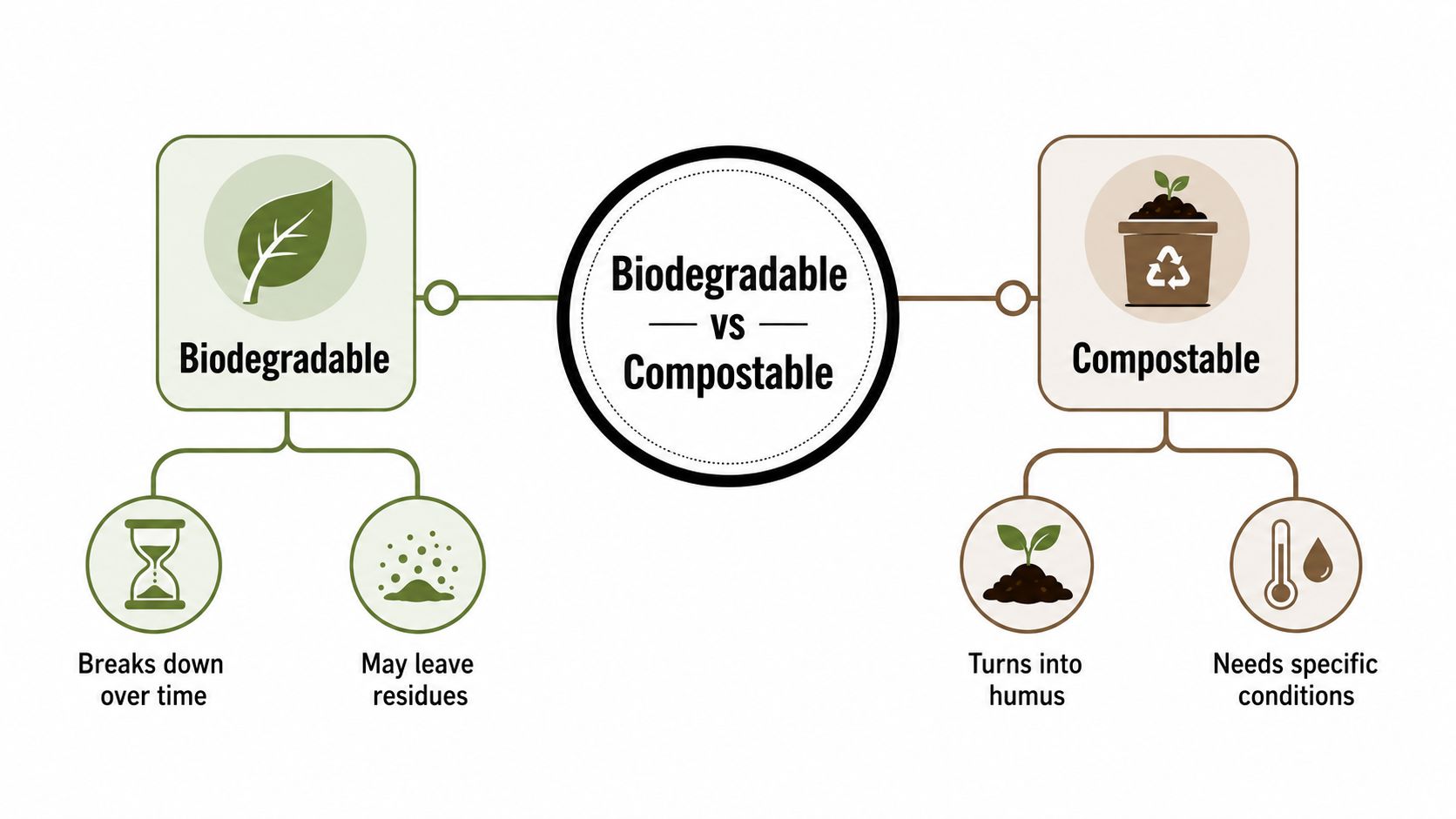
Could a floss labeled biodegradable still belong in general waste? Yes. Biodegradable describes a material that organisms can break down over time when biological conditions support that process. The label does not promise quick decomposition in a landfill, a backyard compost bin, or a sewer system.
Compostable is a narrower claim. The material must break down into compost under defined conditions, with suitable moisture, oxygen, microbial activity, temperature, and time, without leaving problematic residues. A home compost pile and a managed industrial facility provide different conditions, so “industrially compostable” does not mean the product belongs in your garden compost.
Why flushing is a poor shortcut
Water is not a composting system. Even silk floss may break down too slowly for plumbing. The Peace With The Wild disposal guidance explains this distinction, noting that biodegradable silk floss can still be unsuitable for pipes because biodegradability does not mean rapid disintegration in water or sewer conditions.
Floss can catch on other materials, contribute to blockages, or travel through wastewater infrastructure before breaking down. Don't flush dental floss, whether it is nylon, silk, or plant-based. Wrap used floss and place it in general waste unless your local service gives different, specific instructions.
Read the claim, then read the route
A useful check follows the product from its thread to its disposal:
- What is the thread made from? Nylon and PTFE are synthetic materials. Silk is a natural fiber, while a plant-based label needs more detail.
- What is the coating made from? A natural thread may still have a synthetic coating, changing how the complete item should be handled.
- Where can I dispose of it locally? Confirm whether your compost service accepts that exact material. If no suitable composting route exists, general waste may be the appropriate option.
The same principle applies to packaging and dispensers. A biodegradable thread does not make every part of the product biodegradable. Material, conditions, packaging, and local infrastructure work together to determine what sustainable disposal means in practice.
How to Choose a Truly Sustainable Floss
A useful shopping decision doesn't require perfect knowledge of material science. It needs a reliable order of checks. Start with the part that goes between your teeth, then move outward to the coating, dispenser, package, and final disposal route.
Begin with the thread
Look for a clearly named material such as silk, bamboo fiber, or another specifically identified plant fiber. If the label lists nylon, PTFE, polyester, or polyethylene, the floss thread is synthetic and generally not biodegradable.
Be cautious with a product that says only “natural,” “eco,” or “plant-based.” Those phrases may describe the source of one component, not the whole floss. A plant-derived polymer can behave differently from an untreated natural fiber, and its disposal may require a commercial composting facility.
Check the coating and handle
The coating affects both feel and end-of-life handling. Natural waxes, such as beeswax or candelilla, are different from synthetic coatings. If you avoid animal-derived materials, check specifically for a plant-based wax rather than assuming every “natural” product is vegan.
Floss picks require an extra check because the handle becomes part of the waste. A biodegradable thread attached to a conventional plastic handle doesn't create the same disposal situation as a product with a biodegradable or otherwise appropriately managed handle.
Consider the package you can actually manage
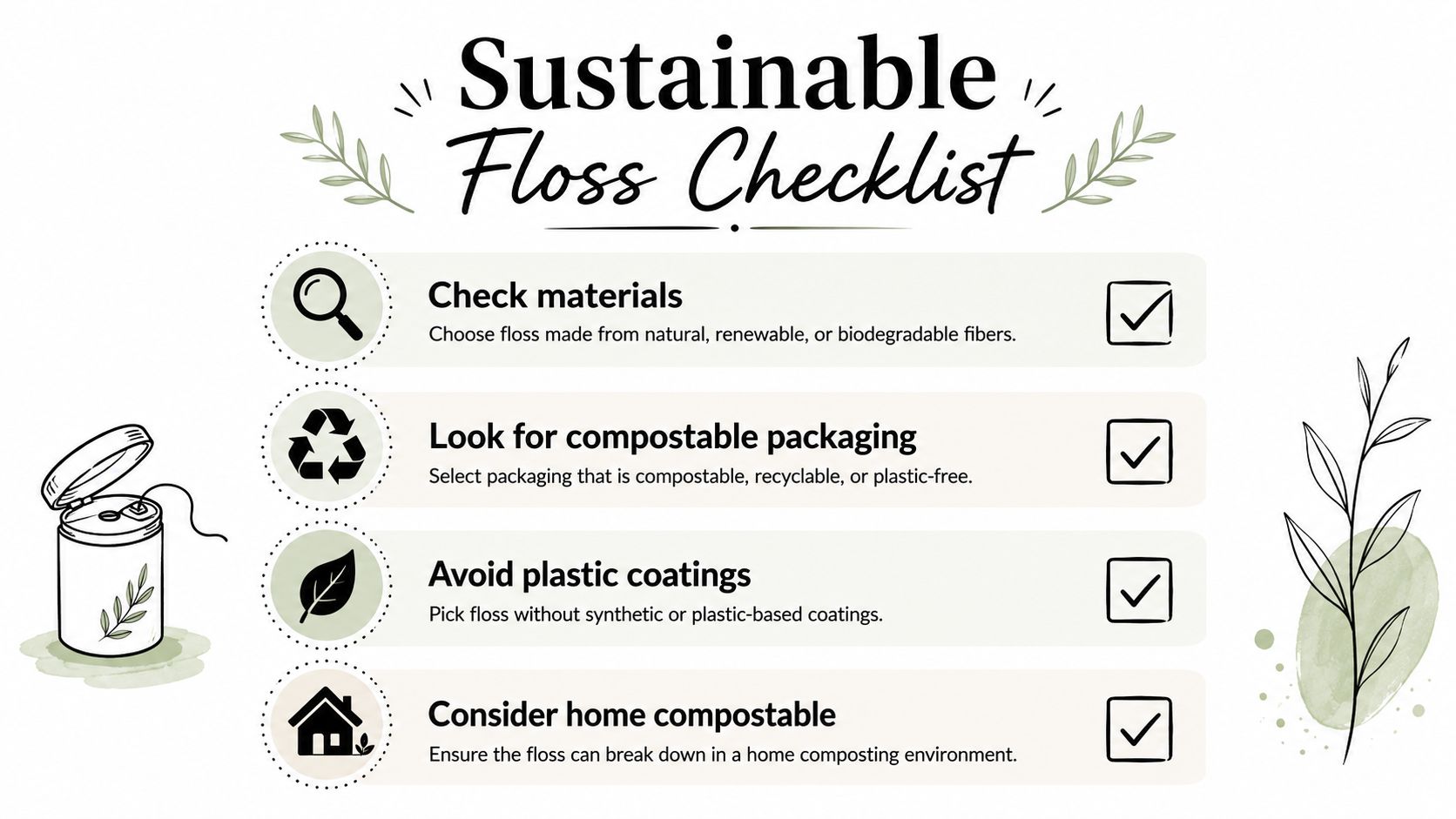
A reusable glass or metal dispenser can reduce repeated container waste when paired with suitable refills. Paper packaging may be easier to manage than mixed plastic, but only if your local recycling or composting system accepts it. Packaging claims need the same scrutiny as thread claims.
A simple checklist can keep the choice practical:
- Identify the fiber. Don't buy on color or marketing language alone.
- Identify the coating. Look for beeswax, candelilla, or another named material.
- Inspect the handle and dispenser. The thread isn't the whole product.
- Confirm disposal locally. Home compost, commercial compost, recycling, and general waste aren't interchangeable.
For readers comparing sustainability decisions across household routines, a biodegradable coffee filters guide offers a useful reminder that the material and disposal instructions both matter.
Mouthology sells biodegradable floss picks, including a 200-count pack listed on its product pages. They're one practical option for people who prefer a pick format, but you should still follow the product's own disposal guidance and consider how the handle and packaging fit your local waste system. For broader ideas, see sustainable oral care.
Building a Sustainable Oral Care Routine
A sustainable bathroom routine doesn't depend on finding a perfect product. It works through small, repeatable upgrades that preserve the habits your mouth needs while reducing avoidable waste.
Floss is one part of that routine. Toothbrushes, toothpaste tubes, replacement heads, tongue cleaners, and packaging all bring their own material questions. You can examine each item in the same order: identify what it's made from, choose a format that fits your actual habits, and confirm the available disposal route.
Keep oral health at the center
The most sustainable floss is the one you'll use correctly and consistently. A natural fiber that stays in the drawer doesn't help your routine, while a familiar format may make daily interdental cleaning easier to maintain. If a new material feels different, test its handling gently and choose an option that moves comfortably between your teeth without forcing it.
Technique matters too. Use a clean section of floss as you move around the mouth, guide it gently between the teeth, and curve it around each tooth rather than snapping it against the gums. This guide to how to floss properly can help you build a careful technique around whichever material you choose.
A thoughtful oral-care routine protects two things at once, your daily health habits and the resources used to support them.
You don't need to replace everything at once. Start with the product you discard most often, choose a clearly labeled alternative if one fits your needs, and learn the disposal instructions before buying in bulk. That keeps sustainability grounded in what you can do, rather than turning it into an all-or-nothing standard.
The answer to is floss biodegradable is therefore more useful as a decision than as a slogan. Conventional nylon and PTFE floss generally aren't biodegradable. Silk and some plant-fiber options can offer a different end-of-life profile, but coatings, handles, packaging, and local facilities still determine what happens next.
If your current floss is synthetic, don't abandon interdental cleaning. Instead, compare clearly labeled materials, select a format you'll use, and check your local disposal rules before making the switch. Your next purchase is a practical place to begin building a lower-waste oral-care routine.
Choose your next floss by checking the thread, coating, dispenser, package, and disposal instructions. Then use it consistently, dispose of it responsibly, and share this guide with someone who's been wondering whether their daily floss belongs in the compost, the trash, or nowhere near the drain.
