

Posted by Sarah Collins
on October 11, 2026

Most standard floss picks aren't recyclable in household bins because their small plastic handles are permanently combined with dental floss. Reusable holders and verified specialty collection programs can be exceptions, but the recycling symbol alone doesn't make a used pick acceptable.
You finish flossing over the bathroom sink, look at the blue bin, and hesitate. The handle is plastic, so recycling feels like the responsible choice. In practice, putting an ordinary floss pick in that bin usually sends the wrong signal to the sorting system and can add a small mixed-material contaminant to a load that was meant for larger, more uniform items.
The practical answer is simple: check your local program first. If it doesn't explicitly accept used floss picks, place the pick in household trash, never flush it, and consider a reusable holder if you use floss picks frequently.
The Honest Truth About Floss Pick Recycling
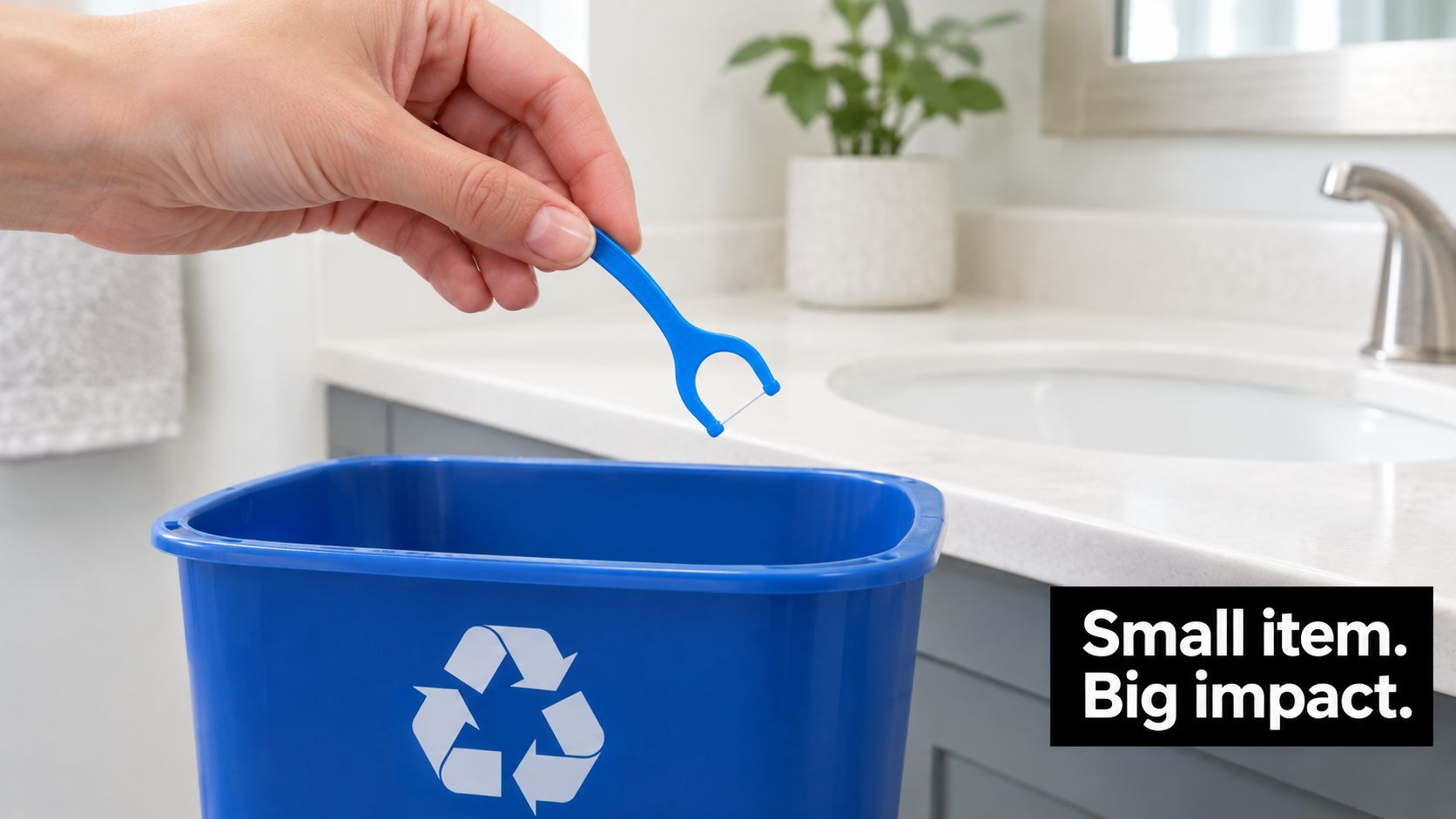
A recyclable material isn't the same as a recyclable product. That distinction matters with floss picks. The handle may be plastic, but a standard floss pick is a finished item made from a rigid frame plus a permanently attached strand of nylon or another synthetic filament. In real household recycling programs, that combination usually matters more than the fact that one part is plastic.
Recycling systems do not sort items by good intentions or by the triangle printed on packaging. They sort by what local programs accept, what the equipment can recognize, and what can move through the line without causing losses or contamination. Resin codes can help identify a plastic type, but they do not guarantee curbside acceptance. A number on a package is not the same thing as permission from your local hauler or material recovery facility.
What usually happens after collection
Household recycling works best with material streams that are large enough, uniform enough, and common enough to be sorted consistently. Paper, metal cans, and larger containers made from PET plastic, known as number 1, or HDPE plastic, known as number 2, are often a better fit for those systems. Small personal-care items with mixed materials are often left off accepted lists for a reason.
A floss pick can miss the intended plastic stream even if the handle itself is made from a recyclable resin. The item is light, irregular, and attached to filament that the system cannot easily separate in normal processing. In practice, that means it may be screened out, dropped into residue, or carried into the wrong stream where it lowers the quality of other recovered material.
Practical rule: If your local accepted-items list doesn't name floss picks, don't guess based on the handle.
That answer can feel frustrating, especially for families who rely on floss picks because they are easier to hold and easier to use with children or anyone with limited dexterity. Oral care still comes first. Disposal comes after that. For many households, the most accurate choice is simple: follow local instructions, place used floss picks in the trash when no approved collection route exists, and avoid treating the recycling bin as the default for every plastic-looking item.
Questions about breakdown and biodegradability come up too. Those details depend on the floss material, any coating, and the conditions after disposal, so this guide to whether floss is biodegradable is useful background.
Why Floss Picks Break Recycling Systems
A standard single-use floss pick is a small assembly, not a single clean plastic article. Its handle is commonly polypropylene or another rigid polymer, while the tensioned strand is often nylon or a similar high-strength synthetic material. The two components are attached for use, not designed to separate easily after use.
That construction creates two problems at once. The facility receives a mixed-material object, and the object is too small and light for reliable capture. Sorting equipment depends on predictable shapes, sizes, weight, and material behavior. A floss pick doesn't behave like a bottle, tub, aluminum can, or sheet of paper.
Size creates a capture problem
Material-recovery facilities use conveyors, screens, air systems, magnets, optical equipment, and manual checks to divide incoming material. None of those stages guarantees that a tiny floss pick will be captured as a useful plastic item. It can slip through a screen, fall into residue, or move with lightweight contaminants.
The EPA describes ordinary floss picks as generally unsuitable for household recycling because their small plastic handle and dental floss are difficult for sorting equipment to identify, separate, and process. Their size also makes them more likely to fall through machinery or be treated as residue rather than recovered plastic. You can read the technical context in the EPA's recycling infrastructure report.
Mixed materials defeat the resin shortcut
A resin identification number identifies the plastic used in a component. It doesn't certify the finished product for curbside collection. A polypropylene handle may be technically recyclable in isolation, while the attached nylon thread makes the used pick unsuitable for the local stream.
Removing the floss at home doesn't automatically solve the problem either. The loose strand still needs an accepted collection route, and the tiny handle may remain outside the facility's specifications. Cutting or rinsing the pick can also create a handling task without creating a viable feedstock.
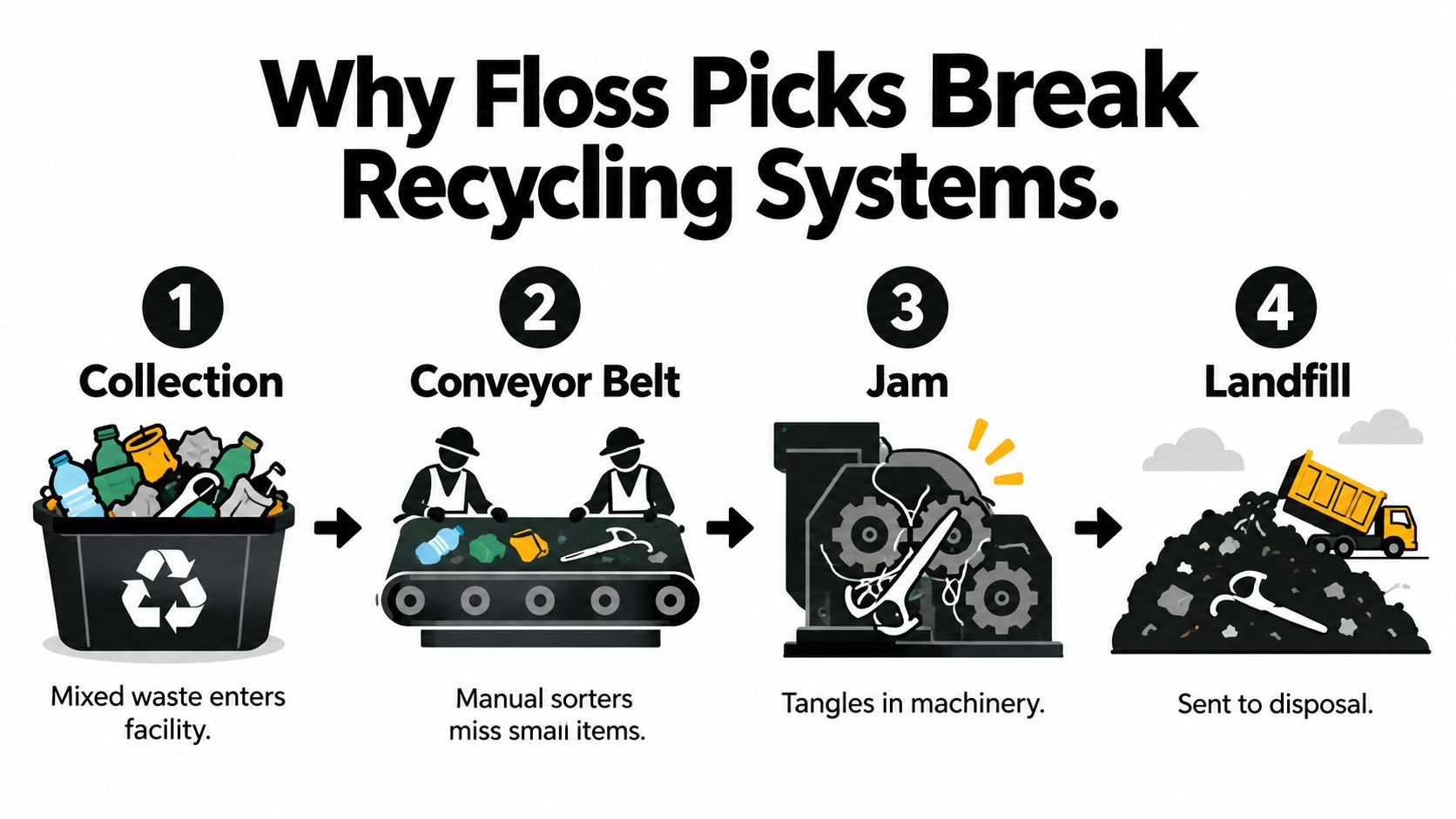
Contamination matters because a recycling load is processed as a group. A small item that doesn't belong can be removed as residue, and workers or equipment must deal with it instead of recovering a useful material. That doesn't mean one pick will ruin an entire truckload, but it does mean wishful sorting isn't the same as recycling.
The cleanest household decision is therefore based on the complete item, not the handle alone. If the local authority explicitly accepts that specific floss pick, follow its preparation rules. Otherwise, keep it out of the recycling bin and place it with household trash.
Checking Your Local Disposal Rules
Recycling rules belong to municipalities, not packaging symbols. Collection contracts, sorting equipment, accepted materials, and local markets differ, so the same item can have different instructions in different communities.
Start with the waste authority that serves your address. Search its accepted-items list for “floss picks,” “dental floss,” and “oral-care plastics,” rather than searching only for the handle's resin number.
Use this household check
- Read the local list. Look for the exact product, not a broadly worded category such as “plastic.”
- Check preparation rules. If the program accepts the item, follow its instructions for rinsing, separating, bagging, or drop-off.
- Look for a specialty route. Search for take-back, mail-in, dental-care, or “Beyond the Bin” programs.
- Choose residual waste when no route exists. Put the used pick in household trash, preferably after wrapping sharp or pointed pieces safely.
- Never flush it. Plastic and floss can enter wastewater systems, contribute to blockages, and escape into the environment.
The U.S. Environmental Protection Agency's recycling guidance explains that the recycling triangle and resin number identify plastic type, but the symbol doesn't guarantee community collection. The agency also lists plastic utensils among items that generally don't belong in household recycling bins, a useful comparison for other small, rigid, multi-material objects.
A number on plastic tells you what it is made from. Your local program tells you where it can go.
Specialty collection deserves careful attention. A municipal Beyond the Bin program in Trumbull, Connecticut, for example, separates dedicated collection from ordinary curbside recycling and includes selected oral-care items such as floss containers. That doesn't prove used floss picks are accepted there. Treat packaging, containers, and picks as separate products unless the program names each one.
Households sorting several materials may also benefit from checking the Monopack ltd guide for broader packaging principles. The same discipline applies in the bathroom: identify the complete item, confirm the local route, and don't infer acceptance from a symbol.
The Environmental Impact of Your Choices
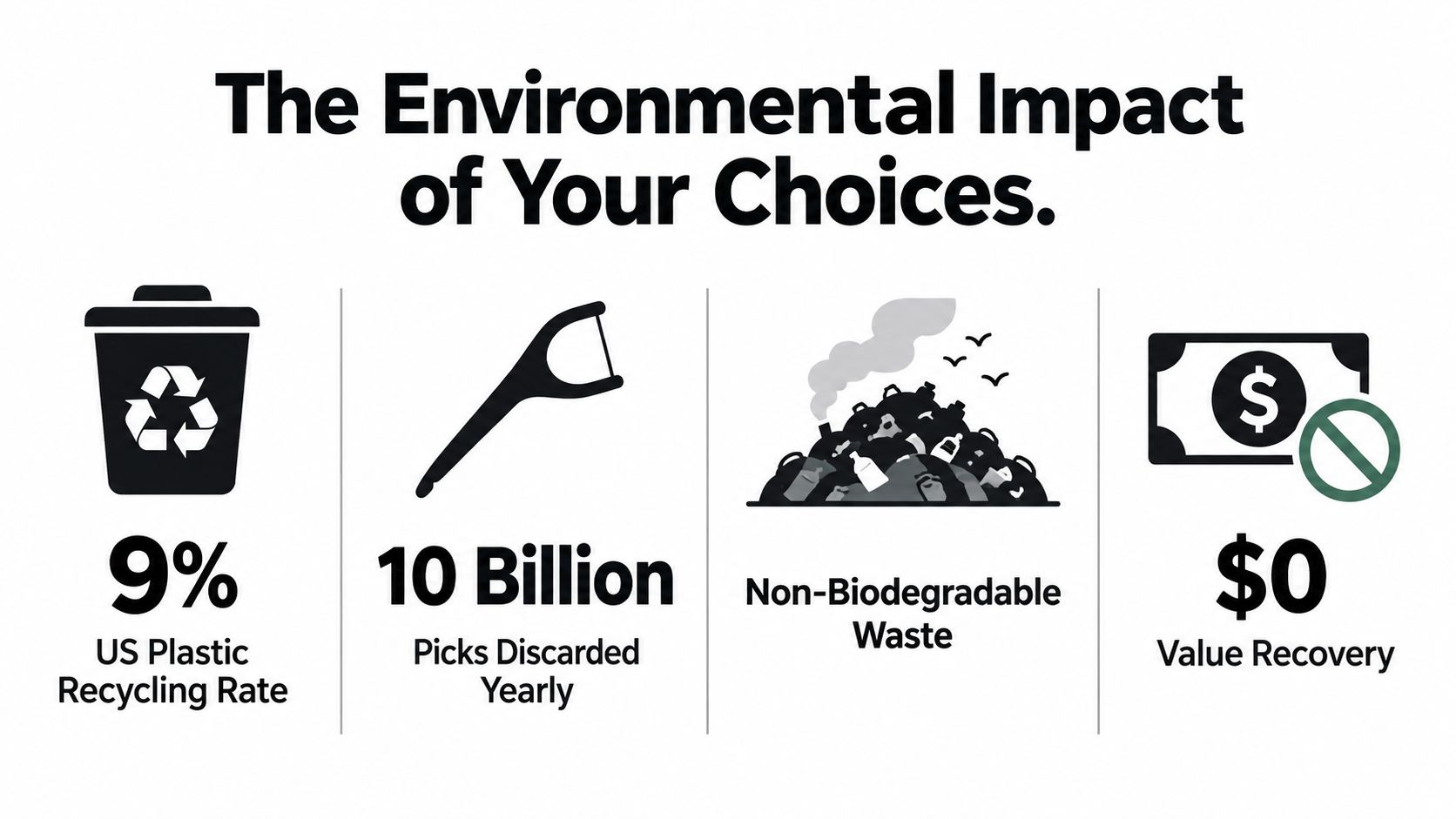
A floss pick can seem too small to matter, but its environmental cost isn't limited to what happens after it leaves your hand. The handle and filament require raw materials, manufacturing, packaging, transport, and disposal. Recycling is only one stage, and it works only when collection and processing systems can recover the item.
The wider plastic picture explains why prevention deserves attention. According to NIST's summary of plastic recycling data, the United States recycled 8.7% of its plastic waste in 2018, incinerated 15.8% with energy recovery, and sent 75.6% to landfills. A later 2021 analysis estimated the national plastic-recycling rate at between 5% and 6%, with approximately 40 million tons of plastic waste and about 2 million tons recycled. These figures describe plastic waste overall, not floss picks specifically.
Disposal isn't the whole life cycle
A peer-reviewed life-cycle study comparing eight interdental-cleaning aids found that floss picks had the highest environmental impact in 13 of 16 assessed categories, making them the worst-performing option overall in that comparison. The study is available through the Journal of Clinical Periodontology.
That result doesn't mean every person should abandon a floss pick immediately. Oral hygiene tools have to work for the person using them. A reusable holder that stays in a drawer, or a string-floss system that someone won't use consistently, may not deliver the intended benefit in practice.
Be careful with “biodegradable”
A handle described as bio-based, biodegradable, or compostable doesn't automatically make the whole pick compostable. The filament, coatings, contamination from use, and required composting conditions all affect the result. A household compost pile and an industrial composting facility don't provide the same environment, and many communities don't accept personal-care items in either system.
| Choice | Main waste question | Practical environmental consideration |
|---|---|---|
| Disposable plastic pick | Is the complete item accepted locally? | Usually avoid curbside recycling unless explicitly listed |
| Reusable holder with replacement floss | Can the handle stay in service? | Reduces repeated handle disposal |
| String floss in a dispenser | What happens to the used strand and dispenser? | Uses less rigid handle material, but still creates waste |
| Bio-based or compostable pick | What are the required conditions? | Verify the filament, coatings, and local facility |
Convenience still matters, especially for families and people with dexterity needs. The better decision isn't a perfect label. It's a tool that supports regular interdental cleaning while minimizing avoidable disposable material.
Better Eco-Friendly Alternatives
The most practical upgrade is often changing the handle, not abandoning the habit. A reusable floss holder lets you keep the controlled grip of a pick while replacing only the working strand. That reduces the number of discarded rigid handles, although the thread and its disposal still need consideration.
Traditional string floss is another straightforward option. It uses a dispenser and a separate strand, so it avoids throwing away a plastic handle after every use. The dispenser itself still needs an end-of-life decision, and string floss may not suit every user, particularly someone who struggles with finger control or reaching back teeth.
Choose according to real use
A family might use string floss at the bathroom mirror, a reusable holder for travel, and disposable picks only when a specific accessibility need makes them the most reliable option. That mixed approach can be more sustainable than buying an ideal product that sits unused.
For readers comparing materials and waste systems, Mouthology's guide to non-plastic dental floss offers another place to examine floss construction and disposal considerations. Mouthology also sells biodegradable wheat-straw floss picks, which it describes as recyclable and compostable. Those claims still need to be checked against the complete product materials and the facilities available in your area.
The most sustainable tool is the one you can use correctly and dispose of honestly.
If you choose a reusable holder, rinse the handle after use, let it dry fully, and replace the floss each time according to the product's directions. Don't assume a reusable handle is automatically recyclable at the end of its life. Ask the manufacturer what material it uses and whether it offers a take-back route.
If you prefer disposable picks, look for clear material disclosure and specific end-of-life instructions rather than relying on broad green language. A plastic-reduction guide from Litter Caterpillars can help place this small bathroom decision within a wider effort to reduce single-use plastic.
| Tool Type | Recyclable in Trash? | Best Disposal Method |
|---|---|---|
| Standard disposable floss pick | Usually no through ordinary curbside systems | Household trash unless local rules explicitly accept it |
| Reusable floss holder | Depends on the handle material and local rules | Reuse the handle, then follow manufacturer or local disposal guidance |
| String floss | Usually not through curbside recycling | Household trash, with the dispenser handled according to local rules |
| Specialized take-back product | Only through the named program | Follow the program's drop-off or mail-in instructions |
| Compostable-design pick | Not automatically | Use a verified composting route only if the complete product is accepted |
For children, parents should prioritize a tool the child can use safely and consistently. For adults with limited dexterity, a disposable pick may remain the most workable option. In those cases, correct disposal is still meaningful, and switching to a reusable system is worthwhile only if cleaning and replacement remain manageable.
Taking Action for a Cleaner Routine
After flossing tonight, pause before reaching for the blue bin. Check your local accepted-items list, keep a standard pick out of curbside recycling unless the program names it, and put it in household trash instead of flushing it.
If you want to reduce repeated handle waste, test a reusable holder or a suitable string-floss routine. For technique and product-selection guidance, this practical guide to choosing the best floss can help you match the tool to your needs.
A better routine doesn't require perfection. It starts with one accurate disposal decision, then a gradual move toward a tool you can use every day.
Before your next bathroom-bin toss, verify your municipality's rules and choose the disposal route it supports. If standard picks are excluded, switch them to household trash, explore a reusable holder, and share this simple rule with your family so convenience doesn't turn into avoidable recycling contamination.
