

Posted by Sarah Collins
on September 16, 2026

Most major dental organizations recommend brushing your teeth for 2 minutes, twice a day. That benchmark is the practical starting point, but the clock alone doesn't determine how effective your routine will be.
So, how long should you brush your teeth if you have braces, sensitive teeth, gum inflammation, or a child who rushes through the bathroom routine? And does brushing longer compensate for poor technique, too little toothpaste, or rinsing away the ingredients that should remain on your teeth?
The useful answer is layered. Two minutes is the standard minimum for routine brushing, but you also need to distribute that time well, use gentle contact, clean every surface, and adapt your approach when your mouth has extra cleaning demands.
The Standard Answer and What It Really Means
The American Dental Association recommends brushing twice a day for two minutes with a soft-bristled toothbrush and fluoride toothpaste. Its guidance explains that two minutes has been shown to achieve clinically significant plaque removal, whether you use a manual or powered toothbrush. You can review the ADA's recommendations in its toothbrush guidance.
The NHS gives the same core advice, recommending brushing twice daily for about two minutes each time and explaining that cleaning all tooth surfaces should take roughly that long. A Mayo Clinic summary of ADA guidance also repeats the standard of at least two minutes per session. This shared benchmark isn't a random slogan. It's the practical time period major dental organizations use to define adequate whole-mouth cleaning.
Why the clock became the standard
Brushing takes time because your mouth has many surfaces that are easy to overlook. The outer sides face your cheeks, the inner sides face your tongue, and the chewing surfaces contain grooves where debris can collect. The gumline and rear molars also require deliberate attention rather than a quick pass over the front teeth.
A high-certainty evidence synthesis found that 2 minutes produces measurably better plaque reduction than 1 minute, while both durations lowered plaque scores by at least 13.4%. The review concluded that two minutes is preferable to one minute, while extending a session to three minutes adds very little additional plaque-removal benefit in that evidence synthesis. Read the full evidence synthesis for its methods and limitations.
Practical rule: Treat two minutes as a coverage target, not a test of endurance.
Why two minutes isn't the whole routine
The time target works alongside other choices. A soft-bristled brush, appropriate toothpaste, light pressure, and a systematic pattern all affect how much plaque you disturb during those minutes. Rinsing habits can also influence how long useful toothpaste ingredients remain in contact with your teeth, so finishing the brushing motion doesn't necessarily finish the routine.
The rest of the guidance becomes easier to apply once you stop viewing two minutes as a magic number. Think of it as a reliable container. Your technique, coverage, toothpaste, and personal circumstances determine how well you use that container.
What Happens During a Two Minute Brushing Session
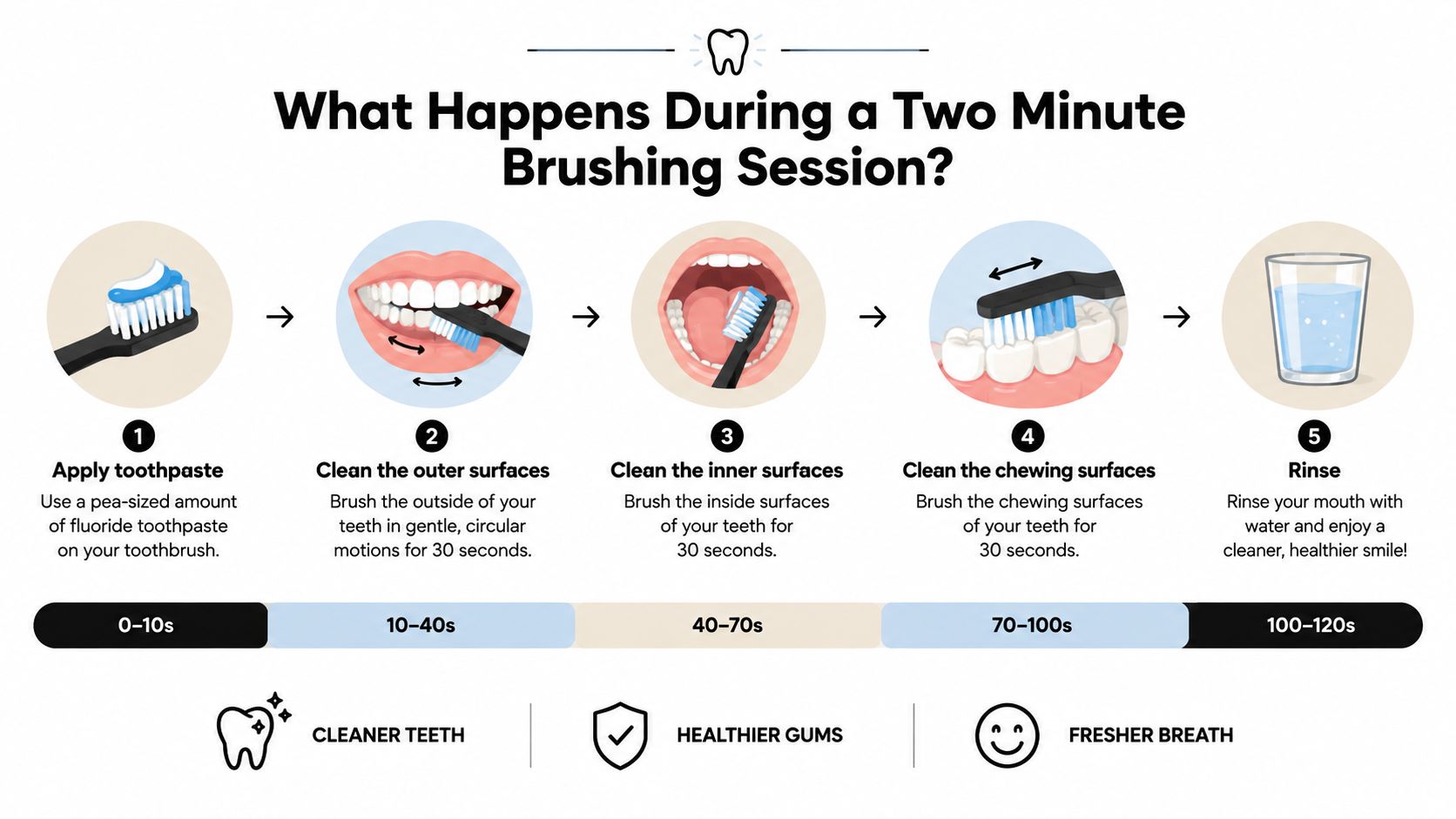
The ADA offers a simple way to divide the mouth: about 30 seconds per quadrant, or roughly 4 seconds per tooth across the whole mouth. The four quadrants are the upper right, upper left, lower right, and lower left. This mapping turns an abstract time goal into a coverage plan.
A practical quadrant pattern
During each 30-second block, move across the three major tooth-surface groups:
- Outer surfaces: Clean the side facing the cheek, moving from the back teeth toward the front and back again as needed.
- Inner surfaces: Turn your attention to the tongue-side surfaces, especially the lower front teeth, where a quick brushing pattern often misses.
- Chewing surfaces: Sweep across the grooves and ridges of the back teeth with controlled, light strokes.
You don't have to follow a perfect geometric route. The point is to prevent your attention from settling only on the visible front teeth. A session with 50 seconds on the front teeth and 10 seconds on the molars still reaches the two-minute total only if the remaining time is spent elsewhere, but it can leave important areas under-cleaned.
Plaque-removal research makes the cost of rushing clear. In a study cited by clinical sources, 45 seconds of brushing removed 26% less plaque than 2 minutes, while 30 seconds removed 55% less plaque than 3 minutes. Those figures come from plaque measurements, not direct long-term outcomes for cavities or gum conditions, so they don't promise a particular health result. They do show why compressed sessions can leave more biofilm behind. See the PubMed study record.
Let the difficult areas set your pace
Back molars, inner surfaces, and the gumline often need more concentration than smooth front surfaces. If your brush has a quadrant timer, use its prompts as reminders to move, not commands to abandon an area that still needs careful coverage.
A good two-minute session should feel unhurried. You aren't trying to scrub every tooth separately for an equal length of time. You're creating a repeatable route that gives neglected surfaces a fair chance to receive the same attention as the easy-to-reach ones.
Brushing Technique That Makes the Time Count
Two minutes of forceful scrubbing isn't a stronger version of two minutes of careful brushing. A soft-bristled brush and light pressure help you clean at the gumline without making the bristles bend aggressively or spread across neighboring surfaces.
Using a manual toothbrush
Hold the handle lightly, preferably closer to its end rather than gripping it tightly near the brush head. Angle the bristles at about 45 degrees toward the gumline, then use short back-and-forth movements or small circles over roughly two or three teeth at a time.
Move methodically across the outer, inner, and chewing surfaces. Let the bristle tips contact the area where each tooth meets the gum, but don't force them into the tissue. If the bristles splay quickly, your pressure is probably too heavy.
Clean the tongue gently at the end. It has a different texture from teeth, so use a light pass rather than vigorous scraping. The aim is to include the tongue in the routine without turning the final part of brushing into another hard-scrubbing session.
Using an electric toothbrush
An electric brush doesn't remove the need for a plan. Place the head against one surface, allow it to work for a few seconds, then move gradually to the next area. Cover the gumline, outer surfaces, inner surfaces, and chewing surfaces without pushing the head forcefully into the teeth.
Don't scrub back and forth as though you're using a manual brush. A powered head supplies the movement, while you supply the positioning and coverage. The Mouthology guide to using an electric toothbrush properly can help you refine that movement.
Gentle pressure is a technique, not a shortcut. It gives the bristles room to reach contours while reducing the temptation to compensate for missed areas by pressing harder.
If sensitivity makes brushing uncomfortable, a dedicated guide to gentle brushing for sensitive teeth offers useful technique reminders. The basic principle remains the same for both brush types: move slowly enough to cover surfaces, but gently enough to protect comfort and control.
When Two Minutes Might Not Be Enough
The two-minute standard suits routine brushing for many people, but mouths don't all present the same cleaning task. Braces, retainers, aligners, inflammation, heavy plaque, dry mouth, and dietary patterns can create extra surfaces or areas that need more attention.
The evidence also isn't perfectly uniform about a hard upper limit. The ADA associates two minutes with greater plaque reduction than one minute, while a 2025 review found that two minutes is moderately better than one minute for plaque. Other evidence suggests plaque-removal benefits may continue up to 3-4 minutes, so the appropriate duration can depend on what you're trying to clean and how well you can maintain gentle technique. The ADA home-care materials provide the broader context.
Match the routine to the situation
| Situation | Recommended Duration | Key Consideration |
|---|---|---|
| Routine adult brushing | 2 minutes | Divide time across all four quadrants |
| Braces, retainers, or aligners | Longer if needed | Clean around attachments, wires, and edges |
| Gum inflammation or periodontal maintenance | Longer if advised | Give careful attention to the gumline |
| Heavy plaque or dry mouth | Longer if needed | Slow down in areas that feel coated or difficult |
| Children developing coordination | About 2.5 minutes when needed | A parent may need to brush alongside or after the child |
| Tooth sensitivity | Gentle 2-minute session | Reduce pressure instead of extending aggressive scrubbing |
Orthodontic appliances can create additional edges and sheltered spaces, so a person with braces may need a longer session or a second pass with an interdental tool. A retainer or aligner can also change where residue collects. Your orthodontic or dental team can show you which surfaces deserve extra time.
People managing gum inflammation, healing after oral surgery, or periodontal maintenance should follow individualized instructions rather than choosing a longer session independently. A dental professional may recommend more time at the gumline, but healing areas may also require special handling.
Children often need help because coordination develops gradually. Brush alongside your child, then check or finish the routine until they can consistently cover every surface. Some families find that allowing about 2.5 minutes makes full coverage more realistic. For equipment upkeep, use this guide to learn when to change a toothbrush head.
Sensitivity belongs at the end of this decision. A calm, gentle two-minute session with a desensitizing toothpaste generally makes more sense than longer, harder brushing that increases discomfort. If sensitivity persists, ask a dental professional to assess it rather than trying to solve it with extra pressure.
Smart Ways to Time and Track Your Brushing
Many people don't deliberately choose a short brushing session. They stop when the routine feels finished. A timing cue removes that guesswork without requiring you to stare at a clock.
Electric toothbrushes often include pacers that buzz, pause, or change rhythm every 30 seconds. Use each signal to shift to another quadrant. The four-part pattern is simple enough for adults, and children can treat each cue as a small assignment rather than facing the entire two-minute routine at once.
Choose a cue you'll actually use
Manual brushers can place a small egg timer near the sink or use a phone timer with an audible signal. Keep the phone away from splashing water, and start the timer before brushing so you aren't checking the display mid-session.
Audio can work better than visual timing. Choose a song that lasts long enough for your brushing routine, or use a familiar audio track that gives you a consistent beginning and end. Don't select music that makes you rush through the difficult areas. The tool should pace you, not pressure you.
Habit anchoring makes timing easier to remember:
- Morning anchor: Brush after a fixed morning ritual, such as getting dressed or preparing coffee.
- Evening anchor: Pair brushing with skincare, setting an alarm, or another dependable bedtime action.
- Visual reminder: Place a small mirror sticker where you can see it before you leave the bathroom.
- Family routine: Let children brush while an adult follows the same timer, then check coverage together.
- Progress tracking: A smart toothbrush app can log sessions, flag rushed areas, and make consistency visible for families.
A dependable cue beats an accurate guess. The right tool is the one that fits your bathroom, your brush, and your daily rhythm.
For broader ideas about building evidence-backed daily routines, focus on repeatable cues rather than relying on motivation. If you use mouthwash, timing matters too. This guide explains when to use mouthwash before or after brushing, so it doesn't unintentionally disrupt the rest of your routine.
Putting It All Together for a Better Routine
A dependable routine combines four moving parts: duration, coverage, technique, and toothpaste habits. Two minutes twice a day gives you the structure. Dividing your attention across the mouth makes the structure useful. Gentle angled strokes help you clean the gumline without treating force as a substitute for precision.
Use the toothpaste recommended for your needs. The ADA pairs its two-minute guidance with fluoride toothpaste and a soft-bristled manual or powered brush, as described in its home oral-care flyer. The amount and what you do afterward also matter. Research found that increasing both brushing duration and toothpaste quantity improved fluoride retention and other measures, while a systematic review emphasized that duration alone doesn't capture the full effect of toothpaste use and rinsing. Explore the research on brushing duration, toothpaste quantity, and fluoride retention.
A simple daily checklist
Before you finish, ask yourself:
- Did I use a timer or another reliable pacing cue?
- Did I reach the outer, inner, and chewing surfaces?
- Did I angle the bristles toward the gumline?
- Did I use light pressure rather than aggressive scrubbing?
- Did I clean my tongue gently?
- Did I spit out excess toothpaste instead of rinsing vigorously?
- Did I leave the mouth undisturbed for 30 minutes before eating or drinking?
That last point belongs to the routine described here, but individual dental advice can differ. People using a fluoride-free product should follow its label directions and discuss toothpaste choices with a dental professional, especially when managing sensitivity, orthodontic appliances, or a higher risk of decay. Mouthology is one fluoride-free option that uses 10% nano-hydroxyapatite in its toothpaste formulations, but the most important outcome is choosing a product and routine you can use correctly and consistently.
A consistent ordinary session is more valuable than an occasional perfect one followed by skipped routines. Set your timer tonight, divide the mouth into four areas, and brush with enough patience to reach the gumline and back teeth. If your gums stay uncomfortable, your sensitivity persists, or you aren't sure whether you're cleaning around dental work effectively, book an appointment with your dentist or dental hygienist for personalized guidance.
Choose a two-minute timer that suits your routine, use it at your next morning and evening brushing sessions, and ask your dental professional to review your technique at your next visit.
