

Posted by Sarah Collins
on September 20, 2026

The right flavor is the one your child will use twice a day with the right amount of paste. In one study of 787 children ages 5 to 12, 50% wanted toothpaste to taste sweet while only 20% preferred minty, which helps explain why a mint battle at the sink can turn into a routine problem, not just a rough morning.
If you're standing in the bathroom with a child who clamps their mouth shut the second the mint tube comes out, you're not dealing with a small preference issue. You're making a long-term routine decision. Flavor doesn't replace good ingredients, supervision, or the right amount of toothpaste, but it often determines whether those things happen consistently at all.
Most parents don't need another list of cute toothpaste flavors. What helps more is knowing how to choose a flavor that improves cooperation without losing sight of the part that matters most: age-appropriate use.
Why Flavor Matters More Than Parents Realize
A lot of brushing trouble doesn't start with brushing. It starts with the first second the toothpaste hits the toothbrush.
The usual scene is familiar. You're trying to get everyone out the door. Your child sees the tube, says it's "too spicy," turns their head, and suddenly a task that should take two minutes turns into a full negotiation on the bathroom floor. Parents often read that as stubbornness. Sometimes it's just sensory rejection.
The real question isn't strawberry or mint
When this happens over and over, flavor stops being a fun extra and becomes a behavior lever. The better question is usually not, "Which kids toothpaste is healthiest?" It's, "Which one keeps this routine workable for the next few years?"
That shift matters because the protective value of toothpaste depends on use. A tube with strong ingredients doesn't help much if it sits in the drawer because your child refuses it. A child-friendly flavor, on the other hand, can lower friction enough that brushing happens before school and before bed without the daily standoff.
Practical rule: A toothpaste your child accepts and uses correctly is more useful than a theoretically perfect one they fight every day.
What parents often over-focus on
It's easy to get pulled toward front-of-box claims, cartoon branding, or whether a toothpaste sounds more "serious" because it tastes like adult mint. But young kids don't experience mint the way adults do. Many hear "fresh" and taste "burning."
That doesn't mean flavor is all that matters. It means flavor is often the first gate. If a child rejects the sensory experience, you never get to the part where the active ingredient, the brushing technique, or the timing can do their job.
A calmer way to think about flavored toothpaste for kids is this:
- Flavor supports participation. It can turn resistance into tolerance, or tolerance into willingness.
- Dosage protects safety. The amount on the brush matters more than making the flavor boring.
- Supervision closes the gap. Parents still control how much paste is used and how brushing happens.
That balance is where most families need help. Not because they're doing anything wrong, but because the toothpaste aisle makes this seem simpler than it is.
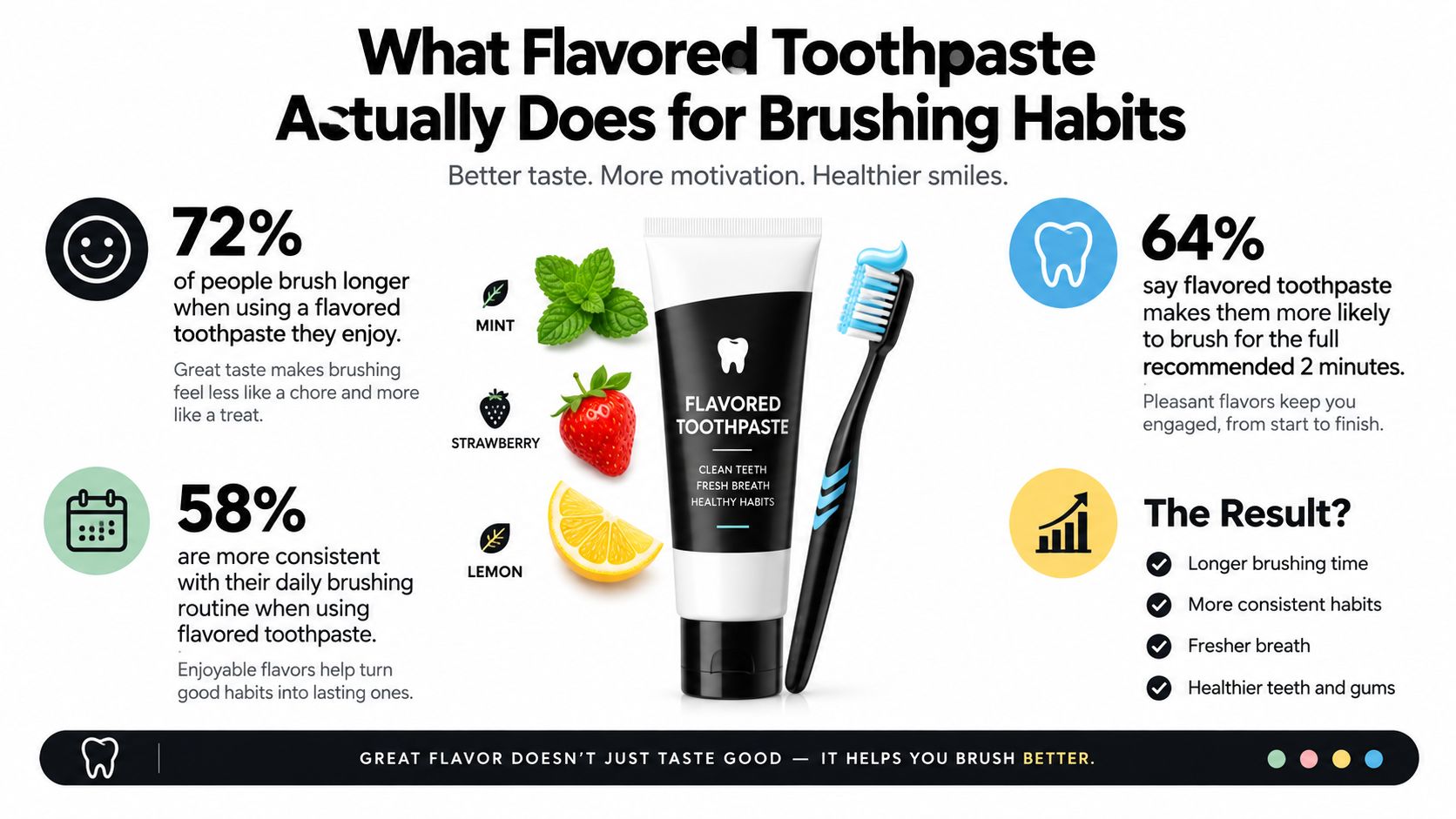
What Flavored Toothpaste Actually Does for Brushing Habits
Flavor doesn't clean teeth by itself. What it does is reduce the odds that brushing turns into a fight.
In a study of 787 children ages 5 to 12, 50% wanted toothpaste to taste sweet, 20% preferred minty, 14% sour, and 11% spicy. The same study found that 41% chose fruity smells and 23% chose sweet smells, pointing toward a strong preference for sweeter, fruit-like sensory profiles over adult-style mint (children's toothpaste flavor preference data).
Why kids respond differently to flavor
Children usually prefer milder, sweeter, fruitier profiles because they don't trigger the same sharp cooling sensation that mint often does. Adults may associate that cooling feeling with "clean." Kids often experience it as too intense.
That changes the brushing dynamic in a few practical ways:
- Less refusal at the start. A familiar fruit or dessert-style flavor removes the first objection.
- Easier handoff from parent to child. Kids are more willing to open, spit, and try again when the paste doesn't feel harsh.
- More routine stability. When brushing feels predictable, parents spend less energy negotiating.
What the behavior research suggests
One pediatric study found that children used a mean of 0.153 grams more dentifrice when it was flavored for children than when it was regular-flavored. The same study reported that the proportion using children's-flavored dentifrice rose from 40% at 9 months to 71% at 60 months, showing that taste can influence real brushing behavior in early childhood (AAPD study on flavored dentifrice use).
That doesn't mean you should pile more toothpaste on the brush. It means flavor has real behavioral weight, which is exactly why parents need to pair appealing taste with careful dispensing.
A good flavor doesn't just make brushing nicer. It makes brushing repeatable.
How to use that information at home
Different flavor categories tend to solve different problems:
- Fruity flavors often help younger brushers who reject mint on contact.
- Mild mint or low-intensity blends can work for kids who want a "big kid" toothpaste without the sting.
- Novelty flavors can help when a child gets bored and starts resisting a once-accepted routine.
- Very plain or lightly flavored formulas often suit sensory-sensitive kids who gag easily.
That's what flavored toothpaste for kids buys you. Not magic. Just fewer skipped sessions, less friction, and a much better shot at making brushing automatic.
What's Really Inside a Flavored Kids Toothpaste
A flavored kids toothpaste is usually doing two jobs at once. It has to protect teeth, and it has to be acceptable enough that your child will keep it in their mouth long enough to brush. That is why the ingredient list matters more than the flavor name on the front.
The easiest way to read the tube is to separate the formula into two buckets. One bucket affects cavity protection and enamel support. The other affects taste, texture, and whether brushing turns into a struggle.
The ingredients doing real work
Start with the active ingredient. That is the part with the dental purpose.
Some families use a fluoride toothpaste because fluoride helps strengthen enamel and prevent cavities. Others choose a fluoride-free formula with nano-hydroxyapatite, a mineral that shows up in newer remineralizing toothpastes. Those are different tools, so this is the first label line to check, especially if you are balancing a child who likes to swallow with a child who spits well.
After the active, the rest of the formula shapes how the toothpaste feels and cleans:
| Ingredient Category | Common Examples | Function | Parent Note |
|---|---|---|---|
| Active ingredient | Sodium fluoride, sodium monofluorophosphate, nano-hydroxyapatite | Supports enamel care and daily cavity-prevention routines | Match the active to your child's age, your dentist's advice, and how reliably your child spits |
| Abrasive | Hydrated silica, calcium carbonate | Helps remove debris and surface buildup | Everyday kids formulas should clean gently, not scrub like whitening pastes made for adults |
| Humectant | Glycerin, sorbitol | Keeps the paste from drying out | These ingredients help the paste stay soft and spreadable |
| Sweetener | Sorbitol, xylitol, sucralose, saccharin | Makes the paste taste pleasant without sugar | Sweet taste does not automatically mean sugar |
| Surfactant or foaming agent | SLS and alternatives | Helps the paste spread and foam | If your child complains that toothpaste "burns" or hates foam, check this line |
| Flavor and color | Fruit flavors, mint oils, natural or artificial colors | Improves acceptance | This is the part your child notices first, but it should not be the only thing you choose by |
That order matters. Flavor can get the brush in the mouth. The active ingredient is what makes the brushing count.
The ingredients mostly there for taste and feel
Parents often worry that a strawberry or bubblegum toothpaste must be sugary. In regular kids toothpaste, the sweet taste usually comes from non-sugar sweeteners and flavoring agents, not cavity-feeding sugar. The practical question is less "Is this flavor childish?" and more "Does this formula stay safe if my child still tends to swallow some of it?"
That is why flavored toothpaste should be judged like cough syrup with training wheels. The taste helps with cooperation, but the dose still matters. A child who uses a rice-sized smear of a fluoridated paste is in a very different situation from a child who loads the brush like frosting because the toothpaste tastes good.
If you want a clearer label-reading guide, this breakdown of children's toothpaste ingredients is a helpful companion.
How to read the label fast
At the store, ignore the cartoon first and scan the back in this order:
- Active ingredient
- Recommended age or use instructions
- Sweeteners and flavor profile
- Foaming and abrasive ingredients
That quick check gets you to the decision point. Choose a flavor your child will accept, then make sure the formula and the amount you dispense fit your child's age and habits.
Age-by-Age Rules for Flavor, Amount, and Supervision
You hand the brush to a two-year-old, they clamp their lips shut at mint, then happily open for strawberry. That feels like a flavor decision. It is, but only partly. The choice is how to use flavor to get cooperation without losing control of amount and supervision.
Age changes that balance fast. A toddler needs toothpaste managed almost like medicine in a tiny dose. A preschooler can start practicing brushing skills, but still needs a parent setting the amount. An older child usually has more say on flavor because the safety piece is less about taste and more about habits.
Under 3 years old
For children younger than 3, pediatric dental guidance recommends a smear or rice-sized amount of fluoridated toothpaste, with a parent doing the dispensing and brushing or closely guiding it (AAPD fluoride therapy guidance).
At this age, flavor is a cooperation tool, not the main event. A mild fruit flavor often works better than strong mint because toddlers react quickly to sharp tastes and new sensations. If a gentle flavor gets the brush in the mouth, that helps. The parent still controls the part that matters most, which is how much paste goes on the brush.
The CDC gives the same rice-sized recommendation for children younger than 3 and ties it to the fact that very young children are more likely to swallow toothpaste while brushing (CDC guidance on toothpaste amount for young children).
Ages 3 to 6
From ages 3 to 6, the amount increases to a pea-sized dab. Supervision still matters because children in this range are learning the full sequence of brushing, swishing, and spitting, and they are not consistent yet.
This is the age when parents often get fooled by the wrong question. The question is rarely "Which flavor is best?" The better question is "Which flavor keeps brushing calm enough that I can consistently use the right amount twice a day?" For a lot of families, that means strawberry, watermelon, bubblegum, or another soft, familiar flavor.
The American Dental Association advises parents to use only a pea-sized amount of fluoride toothpaste for children ages 3 through 6 and to supervise brushing so kids do not use too much (ADA guidance on fluoride toothpaste use in children).
If your family is still weighing fluoride, swallowing habits, and comfort level together, this guide to fluoride-free toothpaste for toddlers can help you compare options more clearly.
Age 7 and up
By about age 7, many children have better spit control and enough brushing experience to handle a wider range of flavors, including light mint, fruit, or mixed flavors. The decision point starts to shift. You are usually not trying to prevent obvious resistance anymore. You are watching for rushed brushing, sloppy technique, or the habit of squeezing out a long ribbon because it looks grown-up.
Parents can loosen supervision here without disappearing entirely. A quick look at the brush before they start and an occasional check on brushing time and coverage usually does more good than arguing over whether berry or mint is the more mature choice.
| Age Range | Amount | Active Ingredient | Best Flavor Types | Supervision Level |
|---|---|---|---|---|
| Under 3 | Rice-grain smear | Formula chosen to match age guidance | Mild fruit or very light flavor | Parent dispenses and brushes |
| 3 to 6 | Pea-sized amount | Formula chosen to match age guidance | Strawberry, watermelon, bubblegum, gentle fruit | Parent dispenses, child practices spitting |
| 7 plus | Follow product directions and family dental guidance | Formula chosen for age and cavity risk | Mild mint, berry-mint, fruit, preferred flavor | Check-ins and technique reminders |
The Swallowing Myth and What the Evidence Says
You squeeze out a kid-friendly strawberry toothpaste because it keeps the peace at the sink. Then a familiar worry pops up. If it tastes good, will your child swallow more of it?
That question sounds sensible, but it points many parents toward the wrong decision. The bigger safety issue is usually not the flavor itself. It is how much toothpaste gets on the brush, whether an adult is watching, and whether the child is developmentally ready to spit with some consistency.
As noted earlier, research reviews have not shown flavor alone to be the main driver of toothpaste ingestion. Younger children swallow more for a simpler reason. Brushing asks them to do several new things at once: hold liquid in the mouth, move the brush around, avoid gulping, and spit on cue. For a toddler or preschooler, that is a coordination task, not just a behavior choice.
What actually drives accidental swallowing
A useful way to picture it is this: flavor may affect whether a child accepts brushing, but dose determines how much can be swallowed. A brush with a small, age-appropriate smear leaves very little to accidentally ingest. A long ribbon of toothpaste creates a different situation, whether it tastes like bubblegum or mild mint.
That is why the most effective safeguards are practical ones:
- Use the right amount for your child's age. Too much paste on the bristles creates most of the problem.
- Dispense the toothpaste yourself. Kids tend to copy the oversized ribbon they see in ads and older siblings' routines.
- Teach spitting as a separate skill. Water practice can help before you expect clean brushing and clean spitting together.
- Keep the tube out of reach between brushings. Unsupervised squeezing and tasting matter more than whether the flavor is fruity.
When to pay closer attention
Pay closer attention if a child regularly licks toothpaste off the brush, asks for more because it tastes good, or gets into the tube outside brushing time. Those patterns deserve a routine fix, not panic. Usually that means tighter dispensing, closer supervision, and storing toothpaste where little hands cannot reach it.
If your child does swallow toothpaste beyond the small amounts that happen during normal learning, this guide on what to do if a child eats toothpaste gives a clear next step.
The safest flavored toothpaste for kids is the one that matches the child's age, uses the correct amount, and stays in an adult-managed routine.
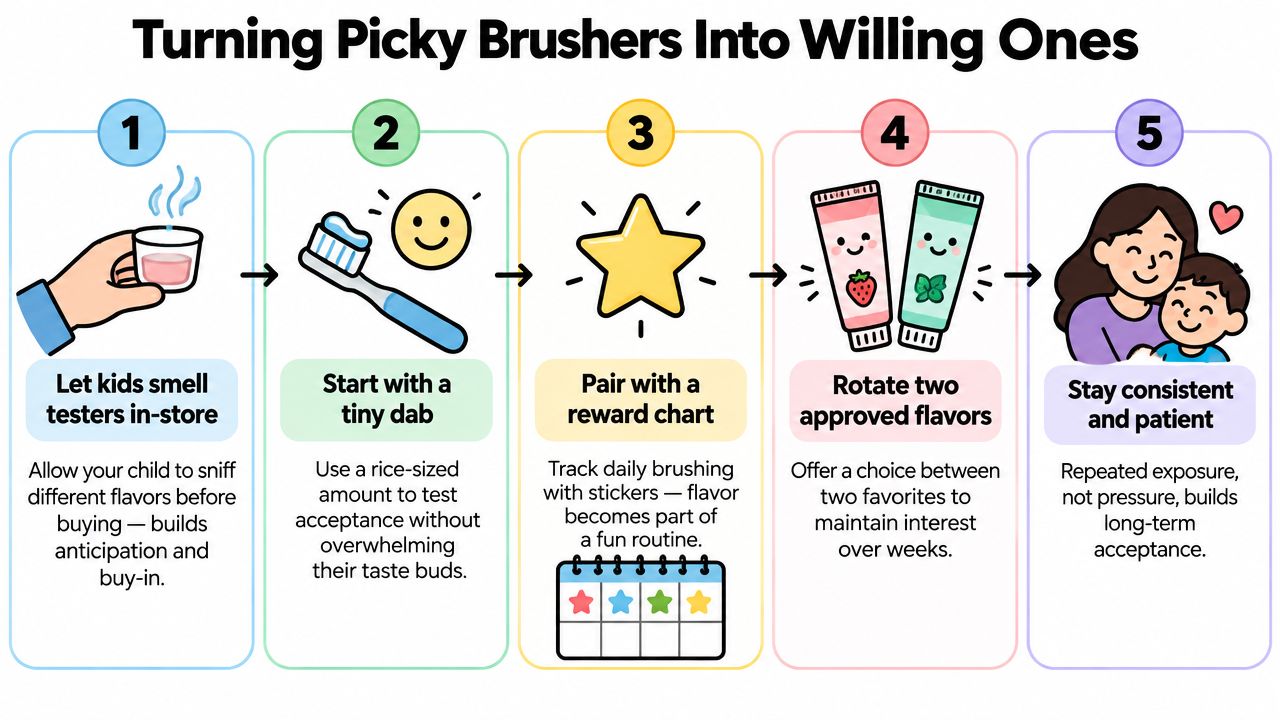
Turning Picky Brushers Into Willing Ones
When a child rejects every toothpaste you've tried, it helps to treat the problem like a fit issue, not a discipline issue.
Some kids hate strong taste. Some hate foam. Some don't like the smell before the brush even reaches their mouth. Once you know what they're reacting to, the fix gets simpler.
A lower-friction way to test flavors
Try making toothpaste selection feel smaller and safer.
- Offer two parent-approved options. A limited choice feels manageable and still gives your child ownership.
- Let them smell before they try. A quick sniff test can rule out flavors they'll reject on contact.
- Start with a tiny dab. Even if they're old enough for more, a test amount can help you check acceptance before a full brush.
- Rotate when boredom hits. Some kids do well with two familiar flavors alternated through the week.
Good options for sensory-sensitive kids
Kids who gag on mint or foam often do better with smoother, milder formulas. That can mean very lightly flavored pastes, low-foam options, or a mineral-based formula with a softer flavor profile.
If you're looking for one example in that category, Mouthology offers a kids toothpaste with 5% nano-hydroxyapatite in strawberry and watermelon flavors as a fluoride-free option for families who want a gentler-tasting routine.
The brush-along trick works better than lectures
Brush your own teeth next to them. Let them watch you spit. Let them copy the motions. A lot of brushing resistance softens when the task looks familiar instead of imposed.
A "Saturday flavor try" can help too. Not because toothpaste needs to become entertainment, but because a low-pressure trial moment often works better than introducing a new taste during the school-morning rush.
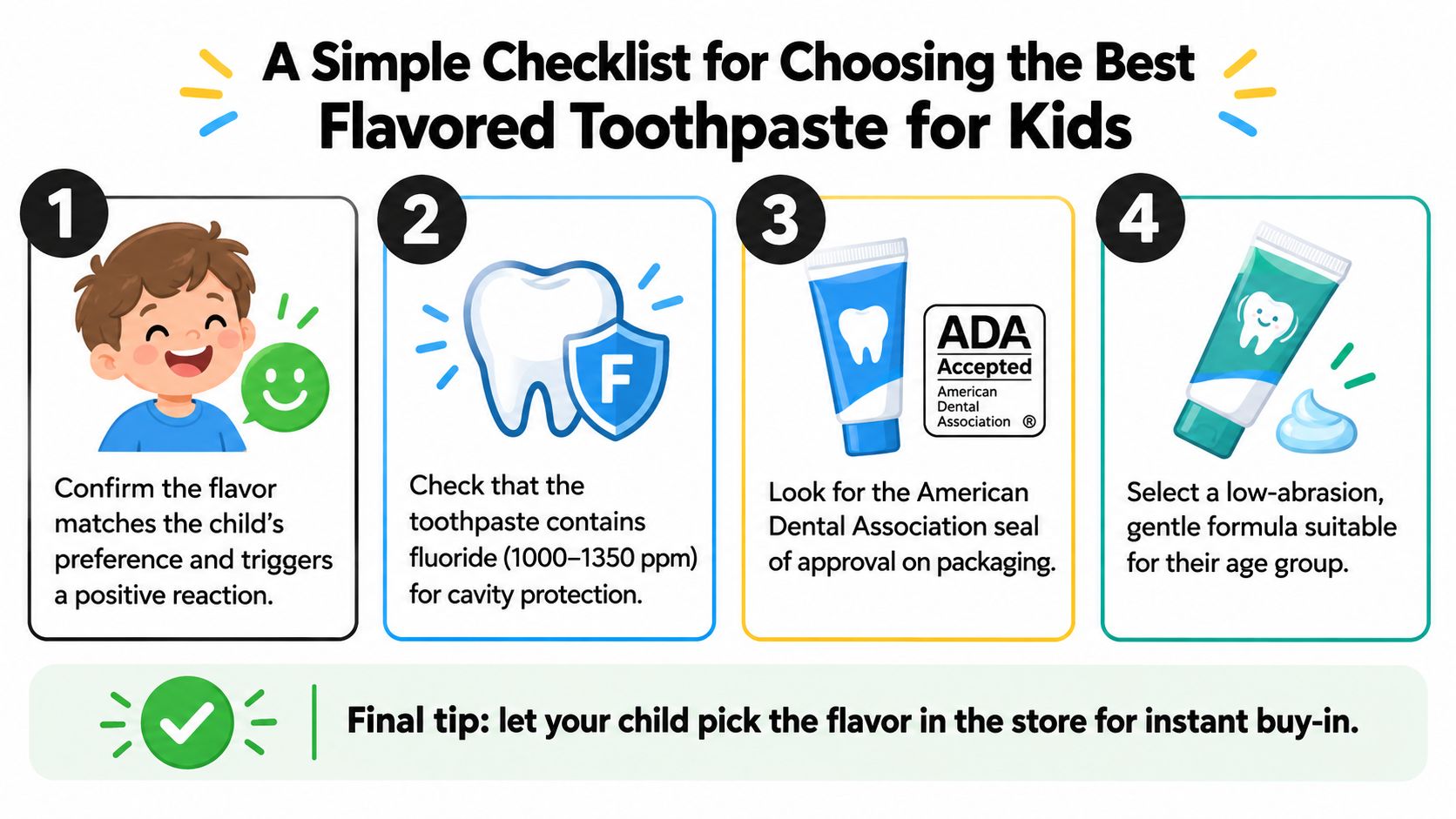
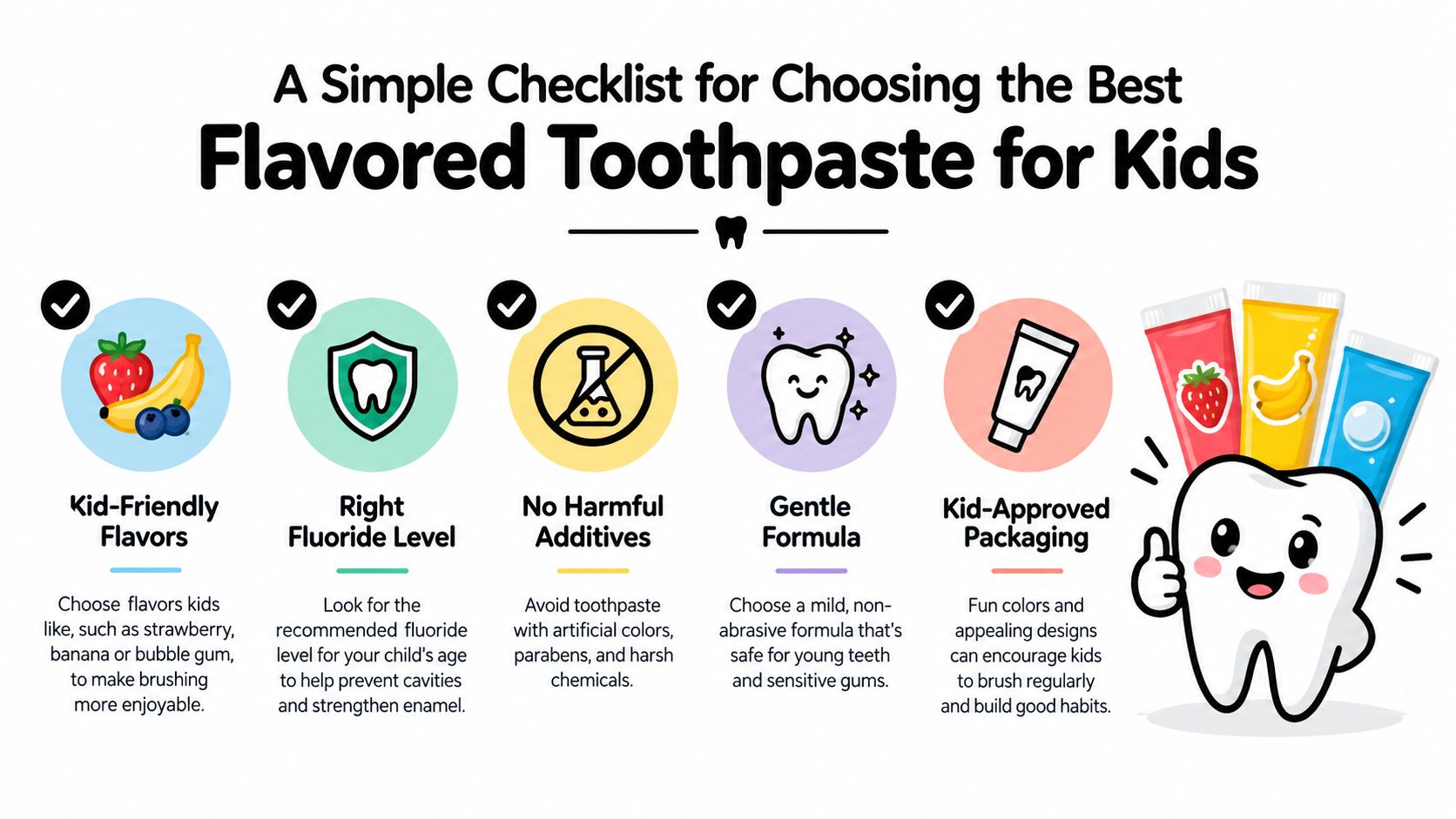
A Simple Checklist for Choosing the Best Flavored Toothpaste for Kids
At the store, I like a short checklist better than a long theory. If a tube passes these four checks, it's probably worth trying.
The four checks that matter most
-
Will your child actually use this flavor twice a day?
This is the first filter. A rejected toothpaste isn't helping anyone. -
Does the formula match your child's age and your family's preference?
The active matters, but so does using the right amount for your child's stage. -
Do the supporting ingredients look sensible?
Non-cariogenic sweeteners such as sorbitol are common. Harsh whitening formulas and adult-style intensity usually aren't what young kids need. -
Can you supervise how it's used?
A good tube still depends on an adult putting the right amount on the brush and watching the routine.
A few aisle shortcuts
Skip whitening toothpastes for young kids. Skip anything that seems built around adult freshness rather than child comfort. And if you want a second opinion while comparing options, this roundup on DentalHealth.com toothpaste for kids is a useful outside resource because it frames product choice around practical family use, not just branding.
One last point matters more than any flavor trend. The best toothpaste is the one your child will use consistently, in the correct amount, with you still paying attention.
Choosing flavored toothpaste for kids doesn't have to mean choosing between "fun" and "safe." Most of the time, the smarter question is simpler: which flavor makes brushing easy enough to happen every day, while the adults handle the amount, supervision, and routine? That's the upgrade.
