

Posted by Sarah Collins
on September 13, 2026

You're standing at the bathroom sink with a wiggly child, a toothbrush in one hand, and a toothpaste tube turned label-side up in the other. The front promises a fun flavor or a “natural” formula. The back offers a long list of words that seem equally important, yet it's hard to tell which ingredients support healthy teeth and which ones mainly make the paste smooth, stable, or pleasant to use.
Children's toothpaste ingredients make more sense once you stop reading the label as a list and start reading it as a design. Each ingredient has a job. Some help clean, some control texture, some support cavity prevention, and others make brushing tolerable for a child who would rather be anywhere else. The useful question isn't whether an ingredient sounds natural. It's whether the ingredient has a clear purpose, appears in an appropriate formula, and fits your child's age and brushing habits.
What Your Child's Toothpaste Is Actually Made Of
A children's toothpaste tube is a small chemistry system built around a very ordinary goal: helping a child brush twice a day. The formula has to stay stable in the tube, spread across the teeth, clean without feeling harsh, taste acceptable, and deliver its active ingredients where they're needed.
Start with water, which acts as the carrier for many other ingredients. Humectants, such as glycerin or sorbitol, hold moisture in the paste so it doesn't dry into a stiff plug. Binders and thickeners keep liquid and solid ingredients mixed together, while abrasives provide the gentle polishing action that helps lift plaque and surface debris.
The active portion may contain a fluoride compound, nano-hydroxyapatite, or another ingredient selected to support enamel. Some formulas also include xylitol, plant extracts, or mineral ingredients. Their usefulness depends on the complete formulation, not just their appearance on the front label.
A practical way to read the tube: Ask what job each ingredient performs before asking whether it sounds familiar.
Flavor systems and sweeteners deserve attention because children often swallow toothpaste or squeeze out too much when the taste is especially appealing. A mild flavor can support cooperation, but an exciting flavor shouldn't encourage treating toothpaste like food. Preservatives help prevent spoilage and keep the product usable throughout its shelf life.
The same architecture applies whether you're comparing a budget supermarket tube with a specialty product. You can also use a broader guide to clean ingredients from Momotaro Apotheca as a reference for how brands explain ingredient purpose and sourcing.
Think of the label as a set of working parts:
- Cleaning system: Abrasives remove plaque and surface residue.
- Texture system: Humectants, binders, and thickeners create a spreadable paste.
- Active system: Fluoride or mineral-based ingredients support enamel care.
- Experience system: Flavors, sweeteners, and foaming agents influence acceptance.
- Stability system: Preservatives help maintain the formula over time.
Once you identify those roles, a long INCI list stops looking like a warning sign. It becomes a recipe you can evaluate.
The Core Ingredient Categories Explained
The easiest way to understand children's toothpaste ingredients is to ask two questions repeatedly: What does this ingredient do? Why is it there?
Cleaning ingredients remove plaque without turning brushing into scrubbing
Hydrated silica and calcium carbonate are common abrasives. They help loosen plaque and surface debris while the toothbrush does the mechanical work. A child's paste should feel smooth rather than gritty, and parents should be cautious about formulas marketed mainly around whitening or aggressive polishing.
A useful label signal is the position of the abrasive in the ingredient list. If several polishing ingredients appear together, look at the product's intended age and claims rather than assuming more cleaning power is better.
Humectants control moisture and mouthfeel
Glycerin and sorbitol help toothpaste remain soft and squeezable. They also give the paste a smoother texture, which can matter to children who reject anything gritty, sticky, or overly foamy.
These ingredients don't provide the main cavity-prevention action. Their label signal is simple: they're usually easy to recognize, and their presence tells you the manufacturer is building a stable gel or paste rather than a dry powder.
Binders and thickeners keep the formula together
Ingredients such as xanthan gum, cellulose gum, and carrageenan help keep solids suspended and maintain consistency. Without this support, a tube could separate, become watery, or dispense unevenly.
Look for a complete ingredient list rather than a vague “proprietary blend.” Parents should be able to identify the texture-building ingredients by name.
Active ingredients are the reason the toothpaste exists
Fluoride may appear as sodium fluoride or sodium monofluorophosphate. Some fluoride-free formulas use nano-hydroxyapatite, a mineral designed to resemble part of tooth enamel. These actives belong to the functional core of the formula, so the package should make the active ingredient and age guidance clear.
Xylitol and other sweeteners may be included to improve taste. Xylitol is not the same as table sugar, but it still deserves careful storage because it can be dangerous to dogs if ingested.
Flavors and foaming agents affect cooperation
Mild fruit or mint flavors can make brushing easier. Foaming agents, including sodium lauryl sulfate in some formulas, help distribute the paste and create foam. Some children tolerate them well, while others prefer a low-foam formula.
The practical signal is your child's response. If the paste causes repeated discomfort or refusal, a different flavor or foaming profile may improve consistency.
Preservatives protect shelf stability
Sodium benzoate and other preservatives help limit microbial growth inside a water-based product. Their presence isn't automatically a problem. A tube that lacks a preservation strategy may have its own stability concerns.
| Ingredient Class | What It Does | Common Examples |
|---|---|---|
| Abrasives | Lift plaque and surface debris | Hydrated silica, calcium carbonate |
| Humectants | Hold moisture and improve texture | Glycerin, sorbitol |
| Binders | Keep ingredients evenly mixed | Xanthan gum, cellulose gum |
| Active ingredients | Support enamel and cavity prevention | Sodium fluoride, sodium monofluorophosphate, nano-hydroxyapatite |
| Sweeteners | Improve taste without using table sugar | Xylitol, sodium saccharin |
| Flavors and foaming agents | Make brushing more acceptable and distribute paste | Flavor oils, sodium lauryl sulfate |
| Preservatives | Help maintain shelf stability | Sodium benzoate |
How Fluoride Works in Children's Toothpaste
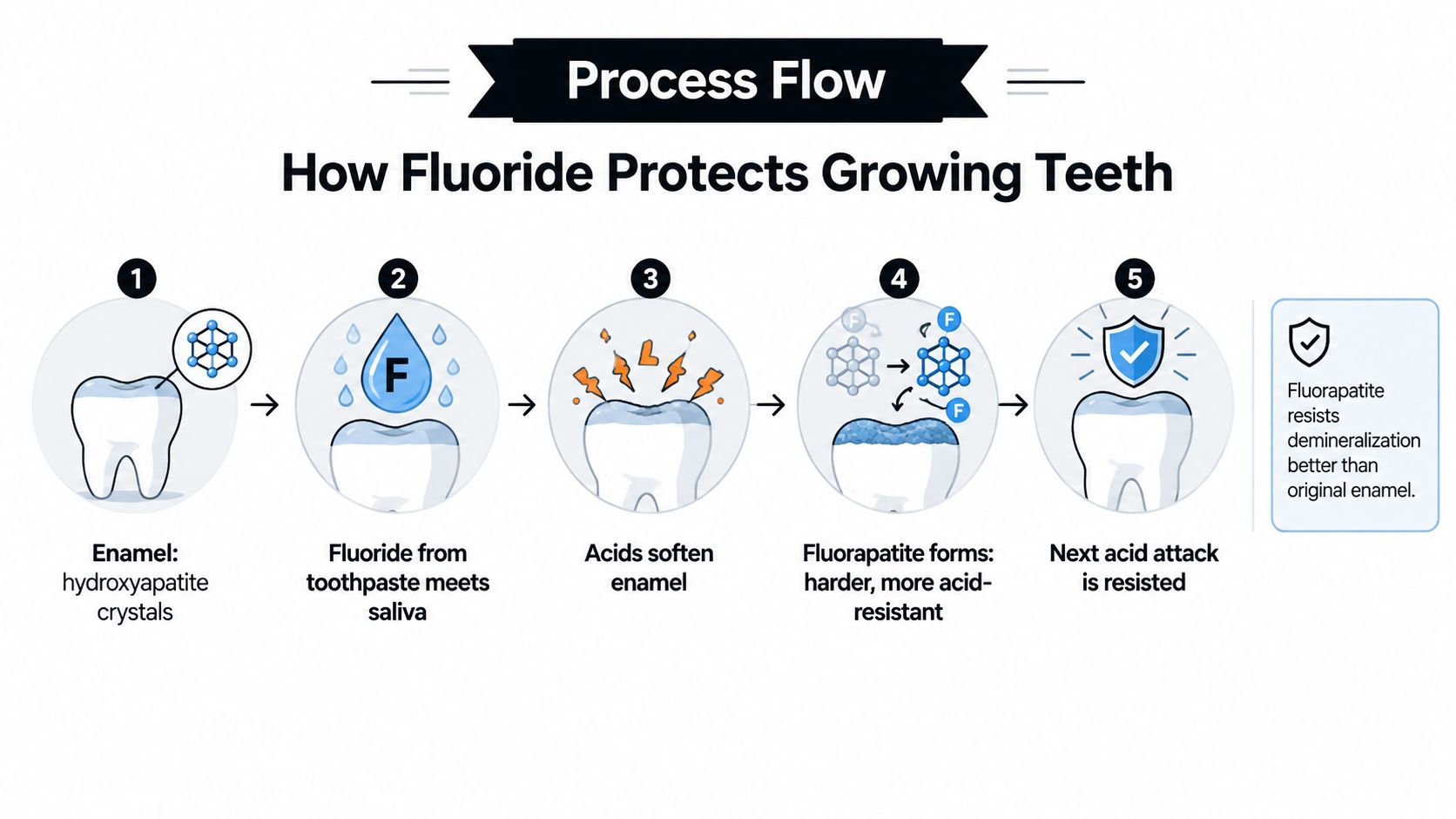
Fluoride works at the tooth surface, where enamel repeatedly encounters saliva, plaque, and acids produced when oral bacteria metabolize carbohydrates. In that environment, fluoride can become incorporated into the mineral structure of enamel and support the formation of fluorapatite, which is more resistant to acid-driven mineral loss than the original mineral.
The effect depends on contact. A toothpaste that contains fluoride but is swallowed immediately gives the tooth surface less opportunity to benefit than a product used with careful brushing and limited rinsing.
Concentration tells only part of the story
Pediatric guidance identifies 1,000 ppm fluoride as a typical twice-daily concentration for children, while the WHO-supported range described in AAPD material is 850 to 1,150 ppm fluoride for children's toothpaste formulations (AAPD fluoride therapy guidance). Some guidance allows standard consumer toothpaste formulations up to 1,500 ppm, with the child's age and dispensing amount determining how the product should be used (AAPD fluoride therapy policy).
Parents should also distinguish total fluoride from chemically soluble fluoride. The soluble portion is the part available to interact at the tooth surface, so a label or quality review that addresses only total fluoride may not tell the whole story. Regulatory and manufacturing decisions therefore need to account for the fluoride compound, its solubility, and the amount dispensed (review of children's toothpaste regulation).
The useful habit beats the impressive number: A fluoride toothpaste used correctly twice daily is more meaningful than a higher-concentration product used irregularly.
Brushing time still matters, but a child who uses the right amount consistently and avoids rinsing away all the residue is following the central preventive routine. Parents should follow the age-specific directions on the label and their child's dental professional's advice, especially when cavity risk or swallowing behavior is a concern.
Fluoride vs Fluoride-Free and Where Nano-Hydroxyapatite Fits
Fluoride has a well-established role in supporting enamel's resistance to acid. Pediatric guidance has therefore centered on fluoride toothpaste, careful dosing, and twice-daily brushing. Families may still choose fluoride-free products because they're concerned about swallowing, prefer a different ingredient philosophy, dislike certain flavors or textures, or want a mineral-based option.
Nano-hydroxyapatite, often shortened to n-HA, is a finely structured form of a mineral related to the material in teeth. It's used in some fluoride-free formulas as a biomimetic ingredient, meaning it's intended to resemble natural tooth mineral. It shouldn't be treated as a miracle ingredient, and the complete formula still matters.
The most sensible comparison is not “which ingredient wins?” It's “which formulation fits this child's risk, age, habits, and professional guidance?”
| Attribute | Fluoride, 1,000 to 1,500 ppm | Nano-Hydroxyapatite, n-HA | Fluoride-Free, no actives |
|---|---|---|---|
| Main role | Supports enamel resistance to acid | Provides a tooth-mineral-based approach to enamel care | Cleans teeth without a declared active |
| Ingestion consideration | Requires age-appropriate quantity control | Avoids fluoride exposure from the formula | Still requires supervision to prevent eating toothpaste |
| Label priority | Fluoride type, ppm, age directions | n-HA identity and stated concentration | Full ingredient disclosure and clear claims |
| Best discussion point | Cavity risk and pediatric guidance | Ingredient philosophy and formulation quality | Whether cleaning alone meets the child's needs |
| Family decision | Often selected when preventive fluoride guidance is central | Considered by families seeking a fluoride-free mineral option | Usually chosen for taste, preference, or training |
A child with high cavity risk should have the fluoride decision made with a pediatric dentist rather than through social media advice. A family considering n-HA can review the evidence, check the product's concentration and sourcing, and discuss whether it fits the child's routine. Mouthology's educational comparison of fluoride and nano-hydroxyapatite offers another perspective on the two formulation approaches.
Some households choose one active consistently. Others use different formulas at different times of day. Neither approach should replace professional guidance, proper brushing, attention to diet, or supervision when a child still swallows toothpaste.
Age-Based Dosing and Swallowing Safety for Parents
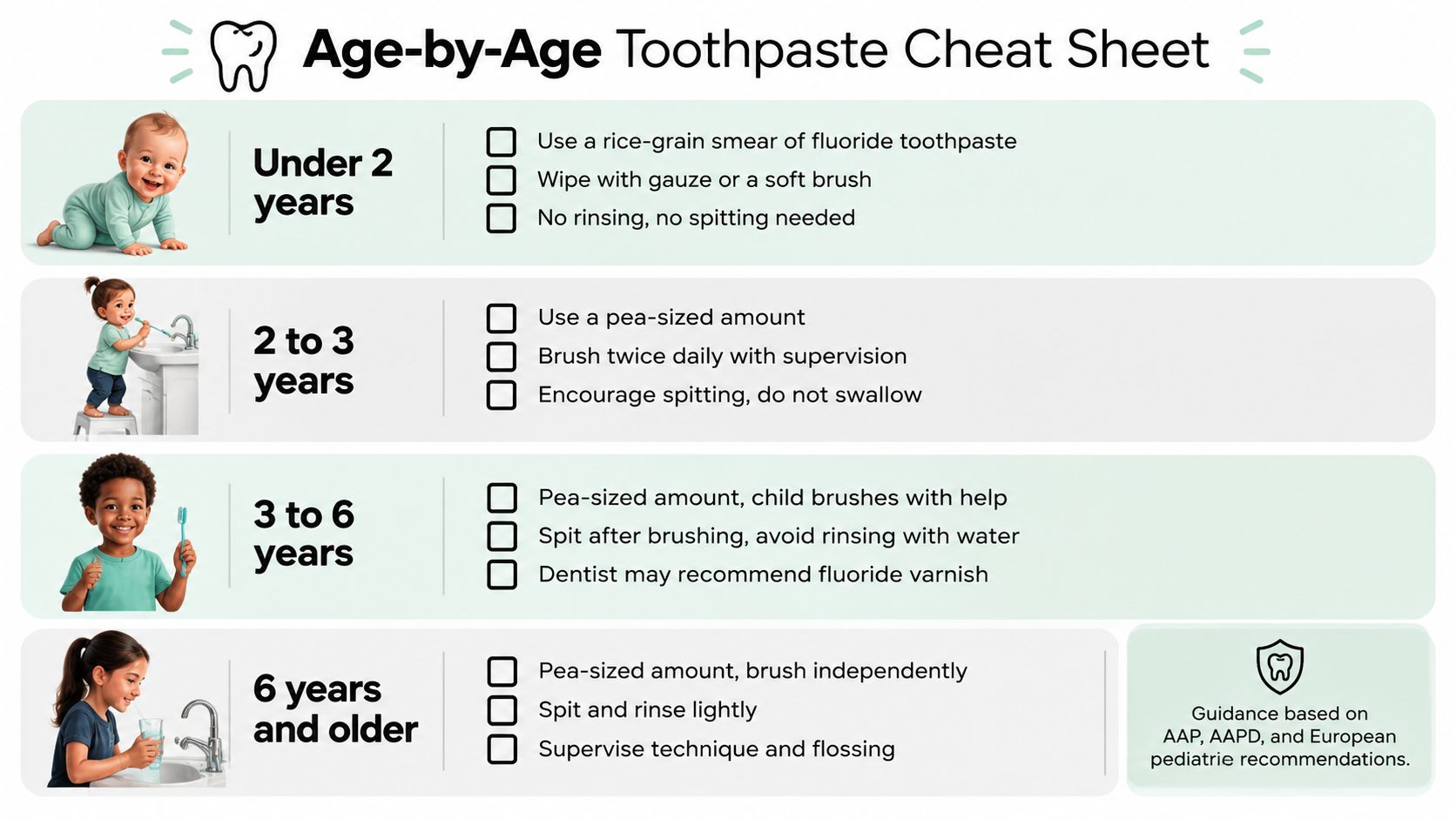
A child may squeeze a large ribbon of toothpaste onto the brush because the flavor is appealing. Quantity matters alongside the ingredient list. AAPD guidance recommends a smear or rice-sized amount of 1,000 ppm fluoride toothpaste for children younger than 3 years, and no more than a pea-sized amount for children ages 3 to 6 (AAPD fluoride-use policy). European pediatric guidance follows a similar age-based structure, recommending 1,000 ppm twice daily from the first tooth through age 6, then 1,450 ppm over age 6, with an amount of 0.5 to 1.0 g for older children (European Academy of Paediatric Dentistry fluoride guidelines).
Use the age bands as a starting point
- Younger than 2: Use a rice-grain or smear amount when fluoride toothpaste is recommended. An adult should place it on the brush and perform the brushing.
- Ages 2 to 3: Continue with a small, controlled amount and close supervision. Encourage spitting as the child develops the skill, while recognizing that rinsing behavior may still be inconsistent.
- Ages 3 to 6: Use no more than a pea-sized amount. Help the child brush thoroughly, then coach them to spit rather than rinse repeatedly.
- Over 6: Follow the product's age directions and the dental professional's advice. Children may manage more of the routine independently, but technique and toothpaste quantity still deserve occasional supervision.
AAPD material identifies about 0.1 mg fluoride in a rice-sized amount and about 0.25 mg fluoride in a pea-sized amount. It also discusses a likely toxic dose of 5.0 mg fluoride per kg of body weight. For everyday care, the practical task is preventing routine swallowing by controlling the amount and supervising brushing.
Bathroom rule: An adult dispenses the paste until the child can reliably control the amount.
“Spit, don't rinse” helps leave topical fluoride on the teeth for longer. If a child cannot yet spit, ask the child's dentist how to handle brushing, swallowing, and product selection. After a toothpaste-eating episode, what to do if a child eats toothpaste can help organize the next step.
Beyond the Safe or Not Question Judging Ingredient Quality
“Is this ingredient safe?” is often too blunt a question to guide a good purchase. A more useful evaluation looks at function, concentration, and interaction with the rest of the formula.
Some ingredients are functional. Fluoride, nano-hydroxyapatite, abrasives, and xylitol each serve a recognizable purpose, although their roles aren't interchangeable. Others, such as flavorings, colorants, and foaming agents, mainly shape the brushing experience.
Function comes first
A formula can include several active-sounding ingredients without giving every ingredient an equally important role. Fluoride and nano-hydroxyapatite may be complementary in some formulations, while a family may view both as unnecessary for a low-risk child. Xylitol may support taste and fit a broader oral-care philosophy, but it doesn't replace the need to evaluate the main active system.
Concentration changes the conversation. A named ingredient may have little practical effect when present in a small amount, while a flavor or detergent can be noticeable to a sensitive child even though it isn't the product's main active.
Watch the child, not just the marketing
Sodium lauryl sulfate is a useful example. It can help create foam and spread the paste, but some children find foaming formulas irritating. If a child repeatedly complains of burning, avoids brushing, or develops a pattern of refusing one particular paste, switching to a milder sensory profile may be reasonable.
The same principle applies to intense fruit flavors, strong mint, gritty abrasives, and very sweet taste systems. A formula that looks impressive on paper still fails its practical purpose if the child won't use it correctly.
Ask these questions:
- What is the ingredient meant to do?
- Is its amount or concentration disclosed?
- Does it add a distinct function, or duplicate another ingredient?
- Does my child tolerate the flavor, texture, and foam?
Ingredient quality is therefore contextual. Parents don't need to fear every unfamiliar name, but they should expect clear labeling and a formula designed for children rather than a smaller version of adult toothpaste.
Heavy Metals Sourcing and Contamination in Mineral-Based Formulas
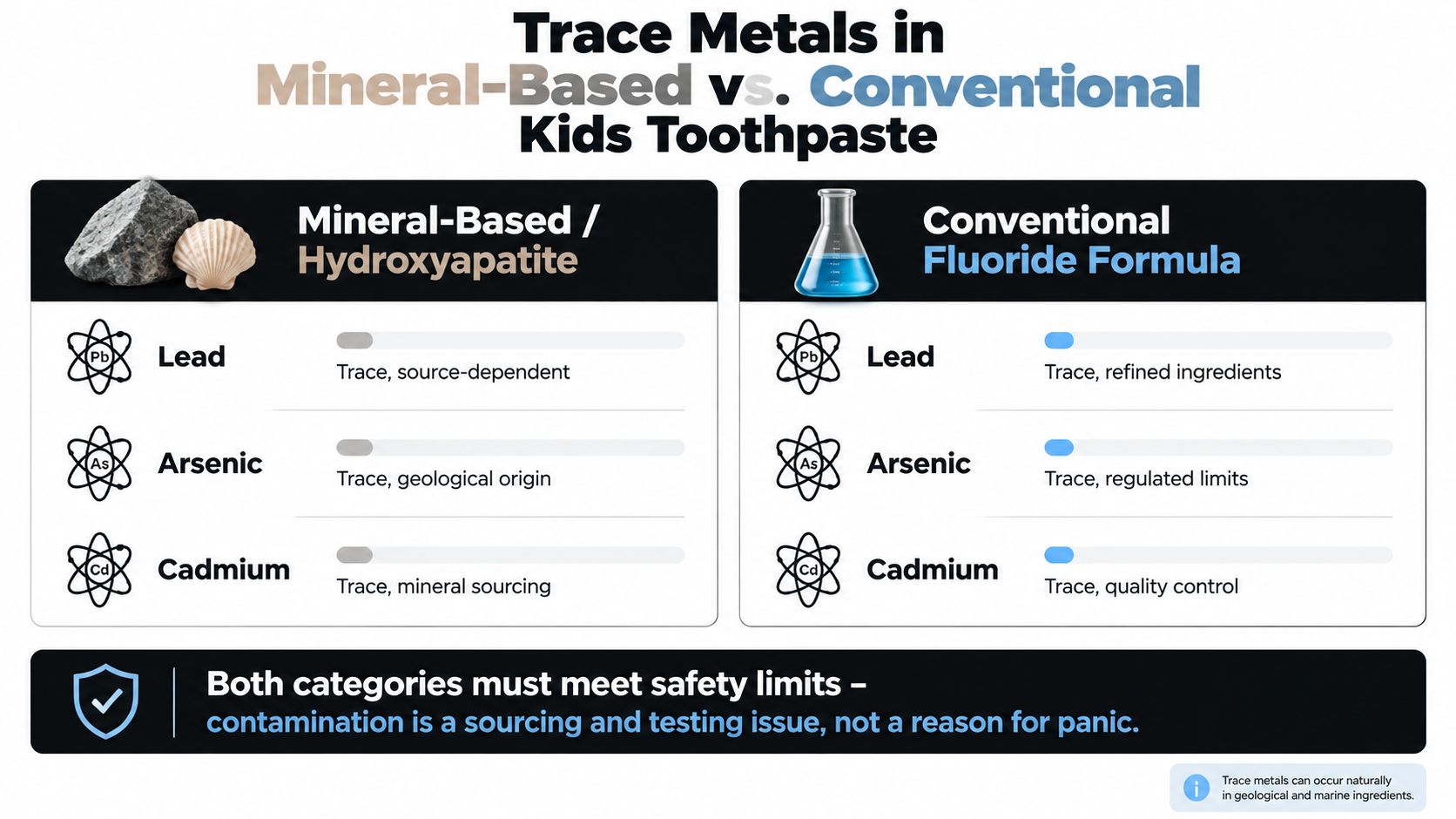
Mineral ingredients can raise a legitimate sourcing question because geological and marine materials may contain trace contaminants. Recent reporting has drawn attention to heavy metals in toothpaste, including concern around hydroxyapatite, calcium carbonate, and bentonite clay (Guardian reporting on heavy metals in toothpaste).
That doesn't mean every mineral-based toothpaste is unsafe. It means the manufacturer's purification process and testing transparency matter. Lead, arsenic, and cadmium are the contaminants parents are most likely to see discussed, and children's products deserve especially careful quality control because accidental swallowing is common.
Ingredient class changes the sourcing question
Calcium carbonate, bentonite clay, and other mineral abrasives may carry more source-dependent uncertainty than highly refined synthetic ingredients. Shell-derived materials and unrefined calcium sources also warrant questions about origin and purification. By contrast, a refined ingredient such as synthetic sodium fluoride or pharmaceutical-grade xylitol has a different sourcing profile, although every finished product still requires quality control.
The important distinction is between potential risk and documented contamination. A mineral ingredient isn't automatically problematic, and a conventional formula isn't automatically exempt from testing.
Before buying, look for:
- Third-party testing: Check whether an independent laboratory evaluates the finished product.
- Certificates of analysis: Ask whether the company can provide batch-specific documentation.
- Recognized grades: USP or pharmacopoeia-grade materials offer a clearer quality reference than vague “pure” language.
- Heavy-metal assays: Look for named analytes and actual testing information, not just “clean” or “non-toxic.”
- Traceability: A batch or lot identifier gives the manufacturer a way to connect the tube to production records.
Calm scrutiny is better than panic: Choose documented sourcing and testing when a formula relies heavily on minerals, and discuss active-ingredient choices with your child's dentist.
How to Read a Kids' Toothpaste Label Like a Pro
Ingredients are generally listed from highest to lowest weight, with ingredients below 1% allowed more flexibility in ordering. The active fluoride information may appear separately in a Drug Facts panel, so don't rely only on the INCI list when checking fluoride.
Use this four-question check:
- Is the active type and concentration clear? Look for the fluoride compound and ppm, or the stated mineral active and concentration.
- Are the abrasives suitable for the child's age? Be cautious with formulas emphasizing whitening or intense polishing.
- Are preservatives and flavor systems named? “Natural flavor” alone tells you little about the specific blend.
- Is there traceability? Check for age guidance, a lot or batch identifier, and accessible company information.
Claims such as “contains xylitol” describe an ingredient, not a guaranteed therapeutic outcome. “Mineral-rich” also lacks a universal meaning, so identify the actual minerals and ask how the company tests them. If you're unsure whether a product contains sugar or sugar-like sweeteners, this explanation of sugar in toothpaste can help you read the label more carefully.
Choosing the Right Toothpaste for Your Family
Start with the formulation philosophy: fluoride-based, fluoride-free with nano-hydroxyapatite, or another clearly disclosed option. Then match it to the child's age, cavity risk, swallowing habits, and the guidance of their dental professional.
Next, check the active concentration and dispensing instructions. Review the abrasive, flavor, foaming, preservative, and sourcing information. Finally, consider cooperation. A technically thoughtful formula isn't useful if the child refuses the taste or texture.
Mouthology is one fluoride-free option that lists nano-hydroxyapatite, xylitol, sorbitol, calcium carbonate, hydrated silica, and preservatives in its children's formula. Families should still compare the full label, follow age guidance, and discuss a switch with the child's dentist.
The strongest routine is the one a child can follow consistently. Technique, supervision, brushing frequency, and dietary habits all matter alongside the tube.
Quick Reference Card for Parents
Amount and age
- Under 3: Smear or grain-of-rice amount when fluoride toothpaste is recommended.
- Ages 3 to 6: Pea-sized amount, with adult help.
- Over 6: Follow the product and dental professional's directions, with supervision as needed.
- Every age: Brush twice daily and encourage spitting rather than repeated rinsing when appropriate.
Ingredient glossary
- Fluoride: Supports enamel resistance to acid.
- Nano-hydroxyapatite: Tooth-mineral-based active.
- Xylitol: Sweetener used in some formulas.
- Hydrated silica: Mild abrasive.
- Sorbitol: Humectant and texture aid.
- SLS: Foaming and dispersing agent.
- Titanium dioxide: Colorant or opacifying ingredient in some products.
- Parabens: Preservatives used in some formulations.
Red flags: Vague “natural” claims without a full ingredient list, missing fluoride ppm, undisclosed flavor systems, and mineral claims without testing information.
Before purchasing, ask: Does it match the child's age? Is the active amount clear? Is the full formula disclosed? Is quality testing documented? Confirm any major switch with your child's dentist.
Choose one tube tonight and read it from the back, not the front. Identify the active ingredient, check the age-based amount, review the abrasive and flavor system, and look for clear sourcing and batch information. If you're still uncertain, take a photo of the label to your child's next dental appointment and ask which formulation best fits their cavity risk and brushing habits.
