

Posted by Sarah Collins
on February 15, 2026

An enamel repair toothpaste works by delivering crucial minerals right where you need them—on the surface of your teeth. The goal is to reinforce weakened spots and bolster your smile’s natural defense system. It’s all about counteracting the daily wear and tear from things like acidic foods and drinks, essentially reinforcing your existing enamel to make it more resilient.
Understanding Your Smile's Natural Armor
Think of your tooth enamel as your smile's personal bodyguard. It’s this incredibly strong, thin outer layer that’s actually the hardest substance in your entire body—tougher than bone. Its main job is to shield the softer, more sensitive layers of your teeth from everything you throw at them.
Every single day, your enamel is up against a barrage of challenges:
- Acidic foods and drinks (like citrus, soda, and coffee)
- Sugary snacks that feed certain bacteria in your mouth
- Sudden temperature changes, like going from hot soup to ice cream
This constant exposure can pull essential minerals like calcium and phosphate right out of your enamel. This process is called demineralization, and it's a perfectly natural part of your mouth's daily cycle.
The Daily Tug-of-War in Your Mouth
Luckily, your body has its own built-in repair crew. Your saliva is working around the clock to neutralize those acids and put those lost minerals back onto your teeth. This natural rebuilding process is called remineralization.
A healthy smile all comes down to balance. When remineralization can keep up with demineralization, your enamel stays strong. But when demineralization starts winning the tug-of-war, your smile's armor begins to weaken.
This imbalance can happen if your diet is heavy on acidic or sugary foods, or if your brushing and flossing routine isn't quite cutting it. Over time, this net loss of minerals leads to the first signs that your enamel could use a little extra support.
Recognizing the Signals Your Teeth Send
When your enamel shield gets thinner, you might start noticing subtle changes. These are gentle nudges from your teeth that it's time to bring in some reinforcement.
Common signs of weakened enamel include:
- Sensitivity: That sudden, sharp twinge you get when you eat or drink something hot, cold, sweet, or acidic.
- Discoloration: As enamel thins, the yellowish dentin layer underneath can show through, making your teeth appear less bright.
- Transparency: You might notice the edges of your front teeth start to look a bit translucent or clear.
These symptoms are your cue that it might be time to upgrade your oral care. Understanding this foundational cycle is the first step toward proactively taking care of your smile. By choosing the right tools—like an effective enamel repair toothpaste—you can help tip the scales back in favor of remineralization and keep your smile’s armor strong for years to come.
How Enamel Repair Toothpaste Supports Your Teeth
So, how does an enamel repair toothpaste actually work? It’s less magic and more smart science, delivering key minerals directly to your tooth’s surface to help rebuild and strengthen weakened spots.
Think of your tooth enamel like a stone wall that’s been out in the elements for years. Over time, tiny cracks and pores start to form, making the whole structure a little less stable. An enamel repair toothpaste is like a specialized mortar, formulated with the exact materials needed to fill in those microscopic gaps and fortify the wall.
This reinforcement process is called remineralization. These toothpastes are designed to tip the daily balance in your mouth back in favor of repair, working against the mineral loss caused by acidic foods and drinks. The end goal is a stronger, smoother, and more resilient tooth surface.
The Two Primary Paths to Enamel Support
When it comes to the active ingredients that drive this repair process, there are two main approaches in modern oral care. Each one works a bit differently, but they both share the same goal: a stronger smile.
First, there’s the well-known method using fluoride. When you brush with fluoride toothpaste, fluoride ions are drawn to your tooth’s surface. There, they can bond with the calcium and phosphate already in your enamel to form a new, tougher crystal structure called fluorapatite. This new layer acts as a protective shield, making your enamel more resistant to future acid attacks.
The second is a modern, biomimetic approach using an ingredient called nano-hydroxyapatite (nHa). That might sound complicated, but the idea behind it is beautifully simple. Hydroxyapatite is the exact mineral that makes up over 95% of your natural tooth enamel. Using nHa is like patching a wall with the original stone it was built from.
This helps to visualize how your enamel acts as armor and how the remineralization process defends it against daily threats.
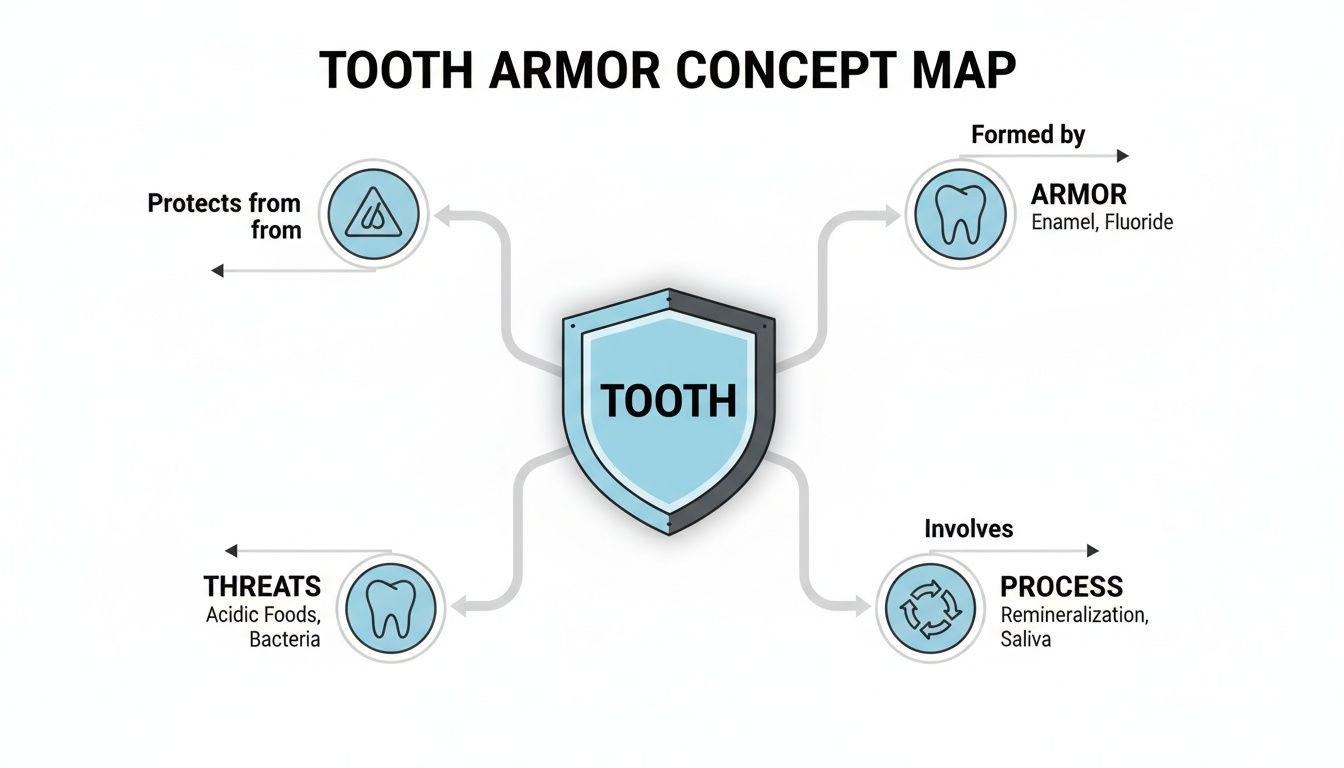
As you can see, fortifying your enamel armor is a direct response to the threats it faces every day, helping to maintain its strength and integrity.
How Nano-Hydroxyapatite Rebuilds Your Smile
Because nano-hydroxyapatite is "biomimetic"—meaning it mimics a natural biological material—it works in perfect harmony with your teeth. The "nano" particles are incredibly small, which allows them to get into the microscopic pores and weak spots in your enamel.
Once there, they bond directly with your natural enamel structure, filling in the gaps and rebuilding it from the inside out. This process doesn't just create a surface-level patch; it actually integrates with your existing enamel to make it more whole and solid.
The key takeaway is that nHa supports your enamel by providing the very building blocks it's made of. This approach not only strengthens the tooth but can also lead to a smoother, brighter surface and a noticeable reduction in sensitivity.
By understanding the "how" behind the results, you can feel more confident in your oral care choices. The science of your smile is all about supporting your body’s natural defense and repair mechanisms. This is crucial for addressing bigger issues before they start. While an enamel repair toothpaste can't fix existing cavities, it plays a vital role in the early stages of mineral loss, which is why learning how to reverse cavities in their initial phase is so important.
The Star Ingredients In Enamel Repair Toothpaste
When you pick up an enamel repair toothpaste, the science is really in the active ingredients. Two ingredients lead the conversation when it comes to strengthening enamel: the long-trusted fluoride and a modern, biomimetic powerhouse called nano-hydroxyapatite (nHa).
Let's break down how each one works so you can decide what feels right for your family.
Understanding the difference between these two isn't about pitting one against the other. It's about seeing how dental science has evolved to give us incredible options that work in harmony with our bodies.
Nano-Hydroxyapatite: The Biomimetic Building Block
Imagine you're fixing a crack in a historic brick wall. The best, most seamless repair would come from using the exact same type of brick the wall was originally built with. That’s the simple yet brilliant idea behind nano-hydroxyapatite (nHa).
Hydroxyapatite is the natural mineral that makes up over 95% of your tooth enamel. It’s literally what your teeth are made of. Nano-hydroxyapatite is just a tiny, lab-made version of this mineral, engineered into particles small enough to integrate directly into your existing tooth structure.
Because it’s biomimetic—meaning it mimics a material our bodies already use—nHa works with your teeth. It doesn’t just patch things up; it becomes part of the tooth itself, filling in microscopic pores and weak spots from the inside out.
This unique approach delivers some amazing benefits:
- Deep Remineralization: By supplying the exact mineral your enamel needs, nHa helps rebuild tooth structure where it's been lost.
- Serious Sensitivity Relief: A major cause of tooth sensitivity is exposed dentinal tubules—tiny channels that lead straight to the tooth's nerve. nHa particles are small enough to get in there and plug those tubes, helping to block the pathway for that painful zing.
- A Smoother, Brighter Surface: As nHa fills in all those microscopic imperfections, it leaves your teeth feeling noticeably smoother and looking brighter.
If you want to go even deeper, our guide on the benefits of nano-hydroxyapatite toothpaste breaks down everything you need to know about this game-changing ingredient.
Fluoride: The Protective Shield
Fluoride has been a staple in cavity prevention for decades, and for good reason. It works by creating a tough, protective shield over the surface of your teeth.
When you brush with fluoride, it interacts with the calcium and phosphate in your saliva and on your enamel to form a new, more resilient compound called fluorapatite.
Think of this as adding a coat of super-strong, acid-resistant paint over that brick wall. Fluorapatite isn't part of the original structure, but it creates a hard outer layer that makes the enamel much more resistant to acid attacks.
How The Two Approaches Compare
While both ingredients aim to strengthen teeth, their methods are fundamentally different. One works from the inside out by becoming part of the tooth, and the other works from the outside in by forming a protective layer.
For families looking for a fluoride-free option that's both effective and biocompatible, nHa is a compelling modern choice. Since it's a material native to our bodies, it's non-toxic and completely safe if accidentally swallowed—making it a worry-free option for kids and adults alike.
Nano-Hydroxyapatite vs Fluoride At a Glance
To make the comparison crystal clear, here’s a simple table breaking down how these two powerful ingredients stack up against each other.
| Feature | Nano-Hydroxyapatite (nHa) | Fluoride |
|---|---|---|
| Mechanism | Integrates directly into enamel, rebuilding it from within (biomimetic repair). | Forms a new, protective layer (fluorapatite) on the tooth surface. |
| Source | A synthetic version of the natural mineral that makes up your teeth. | A naturally occurring mineral found in water and soil. |
| Key Benefit | Remineralizes, reduces sensitivity by plugging tubules, and smooths the tooth surface. | Makes the tooth surface more resistant to acid attacks. |
| Biocompatibility | Highly biocompatible and non-toxic, as it's the same material as enamel. | Effective in small doses but can be toxic if ingested in large amounts. |
Ultimately, choosing the right enamel repair toothpaste is about arming yourself with knowledge. Understanding how ingredients like nano-hydroxyapatite work allows you to pick a product that aligns with your health values and provides effective, modern care for your family’s smiles.
Who Really Needs an Enamel Repair Toothpaste?
While pretty much everyone can benefit from stronger teeth, some people will notice the difference an enamel repair toothpaste makes almost immediately. It’s all about giving your smile’s natural armor the specific backup it needs to handle what you throw at it every day.
So, is it time to upgrade your daily routine? Let’s walk through a few scenarios where it can make a world of difference.
If You Deal With Tooth Sensitivity
Ever feel that sharp, sudden “zing” when you sip a hot coffee or bite into something cold? That’s a classic sign your enamel is calling for help.
Tooth sensitivity often happens when your protective enamel layer wears thin. This exposes tiny, fluid-filled tubes in the dentin underneath that lead straight to the tooth’s nerve. An enamel repair toothpaste with an ingredient like nano-hydroxyapatite works by physically plugging these tubes, blocking the pathway that triggers pain. For many people, this brings incredible relief and the freedom to enjoy their favorite foods again.
This isn't a niche problem, either. The demand for sensitive toothpaste—which is closely tied to enamel support—is skyrocketing. The market jumped from $1.93 billion to an estimated $2.14 billion in a single year and is on track to hit $3.18 billion by 2030. That’s a clear signal of just how many people are looking for a real solution. You can discover more insights about these dental care trends and their market impact.
If You Love Acidic Foods and Drinks
That morning coffee, a glass of orange juice, or even the vinaigrette on your salad can contribute to acid erosion over time. These everyday acids slowly soften and dissolve the mineral structure of your enamel.
Using an enamel repair toothpaste is the perfect counterbalance. It helps put back the minerals lost to these daily acid attacks, fortifying your teeth and making them tougher against future erosion. Think of it as sending in reinforcements for your smile’s front line.
It’s not about giving up the foods you love. It’s about giving your teeth the tools they need to stay strong in the face of modern diets.
For Parents and Expecting Mothers
When it comes to your family’s oral health, you want products that are both effective and unquestionably safe. This is where modern, biocompatible ingredients really stand out.
- For Kids: Parents are often searching for a fluoride-free option that’s safe if a little is accidentally swallowed. Toothpastes with nano-hydroxyapatite are a fantastic choice because nHa is the very same material teeth are made of, making it non-toxic and gentle for young brushers.
- For Expecting Mothers: Pregnancy can bring on all sorts of changes to oral health, and many moms-to-be are extra careful about using clean, non-toxic products. A biocompatible enamel repair toothpaste offers effective support without introducing any unwanted chemicals.
At the end of the day, if you're looking to proactively strengthen your teeth, finally get rid of sensitivity, or find a safe oral care solution for the whole family, an enamel support toothpaste is one of the smartest upgrades you can make to your routine.
How To Choose The Right Toothpaste For Your Family
Walking down the toothpaste aisle can feel overwhelming. Every box makes a bold promise, but finding an enamel repair toothpaste that actually works for your family is simpler than it seems. The secret is knowing what to look for. It's all about becoming a confident label-reader and understanding which ingredients truly build a stronger, healthier smile.
True confidence comes from looking past the flashy marketing on the front of the box and flipping it over to the ingredient list. A few key markers will tell you everything you need to know about a product's quality, safety, and effectiveness.
Check The Active Ingredient Concentration
This is the big one. The most critical factor in any enamel repair toothpaste is the concentration of its active ingredient. Whether it's nano-hydroxyapatite or fluoride, the amount matters—a lot. Not all formulas are created equal, and a higher, clinically-backed concentration almost always delivers better results.
For nano-hydroxyapatite (nHa), a concentration of 10% is widely considered the gold standard in clinical studies. This robust percentage ensures there are enough biomimetic particles to patch up microscopic weak spots in your enamel, fill tubules, and dial down sensitivity. Always check the packaging to see if a brand is transparent about its nHa percentage.
Say No To Harsh Foaming Agents
That rich, bubbly foam you associate with clean teeth? It often comes from an ingredient called sodium lauryl sulfate (SLS). While it creates the sensation of cleaning, SLS is a harsh detergent that can be a troublemaker for many people.
SLS is known to contribute to issues like canker sores, gum irritation, and dry mouth. Opting for an SLS-free formula is a gentler choice for the whole family, especially for those with sensitive mouths.
A great toothpaste doesn't need aggressive sulfates to do its job. Modern formulas use milder, often plant-derived, surfactants that clean your teeth beautifully without causing irritation.
Prioritize A Clean and Biocompatible Formula
Your mouth is one of the most absorbent parts of your entire body, so what you put in it really matters. A top-tier enamel repair toothpaste should have a clean, purposeful ingredient list, free from unnecessary fillers, artificial colors, and harsh chemicals.
Look for a formula that is:
- Biocompatible: The ingredients work with your body's natural biology, not against it. This is especially true for an ingredient like nHa, which is literally the same mineral your teeth are made of.
- Free from Parabens and Phthalates: These are preservatives you're better off avoiding in products you use every single day.
- Family-Safe: A non-toxic formula gives you peace of mind, particularly if you have little ones who might accidentally swallow some toothpaste while they're learning to brush.
Choosing a product with a clean ingredient deck is a win for your oral health and your overall wellness. If you're exploring different options, learning about the best fluoride alternatives you can use can offer even more clarity.
Look For Trusted Formulation and Manufacturing
Finally, take a moment to consider where and how the toothpaste is made. Products that are formulated by dental professionals and manufactured in regulated facilities offer an extra layer of trust and quality assurance. A brand that proudly states it is "dentist-backed" or "made in the USA" is often held to a higher standard of safety and efficacy.
Making an informed choice is about aligning a product's formula with your family's health values. By checking for these key factors, you can confidently pick an enamel repair toothpaste that actually delivers on its promises. For more insights from dental professionals, check out Our Guide To Toothpastes.
Getting The Most From Your Brushing Routine
Choosing a high-quality enamel repair toothpaste is a fantastic first step, but the real magic happens in how you use it. Your daily technique can either supercharge its remineralizing power or, quite literally, wash it right down the drain.
By making a few small tweaks to your routine, you can ensure those powerful ingredients get the time they need to work. Think of it like a nourishing face serum—you wouldn't apply it just to wash it off a second later. The goal here is maximum contact time between your enamel and ingredients like nano-hydroxyapatite.
Fine-Tuning Your Brushing Technique
It's easy to fall into the habit of aggressive, back-and-forth scrubbing. While it might feel like you're cleaning better, this can actually do more harm than good, especially if your enamel is already vulnerable. A gentler approach is far more effective for cleaning your teeth and protecting your gums.
To get the most out of every session:
- Use Just a Pea-Sized Amount: You don’t need a huge ribbon of toothpaste covering the bristles. A small, pea-sized dab has more than enough power to get the job done right.
- Brush Gently in Circles: Hold your toothbrush at a 45-degree angle to your gums and use soft, circular motions. This technique is brilliant for lifting plaque without wearing down your enamel.
- Take Your Time: The American Dental Association recommends brushing for a full two minutes, twice a day. It's not a race. Set a timer on your phone to make sure every tooth gets the attention it deserves.
The Most Important Tip: Spit, Don’t Rinse
If you make only one change to your routine, let it be this: spit out the excess toothpaste, but do not rinse your mouth with water afterward.
Rinsing with water immediately after brushing washes away all the beneficial minerals, like nHa, before they have a chance to bond with your enamel. By simply spitting, you leave a concentrated layer of these powerful ingredients on your teeth to continue their repair work long after you’ve put your brush down.
This simple habit dramatically increases the effectiveness of your enamel repair toothpaste, allowing it to fortify your teeth for hours.
Habits That Support a Stronger Smile
Your brushing routine is the main event, but a few complementary habits can create an even healthier environment in your mouth. Think of these as the supporting cast for your star performer—your toothpaste.
To round out your routine for long-term oral wellness, consider adding these simple practices:
- Daily Flossing: Brushing is great, but it can't reach between your teeth where plaque loves to hide. Flossing once a day is crucial for getting rid of that hidden debris and keeping your gums healthy.
- Use a Tongue Scraper: A surprising amount of bacteria lives on your tongue. Using a scraper each morning can help reduce bad breath and remove buildup for a cleaner feeling.
- Be Mindful of Acids: After having acidic foods or drinks like coffee, soda, or citrus, wait at least 30 minutes before you brush. This gives your saliva time to neutralize the acids and reharden your temporarily softened enamel.
Common Questions About Enamel Health
Even with a solid grasp of how enamel repair works, it’s completely normal to have a few questions floating around. Feeling confident in your oral care choices is everything, so let's tackle some of the most common things people ask about strengthening their smile.
Can Enamel Repair Toothpaste Reverse Cavities?
An enamel repair toothpaste is your first line of defense. It’s fantastic at reinforcing weakened enamel and can even support the reversal of the very earliest stage of mineral loss—that little white spot you might see—before a real cavity has a chance to form.
But once that weak spot progresses into a physical hole, that's a full-blown cavity. This is structural damage that toothpaste alone can't fix, and it definitely requires a trip to your dentist. Think of your toothpaste as the best tool for keeping enamel strong and resilient, helping to stop problems before they start.
How Long Until I Notice a Difference?
Everyone’s teeth are different, but many people report feeling a real drop in tooth sensitivity within just two to four weeks of consistent, twice-a-day brushing. That nagging twinge from a cold drink can be a huge source of discomfort, and understanding what causes tooth sensitivity to cold is a great first step in managing it.
As for the deeper structural benefits, like creating a stronger, smoother tooth surface? That’s happening on a microscopic level. These benefits build up over time with long-term use, helping to maintain that healthy enamel shield day in and day out.
Is Nano-Hydroxyapatite Toothpaste Safe For Kids?
Yes, absolutely. Nano-hydroxyapatite (nHa) is widely considered one of the best and safest choices for children.
The real magic of nHa is that it's biocompatible—it's the exact same mineral that teeth are already made of. This means there’s no toxicity risk if a little bit gets swallowed, which is a key difference from fluoride-based toothpastes.
This makes it a go-to, worry-free option for parents who want effective oral care for the whole family without any of the usual concerns.
Does This Toothpaste Replace My Dentist Visits?
Not a chance. Using a great enamel repair toothpaste is a critical part of your daily home care, but it’s designed to complement your professional dental care, not replace it.
Nothing beats regular check-ups and cleanings for catching issues you can't see yourself and for maintaining your overall oral health. Think of your toothpaste as your trusted partner for keeping your smile strong between those essential professional visits.
Ready to give your family’s smiles the science-backed, biomimetic support they deserve? Discover how Mouthology’s 10% nano-hydroxyapatite toothpaste can help build stronger enamel, reduce sensitivity, and deliver that dentist-clean feeling every day.
