

Posted by Sarah Collins
on February 12, 2026

Can you reverse a cavity? Yes—but only in its earliest stage, before an actual hole forms in your tooth. Think of it as hitting the brakes on tooth decay and giving your body’s natural repair crew the support it needs to rebuild and strengthen your enamel.
The Constant Battle Inside Your Mouth
It might sound a little dramatic, but your teeth are in a constant state of tug-of-war. This ongoing cycle involves two key processes: demineralization and remineralization. Getting a handle on this dynamic is the first step to understanding how you can help stop a cavity before it truly takes hold.
Demineralization is the process where acids attack your tooth enamel. When you eat sugary or acidic foods, certain bacteria in your mouth produce acids as a byproduct. These acids strip away essential minerals like calcium and phosphate from your enamel—the hard, protective outer layer of your teeth. This weakens the enamel, making it soft and porous.
But your body has a built-in defense mechanism: remineralization. This is the natural repair process where your saliva, the unsung hero of oral health, constantly bathes your teeth in those same lost minerals. It works to replenish the weakened enamel, making it strong and resilient again.
A cavity doesn't just show up overnight. It's the result of the battle tipping in favor of demineralization for too long.
The White Spot Lesion: Your First Warning Sign
Long before a cavity becomes a hole you can see or feel, it starts as a white spot lesion. This chalky, flat white area on your tooth is a clear visual sign of demineralization. It’s your enamel sending out an SOS, telling you it has lost significant mineral content, even though the surface is still intact.
This is your window of opportunity. At this stage, the damage is often reversible because the underlying structure of the enamel hasn't collapsed yet. If you can shift the balance back toward remineralization, you can help your body rebuild this weakened area.
Key Takeaway: Reversing tooth decay is an option primarily when it's a "white spot lesion." Once the enamel breaks open and a physical hole forms, the tooth can't regrow that lost structure on its own. That's when you'll need a dental filling.
This isn't just a theory; it's a well-documented process. A long-term study that followed people from age 9 to 23 found that these early, non-cavitated lesions have a remarkable ability to heal. In fact, 72% of the early lesions found at age 9 had actually regressed to a healthier state by age 13, proving our bodies are well-equipped to manage initial decay if we give them the right support.
Knowing When You Need a Dentist
Catching tooth decay early is everything. If you notice any changes, it’s always best to get a professional opinion. Knowing the subtle indicators is crucial for intervening while reversal is still on the table. You can learn more about the early signs of tooth decay to stay ahead of any potential issues.
To give you a clearer picture, it helps to see how decay progresses and what your options are at each point.
Understanding the Stages of Tooth Decay
This table breaks down the different phases of decay, from the reversible early stage to the more advanced stages that need professional intervention.
| Stage of Decay | What It Looks Like | Can It Be Reversed at Home | Recommended Action |
|---|---|---|---|
| Stage 1 White Spots | Chalky, white spots on the enamel. No pain or sensitivity. | Yes. This demineralization stage is considered reversible. | Enhance oral hygiene, adjust diet, and use a remineralizing toothpaste. |
| Stage 2 Enamel Decay | The white spot may turn light brown as the enamel continues to weaken. | Unlikely. The surface may be close to breaking. | Consult a dentist immediately. Minimally invasive treatments may be possible. |
| Stage 3 Dentin Decay | A visible cavity (hole) has formed. You may feel sensitivity or mild pain. | No. The enamel structure is broken. | A dental filling is required to remove the decay and restore the tooth. |
| Stage 4 Pulp Damage | Decay reaches the soft inner pulp of the tooth, often causing significant pain. | No. The damage is extensive. | Professional treatment, such as a root canal, is necessary to save the tooth. |
Ultimately, learning how to reverse early tooth decay starts with recognizing that crucial first stage and taking decisive action to support your body's powerful, natural healing abilities.
How Remineralization Rebuilds Your Enamel
Think of your body as having a built-in, 24/7 dental repair service. The star of that show? Your saliva. It's not just water—it's a mineral-rich solution constantly bathing your teeth in the good stuff they need to stay strong: calcium and phosphate. This whole process is called remineralization, and it's how you can stop early-stage cavities dead in their tracks.
Every time you eat or drink something sugary or acidic, your enamel loses some of those crucial minerals. That’s demineralization. Remineralization is the comeback story—it's your body's way of depositing those minerals back onto the tooth's surface, patching up weak spots before they become full-blown cavities. But for this to work, your mouth needs a steady supply of the right materials.
Supercharging Your Natural Repair System
While saliva does a pretty good job on its own, modern science has found ways to give this natural process a serious boost. The goal is to deliver a concentrated dose of the exact minerals your enamel is made of, right where you need it most. This is where a key ingredient comes in, one designed to work in perfect sync with your body’s own biology.
Meet nano-hydroxyapatite (nHA), a genuine game-changer in oral care. It sounds complicated, but the idea is actually quite simple. Hydroxyapatite is the very mineral that makes up about 97% of your tooth enamel and 70% of your dentin. Nano-hydroxyapatite is just a lab-created, particle-sized version of that exact mineral.
Because nHA is biomimetic—meaning it perfectly mimics a substance already in your body—your teeth recognize it as their own. When you brush with a toothpaste containing nHA, these tiny particles get to work instantly, bonding directly to your enamel.
This direct bonding action allows nano-hydroxyapatite to fill in the microscopic pits and fissures on the tooth's surface—the very spots where demineralization begins and cavities start to form.
It’s a bit like fixing a pothole. You wouldn't just sweep some sand into it; you’d use fresh asphalt to create a strong, seamless patch. In the same way, nHA doesn't just cover up weak spots. It integrates right into the enamel structure, replenishing lost minerals and rebuilding it from the outside in.
The Science Behind a Stronger, Smoother Smile
The power of nano-hydroxyapatite isn't just talk; it's backed by solid research. For example, a 2019 review published in the journal Molecules concluded that nano-hydroxyapatite has remarkable remineralizing effects on early enamel lesions. By providing a rich source of calcium and phosphate ions, it effectively reverses the demineralization process.
Here’s a quick look at how this powerful ingredient shores up your enamel:
- Mineral Replenishment: It delivers the essential building blocks directly to weakened areas of enamel, helping restore its density and hardness.
- Surface Smoothing: By filling in those microscopic imperfections, nHA creates a much smoother tooth surface. This not only gives your teeth a glossier look but also makes it harder for plaque and bacteria to get a foothold.
- Sensitivity Reduction: Tooth sensitivity often comes from tiny, open tubules in the dentin that lead to the tooth's nerve. Nano-hydroxyapatite plugs these tubules, offering lasting relief from zings of pain from hot, cold, or sweet foods.
This all creates a positive feedback loop. A stronger, smoother enamel surface is naturally more resistant to future acid attacks, making it less likely for demineralization to take hold again. It’s a proactive approach that doesn't just fix today's problem but also fortifies your teeth against tomorrow's challenges.
Using a toothpaste with a high concentration of this ingredient, like Mouthology's 10% nano-hydroxyapatite formula, gives you a powerful, daily tool to support your body’s remineralization efforts. It’s a smart, fluoride-free way to help maintain the structural integrity of your smile, ensuring your enamel has everything it needs to repair itself and stay resilient.
Your Daily Action Plan for Stronger Teeth
Knowing that you can actually rebuild your enamel is one thing, but putting that knowledge into practice is where you'll see real results. The key is to build a daily routine that consistently supports remineralization, creating an environment where your teeth can heal themselves. This isn't about adding a dozen complicated new steps; it's about tweaking your current habits to make them far more effective.
The goal is simple: shift the balance in your mouth away from one that helps acid-loving bacteria thrive to one that actively helps minerals get back into your teeth. A solid daily routine is also the foundation for powerful natural strategies to prevent cavities before they even start. It’s the small, consistent things you do every day that add up to a strong, resilient smile.
Upgrade Your Brushing Technique
It turns out how you brush matters just as much as how often you brush. The right technique clears away plaque without damaging your enamel or gums, while also giving those powerhouse remineralizing ingredients a chance to do their job.
First things first, switch to a toothpaste designed to support enamel health. A toothpaste with a high concentration of nano-hydroxyapatite is a game-changer because its key ingredient can supply the minerals needed for remineralization directly to the weak spots on your teeth. When you brush, think gentle, circular motions with a soft-bristled brush, and give a little extra attention to the gumline where plaque loves to accumulate.
Here's a pro tip: Brush for a full two minutes, twice a day. When you're finished, spit out the extra foam, but don't rinse with water right away. Leaving a thin layer of that mineral-rich toothpaste on your teeth gives ingredients like nHA more contact time to absorb and get to work.
Reduce the Bacterial Load
Cavities are caused by acid. That acid is produced by bacteria. It's a simple equation, which means a huge part of your daily plan should focus on cutting down the number of harmful bacteria in your mouth. One of the most effective—and most overlooked—tools for this is a tongue scraper.
Your tongue is covered in tiny grooves that are a perfect hiding place for bacteria. A quick scrape every morning physically removes that buildup. The immediate benefit is fresher breath, but the long-term win is a lower concentration of the specific bacteria that produce enamel-destroying acids. It’s a 10-second habit that makes a surprisingly big impact.
This simple visual breaks down the powerful process of enamel repair. It shows how creating the right conditions allows your body's own defenses, like saliva, to rebuild and fortify your teeth.
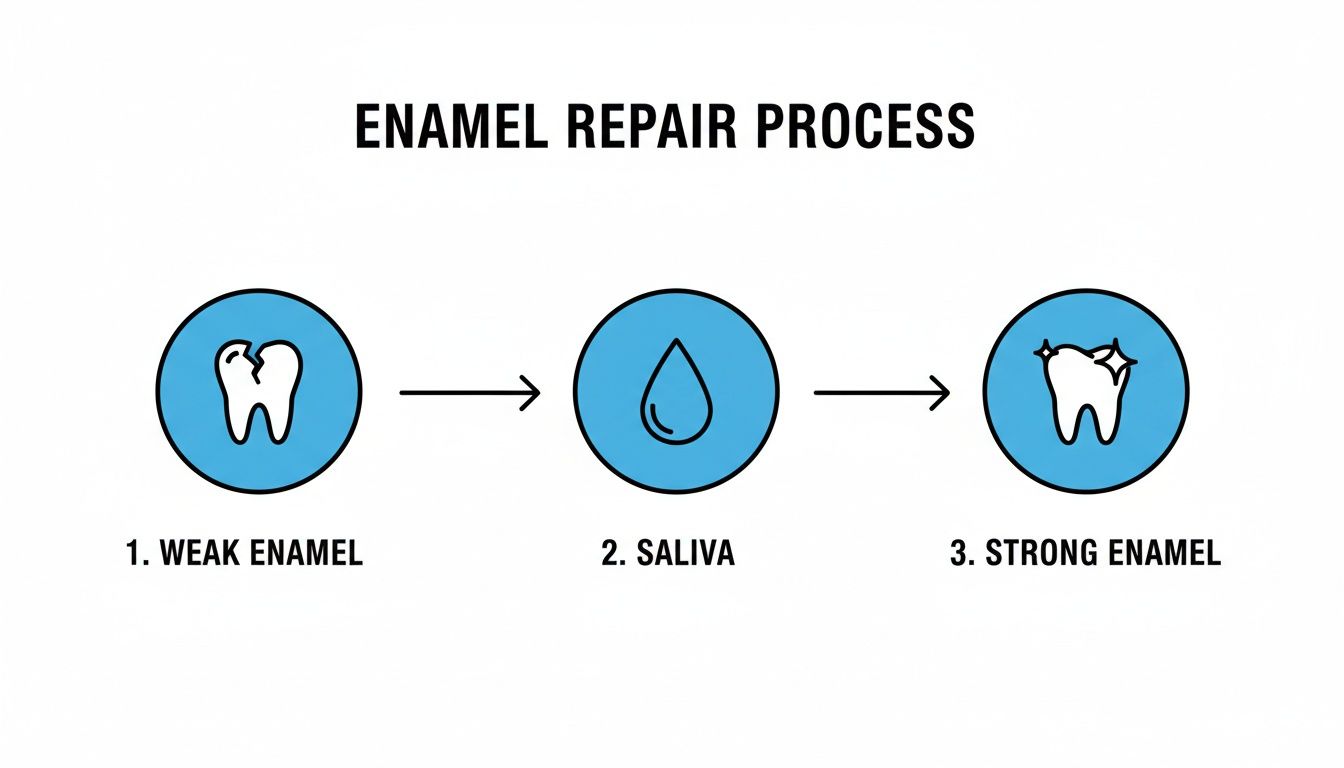
As you can see, your saliva is your best friend here. When the environment is right, it can effectively deliver minerals to turn weak spots back into strong, healthy enamel.
Create the Ideal pH Environment
The final piece of your daily routine is managing your mouth's pH. Acid-producing bacteria do their worst damage in a low-pH, acidic environment. Your mission is to keep your oral environment as close to neutral—or even slightly alkaline—as possible.
Here are a few easy ways to do this every day:
- Rinse with Water: After eating or drinking something sugary or acidic (like coffee or soda), just swish with plain water. It helps neutralize the immediate acid attack and washes away leftover particles.
- Use a pH-Balancing Rinse: Some mouth rinses are specifically formulated to balance oral pH. This makes your mouth a much less friendly place for bad bacteria and a better place for remineralization.
- Chew Sugar-Free Gum: Popping a piece of gum with xylitol after a meal is a great move. The chewing stimulates saliva—your body’s natural acid buffer—and xylitol helps starve harmful bacteria.
When you combine smart brushing, reducing bacteria, and maintaining a healthy pH, you've created a powerful daily protocol. This consistent approach is what gives your teeth the absolute best chance to remineralize and stay strong for the long haul. You can learn more about nano-hydroxyapatite toothpaste and how it supercharges a remineralizing routine. These simple habits are truly the foundation of lasting oral health.
How Your Diet Fights or Fuels Tooth Decay
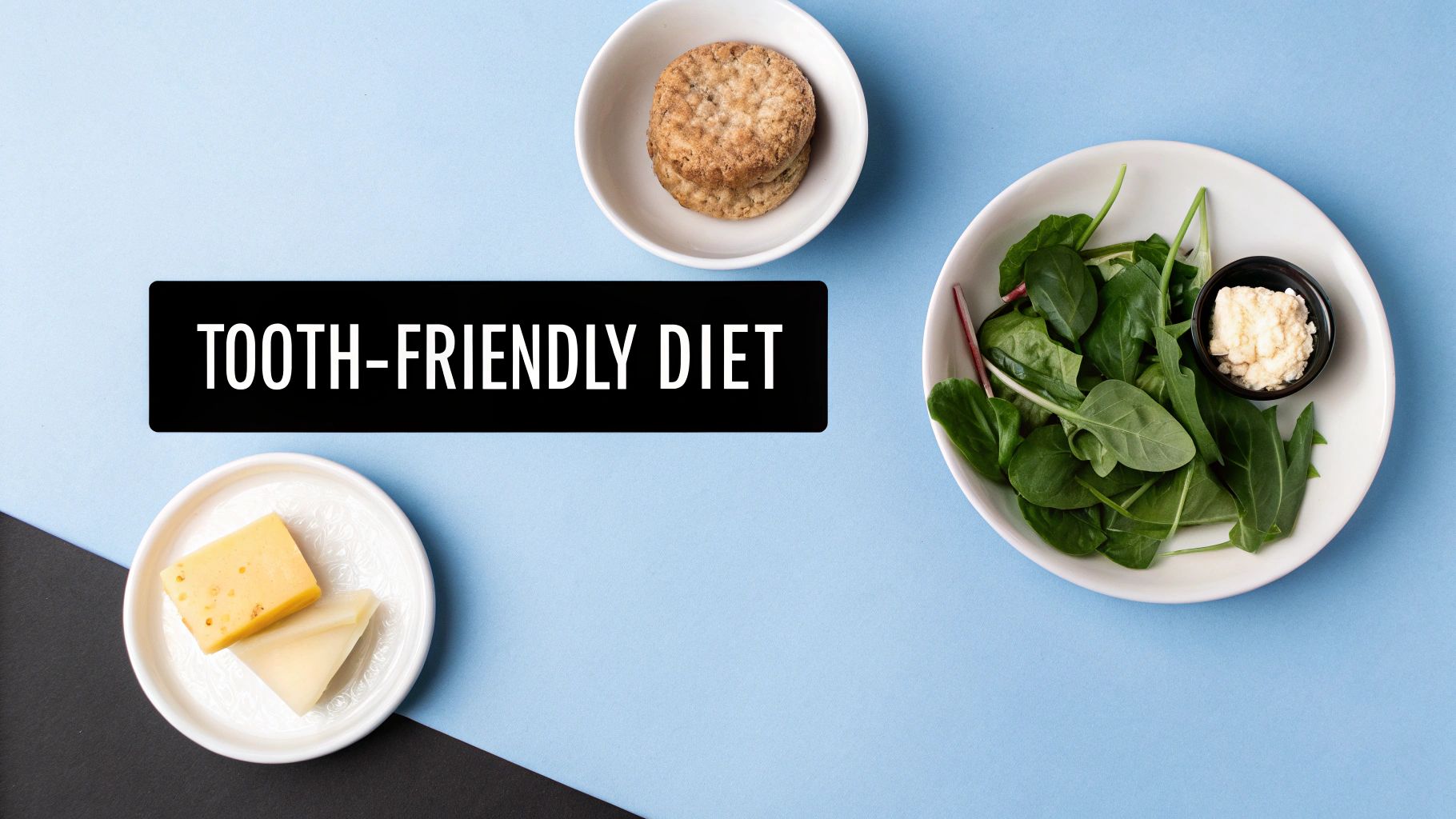
While a great oral care routine sets the stage for remineralization, what you eat throughout the day plays an equally important starring role. Every meal and snack can either fuel the acid-producing bacteria that cause decay or provide the minerals needed to rebuild strong, resilient enamel.
Think of it this way: your brushing routine is the repair crew, but your diet provides the building materials. Without the right supplies, even the most dedicated crew can’t get the job done. This is why a tooth-friendly diet is a cornerstone of halting decay in its tracks.
The Foods That Weaken Your Enamel
The main culprits behind demineralization are foods high in sugars, starches, and acids. When bacteria in your mouth feast on sugars and simple starches—from soda and candy to crackers and chips—they churn out acids that attack your enamel for at least 20 minutes after you finish eating.
A few key offenders to watch out for:
- Sugary Drinks and Snacks: Sodas, sports drinks, and juices are a double-whammy, bathing your teeth in both sugar and acid. Sticky candies or pastries are just as bad because they cling to your teeth, prolonging the acid attack.
- Starchy, Processed Foods: Things like potato chips, crackers, and white bread break down into simple sugars almost immediately. They also tend to get stuck in the grooves of your molars, giving bacteria a long-lasting food source.
- Highly Acidic Foods: While often healthy, items like citrus fruits, tomatoes, and some vinaigrettes can directly erode enamel. The goal isn't to avoid them entirely but to eat them as part of a meal to buffer their effects.
The real problem isn't just a single sugary treat; it's the frequency of exposure. Sipping on a soda all afternoon is far more damaging than drinking it with a meal because it creates a constant state of acidity in your mouth.
This acidic environment stops your saliva from doing its job—remineralizing your teeth—and tips the scales in favor of decay.
Building a Tooth-Friendly Shopping List
The good news is that so many delicious foods actively support your remineralization efforts. These foods work by providing the minerals your teeth need, neutralizing harmful acids, and stimulating saliva flow to naturally rinse your mouth.
Here’s what to load up on:
- Rich in Calcium and Phosphorus: These are the primary building blocks of your enamel. Dairy products like cheese, plain yogurt, and milk are fantastic sources. For dairy-free options, look to tofu, canned salmon, and almonds.
- Packed with Vitamins: Vitamins are crucial for absorbing calcium and maintaining healthy gums. Leafy greens like spinach and kale are loaded with minerals, while fatty fish and mushrooms provide vitamin D, which is essential for putting calcium to work.
- Crunchy and Hydrating: Foods with high water content—think celery, apples, and carrots—act like natural toothbrushes. The crunching scrubs away plaque, and all that chewing stimulates saliva, your body’s best defense against acid.
Making smart swaps is an easy way to start. Instead of reaching for crackers, try a handful of nuts. Instead of a sugary sports drink, rehydrate with water. These small changes make a huge difference in the acid load your teeth face all day.
Family-Friendly Swaps for Stronger Smiles
Shifting your family’s diet doesn’t have to be a battle. The key is making simple, appealing swaps that don't feel like a sacrifice. If you're looking for more ideas, you'll find great tips in our guide to enamel-strengthening foods.
Here’s a quick look at some easy trades you can make:
| Instead of This Snack... | Try This Tooth-Friendly Option... | Why It's Better for Teeth |
|---|---|---|
| Gummy Fruit Snacks | Fresh Apple Slices | Crunchy texture helps clean teeth; high water content dilutes sugars. |
| Potato Chips | Cheese Cubes or String Cheese | Rich in calcium and phosphate; helps neutralize mouth acids. |
| Soda or Juice | Water or Milk | Water rinses away food particles; milk provides enamel-building calcium. |
By being mindful about what you eat, you give your body the resources it needs to fight decay from the inside out. A tooth-friendly diet is one of the most powerful tools you have in your mission to reverse early cavities.
Knowing When to Partner with Your Dentist
A solid at-home routine is a powerful tool for your oral health, but it’s designed to work with professional dental care, not replace it. Knowing how to reverse cavities at home is really about catching them at the earliest possible stage—that chalky white spot lesion.
Once decay progresses beyond that point, it’s time to call in the experts.
Regular dental check-ups are non-negotiable for keeping your smile healthy. Your dentist has the tools and trained eye to spot signs of demineralization you might miss, giving you the best chance to intervene before a tiny issue snowballs into a major problem. Think of it as a partnership; you're both working to stay one step ahead of decay.
Telltale Signs You Need a Dentist
While your at-home efforts can work wonders on those early white spots, some symptoms are clear signals that a cavity has moved past the point of no return. Ignoring these signs can lead to more complex and expensive treatments down the road.
Be on the lookout for these warning signs:
- Visible Pits or Holes: If you can see or feel an actual hole in your tooth, the enamel has been breached. This isn't something that can be regrown at home; it needs a filling.
- Brown or Black Spots: While early lesions are white, a darker spot often means the decay is more advanced and active.
- Persistent Sensitivity or Pain: A lingering ache when you eat or drink something hot, cold, or sweet often means the decay has gotten dangerously close to the tooth's nerve.
- Pain When Chewing: If it hurts to bite down, that can be a sign that the inner structure of the tooth is compromised.
If you notice any of these, don't wait. Schedule a dental visit right away.
Modern, Minimally Invasive Treatments
Partnering with your dentist doesn't automatically mean you’re in for drilling and filling. Modern dentistry has some fantastic conservative options to halt decay, especially when it’s caught early enough. A forward-thinking dentist might suggest one of these treatments to stop a cavity in its tracks.
One of the most promising treatments is Silver Diamine Fluoride (SDF). It’s a liquid that a dentist can simply paint onto a cavity. SDF kills the bacteria causing the decay and hardens the affected tooth structure, effectively putting a stop to the cavity's progression.
The power of SDF is well-documented. A groundbreaking study of nearly 3,000 New York City elementary schoolchildren found that a single application prevented about 80% of new cavities and halted 50% of existing ones over two years. The results really speak for themselves.
Another advanced option is resin infiltration. This technique is perfect for those sneaky early cavities that start between the teeth. A dentist uses a fluid-like resin that seeps into the weakened enamel, filling the porous areas and stopping the decay without any drilling.
These modern approaches are all about preserving as much of your natural tooth as possible. It’s always worth asking your dentist about all available options, as not every practitioner is quick to recommend these newer methods. You can learn more about this in our article exploring why dentists might not recommend certain alternatives. Ultimately, staying informed empowers you to advocate for the best possible care for your smile.
Your Top Questions About Reversing Cavities
Diving into oral health, especially the idea of reversing cavities, can feel like navigating a maze of conflicting information. It’s a topic buzzing with both genuine hope and a fair bit of myth. Let's tackle some of the most common questions head-on with clear, science-backed answers so you can feel confident about your family's dental care.
Knowing what's truly possible—and what isn't—is the first step toward taking action that actually works.
How Long Does It Take to Remineralize a Tooth?
This is a fantastic question, but the answer isn't a simple number. Think of remineralization less like a one-time fix and more like a continuous biological process. Your body is always trying to repair your enamel; your job is to create the perfect environment for it to succeed.
For a very early white spot lesion, you could start seeing noticeable improvement in just a few months with a truly diligent and consistent routine. That means absolutely no days off from top-notch oral hygiene, sticking to a low-sugar diet, and—this is key—using a remineralizing agent that delivers the minerals your teeth are craving.
Real, lasting results come from making these healthy habits a permanent part of your life. The balance between mineral loss and gain is a constant tug-of-war, so consistency is the best tool you have to keep your enamel strong.
Is Nano-Hydroxyapatite Safe for My Children?
Yes, absolutely. In fact, nano-hydroxyapatite's exceptional safety profile is one of the biggest reasons so many parents are making the switch for their families. It’s a biocompatible material, which is a scientific way of saying our bodies already know and use it—it's the very same mineral that makes up 97% of our tooth enamel and 70% of our bones.
Because it’s identical to our natural tooth structure, nano-hydroxyapatite is completely non-toxic and perfectly safe even if accidentally swallowed. This is a huge relief for parents of young kids who are still figuring out how to brush properly and haven't quite mastered spitting.
It’s an effective, gentle way to strengthen enamel that you can feel completely comfortable using for everyone in your home, from your toddler to yourself.
Can I Reverse a Cavity That Already Formed a Hole?
No, and this is probably the most critical distinction to understand. Once the enamel has physically collapsed and a hole—what dentists call a cavitation—has formed, it cannot be regrown at home. The body simply doesn't have a mechanism to rebuild that much lost tooth structure.
At that point, the decay requires a professional fix from your dentist. They'll need to clean out the decayed area and place a filling to restore the tooth’s shape and function. This is exactly why identifying and treating tooth decay in that early "white spot" stage is so vital for a successful, non-invasive reversal.
Does Oil Pulling Help Remineralize Teeth?
Oil pulling, which involves swishing an oil like coconut oil around your mouth, has become a popular natural health practice. While it can be a supportive habit, it does not directly remineralize teeth.
The main benefit of oil pulling is that it can help reduce the population of harmful, plaque-forming bacteria in your mouth. But rebuilding enamel requires a direct supply of specific minerals—namely calcium and phosphate. Oil pulling just doesn't deliver these crucial building blocks.
Here's a good way to think about it: oil pulling can help clean up the construction site, but an ingredient like nano-hydroxyapatite is what actually brings the bricks and mortar to repair the wall. It’s a fine complementary practice, but it's no substitute for a mineral-rich toothpaste.
Ready to give your enamel the building blocks it needs to stay strong and resilient? The Mouthology nHa+™ Toothpaste is packed with 10% nano-hydroxyapatite to support your body's natural remineralization process, dial down sensitivity, and give you that fresh-from-the-dentist feeling every single day. Upgrade your routine and discover the difference at Mouthology.com.
