

Posted by Sarah Collins
on September 27, 2026

Have you ever chosen a toothpaste because its bright stripes looked “active,” then wondered whether the color was doing anything for your teeth? Dye free toothpaste raises a useful question that many labels avoid: if a pigment doesn't clean, protect enamel, or freshen breath, what changes when you leave it out?
The honest answer is narrower than most marketing suggests. Removing dyes can simplify ingredient exposure and may suit people with known sensitivities, but it doesn't automatically make a formula more effective. The meaningful decision comes from looking at the whole product, including its active ingredients, flavor, texture, abrasivity, and suitability for your household.
Why Your Toothpaste Has Stripes in the First Place
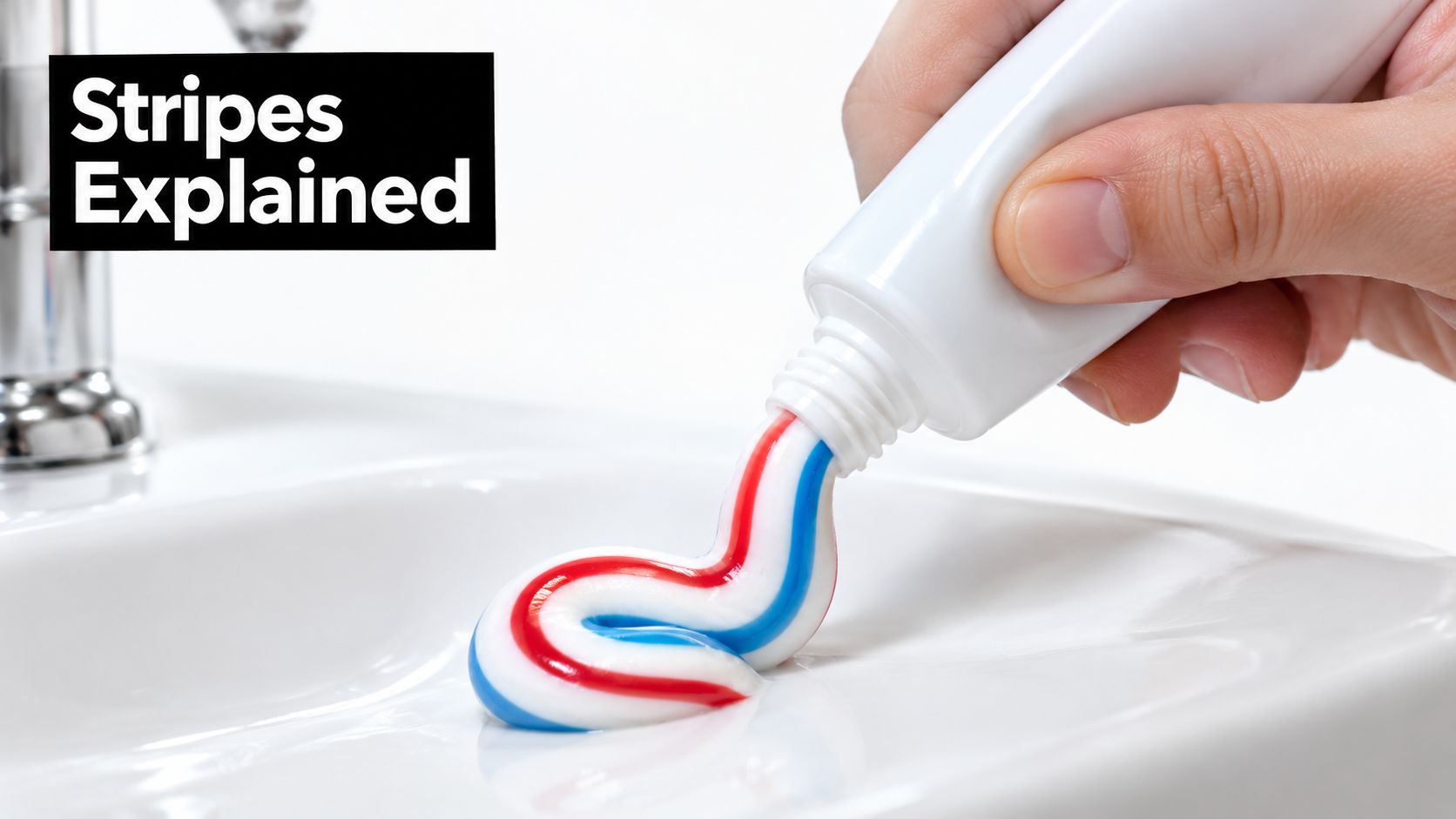
You're standing at the sink, squeezing toothpaste onto a brush, and a red, white, and blue ribbon appears. The stripes look deliberate because they are. They're created by feeding differently colored gels through a special nozzle as the tube is filled, giving the paste a visual pattern that makes the product feel distinctive.
That color is usually cosmetic, not functional. Names such as FD&C Blue No. 1 or Red No. 30 identify color additives, while ingredients such as abrasives, surfactants, fluoride, or hydroxyapatite perform the work associated with cleaning and enamel support. A pigment can make a formula look fresh, medicinal, or child-friendly, but it doesn't scrub plaque from a tooth.
A quick audit of your current tube
Turn the tube around and look for the ingredient list. You may see a mixture of active ingredients, abrasives, humectants that keep the paste moist, flavoring agents, sweeteners, detergents, preservatives, and colorants.
The easiest distinction is this:
- Cosmetic colorants change appearance. They include named dyes, lakes, and some mineral pigments.
- Abrasives help remove surface deposits through brushing. Silica and calcium carbonate are examples.
- Actives support the formula's intended oral-care function. Fluoride and hydroxyapatite are examples.
- Flavor systems affect whether the paste feels mild, spicy, sweet, or refreshing.
A white paste and a clear gel can both be well formulated. Color doesn't tell you whether the product contains an appropriate active system or whether its abrasivity suits your teeth. For a useful ingredient-by-ingredient walkthrough, compare your tube with this guide to toothpaste ingredients and their purposes.
That leads to the central question: if color adds little to cleaning, what does removing it change?
How Regulation Shaped the Dye Free Category
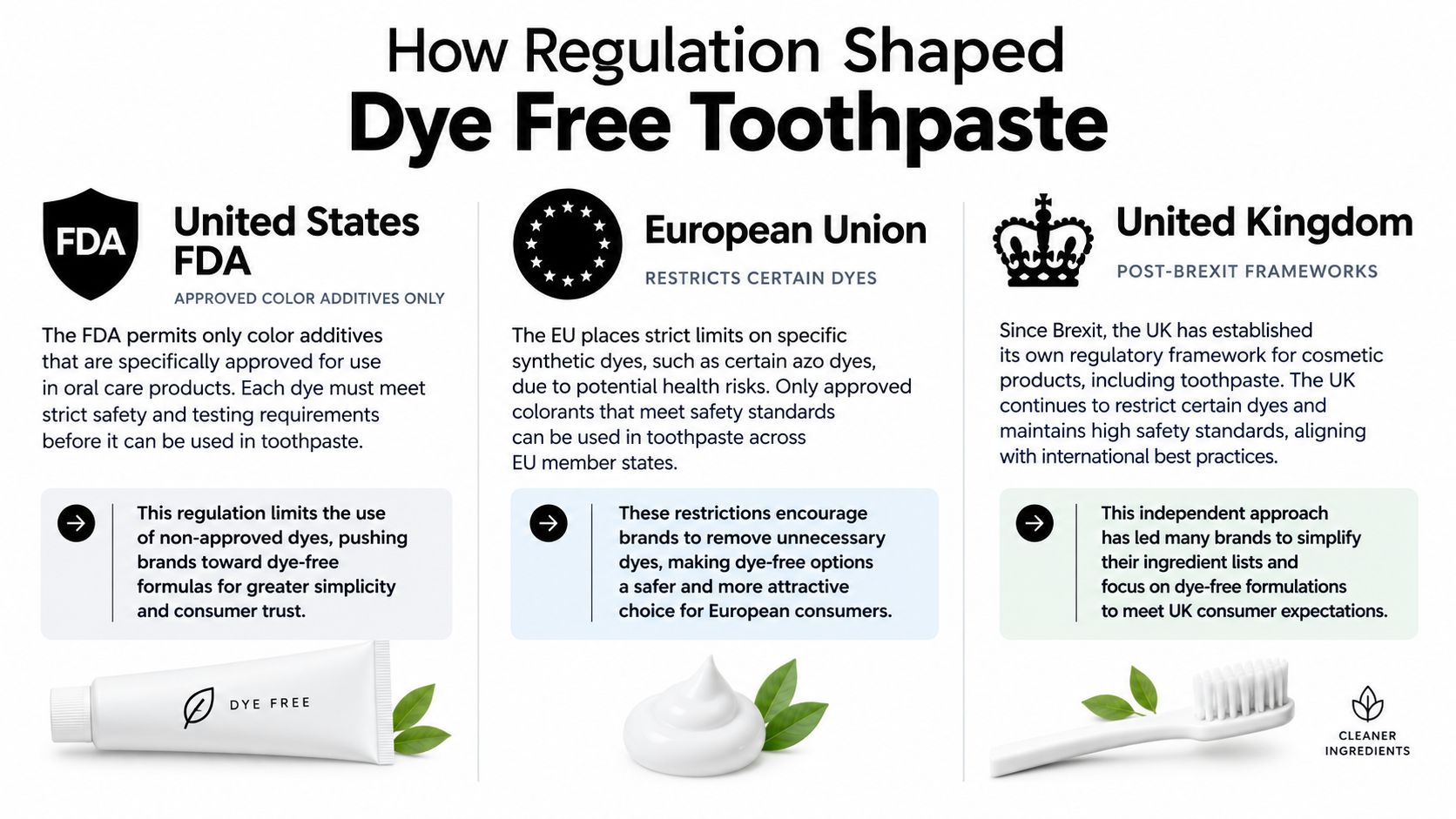
Color additives in toothpaste aren't unregulated decoration. In the United States, the FDA explains that most color additives require approval before use, and manufacturers must follow approved uses, specifications, and restrictions. FDA records specifically list D&C Orange No. 5 for use in mouthwashes and dentifrices, while some additives used in toothpaste are subject to batch certification before products reach the market. That system creates a permitted-use framework, not a blanket endorsement of every color in every product.
Historical regulation also shows why brands and shoppers pay attention to particular dyes. A Harvard Law School review of toothpaste regulation records that D&C Red No. 8 and D&C Red No. 9 were approved for dentifrices in 1983, then prohibited in toothpaste and mouthwash after January 5, 1987. The same review identifies D&C Red No. 33 and D&C Red No. 36 as prohibited in those products.
Different markets, similar pressure toward scrutiny
European oral-care products operate within strict cosmetic rules, and regulatory guidance on colorants and warning labels reflects continuing scrutiny of certain synthetic dyes. The United Kingdom follows its own post-Brexit regulatory framework while retaining a strong focus on permitted cosmetic ingredients and labeling. These systems differ in detail, but each encourages manufacturers to justify what goes into a formula and how the ingredient is declared.
The broader market shift also matters. One independent industry source reports that about one-third of toothpastes sold in the UK are fluoride-free, linking that growth in alternative formulations to consumer concern about ingredient exposure. Dye-free products often appear within this wider “free-from” movement rather than as a clearly separate mainstream category, as described in the review of fluoride-free toothpaste with hydroxyapatite.
Dye-free toothpaste, then, isn't a visual trend. It reflects ingredient scrutiny, compliance history, and shoppers' preference for shorter or more transparent formulas. Regulation doesn't prove that every dye-free product performs better. It explains why the category has a coherent place on the shelf.
What the Science Says About Dyes and Sensitivity
The strongest case for dye-free toothpaste is not universal cleaning improvement. It's the possibility of reducing exposure to an ingredient class that some people don't tolerate well.
Independent clinical reviews describe oral contact reactions associated with toothpaste colorings and preservatives. Reported symptoms can include lip or tongue desquamation, swelling, perioral dermatitis, angular cheilitis, gingival irritation, and oral ulceration. The Australian Prescriber review of toothpaste contents and safety also makes an important distinction: these reactions are relatively rare, and mild irritation is more commonly associated with detergents or essential-oil flavor systems than with dye.
Sensitivity is personal, not automatic
A person with recurring unexplained mouth irritation may reasonably prefer a shorter ingredient list and a dye-free formula. Someone who has never reacted to toothpaste may notice no oral-health difference after removing color. That's why “dye-free” should be treated as a targeted preference, not a guarantee of better outcomes for everyone.
The same source points toward a practical complication. If irritation continues after switching to dye-free toothpaste, the trigger may be a detergent, preservative, or strong flavor blend. Removing one ingredient class doesn't identify the cause by itself.
| Ingredient type | Role | Example | Cleaning impact |
|---|---|---|---|
| Colorant | Changes appearance | FD&C dye or lake | No direct cleaning role |
| Abrasive | Helps lift surface deposits during brushing | Silica or calcium carbonate | Directly affects cleaning feel |
| Active ingredient | Supports the formula's oral-care purpose | Fluoride or hydroxyapatite | Important to the formula's intended function |
| Surfactant | Helps spread ingredients and create foam | Detergent system | Affects texture and rinsing experience |
| Flavor system | Creates taste and freshness | Mint or essential oils | Influences comfort and brushing consistency |
The takeaway is simple. Dye removal can help a sensitive subset, but it doesn't replace proven actives or good brushing technique. If symptoms persist, stop experimenting randomly and discuss the product with a dental professional. Bringing the tube or a photograph of its ingredient list can make that conversation more useful.
Reading a Toothpaste Label Like an Insider
You don't need to memorize every ingredient name. You need a repeatable way to inspect the back of the tube.
Start with the ingredient list
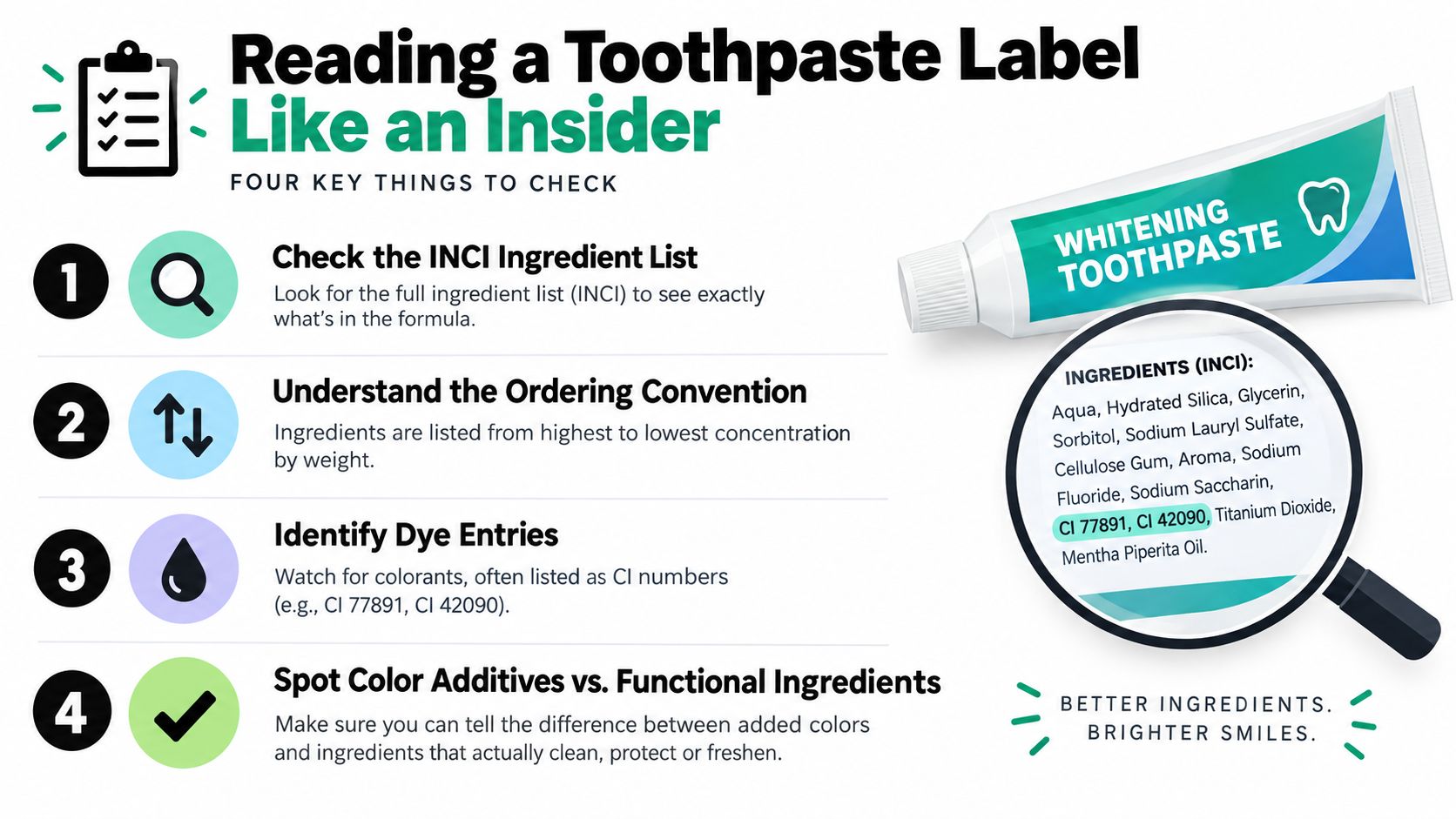
Look for the full ingredient or INCI list, then separate entries by role. In many formulas, ingredients appear in descending order by amount until a point where smaller quantities may be listed more flexibly. The label still deserves a complete read because a dye can appear near the end even when it changes the product's appearance noticeably.
Colorants may be listed with names such as FD&C Blue No. 1, Yellow No. 5, or Red No. 40. They can also appear as lakes, CI numbers, “color,” or “may contain” statements. The FDA's color-additive records are useful when a name is unfamiliar.
Then separate color from function
Titanium dioxide and iron oxides may function as pigments, while caramel, beetroot, or chlorophyll can provide naturally derived color. “Natural” describes an origin, not a universal safety result. These ingredients still need to suit your preferences and your mouth.
Use this quick audit:
- Scan for color words. Look for color, dye, lake, CI, and named FD&C additives.
- Check pigment names. Note titanium dioxide and iron oxides separately from functional ingredients.
- Review the active section. Identify fluoride or another stated active system.
- Assess the sensory cluster. Notice flavor oils, sweeteners, detergents, and foaming agents.
- Compare products directly. Photograph both labels so you can spot what changed.
Practical rule: A dye-free claim answers one label question. It doesn't answer whether the formula is gentle, effective for your needs, or pleasant enough to use consistently.
Save unfamiliar ingredient names in your phone. After a few comparisons, you'll recognize the patterns quickly and won't need to rely on front-of-pack language.
Myths Worth Putting to Rest
Myth one, white toothpaste cleans better. Paste color has no reliable connection to cleaning power. The physical cleaning sensation comes mainly from the brush, brushing motion, and abrasive system, not from whether the formula is white, transparent, green, or striped.
Myth two, stripes signal clinical effectiveness. Stripes are a delivery and design feature. They can make a tube distinctive and may help a product communicate separate visual zones, but they don't show that the formula contains more effective cleaning ingredients.
Myth three, natural colorants are automatically safer. Beetroot, caramel, chlorophyll, and turmeric may sound gentler because shoppers associate them with food or plants. Yet a naturally derived pigment can still be unsuitable for a particular person, may affect appearance, or may contribute to an individual reaction. Origin alone isn't a sufficient screening method.
Myth four, removing dyes automatically improves the whole formula. A dye-free product might still contain a strong flavor, a texture you dislike, or an abrasive level that doesn't suit your routine. Some formulas may also use other ingredients to create a particular sensory experience, so the absence of color shouldn't end your evaluation.
A better way to judge the claim
Ask three questions:
- Does the formula contain an active ingredient you want?
- Can you tolerate its flavor, foam, and texture?
- Does the complete ingredient list match your personal avoidance goals?
The consumer guidance on children's toothpaste and colorants highlights names such as FD&C Blue No. 1, Blue No. 2, Red No. 3, and Yellow No. 6, while also discussing concerns around certain dyes and titanium dioxide. That information can help you identify what's present. It can't decide which formulation fits your mouth or your family.
Dye Free Toothpaste for Kids and Expecting Mothers
A parent may be comparing a bright fruit-flavored paste with a plain white one. An expecting mother may be reviewing every label more carefully than usual. An adult with recurring lip irritation may want to remove avoidable variables. These shoppers can arrive at the same dye-free choice for different reasons.
For children, acceptance matters as much as appearance. A product that tastes too strong, feels gritty, or foams heavily may create resistance at brushing time. The American Dental Association notes that a systematic review found dentifrice flavoring didn't increase toothpaste ingestion by children, which suggests that flavor choice should focus on tolerance and routine rather than assuming a sweeter taste alone creates a swallowing problem. See the practical ingredient guide to children's toothpaste choices.
The family decision is broader than dye status
Dye-free toothpaste can reduce unnecessary color exposure and may be appealing when a child has a history of irritation or strong ingredient preferences. But it doesn't guarantee that a child will brush willingly. Flavor, mouthfeel, supervision, and a predictable routine usually matter more to compliance than whether the paste is white.
For an expecting mother, dye is only one label detail. It may also make sense to review flavor oils, detergents, sweeteners, abrasives, and the product's active system. A dental professional can help personalize that decision, especially if there's a history of sensitivity or a specific oral-care concern.
The same pattern applies to adults with reactive mouths. If symptoms improve after switching, the change may be useful, but don't assume dye was the only possible trigger. A mild, simpler formula can be a reasonable experiment, while persistent irritation deserves professional evaluation.
For families: Choose the product the user can tolerate and use consistently, then confirm that its active ingredients and directions fit the child's or adult's needs.
Choosing a Dye Free Toothpaste That Actually Works
Start with what the toothpaste is designed to do, not what it leaves out. Depending on your preferences and professional guidance, the formula may use fluoride, hydroxyapatite, xylitol, or baking soda. These ingredients don't all serve the same purpose, and a dye-free label doesn't tell you which one is present.
Build the choice around daily use
Flavor is practical, not superficial. Mint may feel traditionally fresh, mild mint can reduce intensity, fruit flavors may suit children, and an unflavored option may appeal to people who react to strong flavor systems. Texture matters too. A low-foam paste can feel different from a highly foaming one, while a gritty formula may feel more scrubby than a smooth gel.
Abrasivity deserves attention when you're comparing whitening or stain-removing products. Relative Dentin Abrasivity, or RDA, is the numerical shorthand used to describe how abrasive a toothpaste is, and dental professionals often discuss staying within a range from 35 to 250. That range is cited in Mouthology's guide to titanium dioxide-free toothpaste. Your dentist can help interpret the number alongside enamel condition, exposed dentin, brushing pressure, and product use.
Use this buyer's checklist:
- Active system: Confirm the stated fluoride or hydroxyapatite information rather than assuming from the product category.
- Abrasivity: Look for an RDA value when available, especially if you're considering whitening formulas.
- Ingredient transparency: Prefer a complete list over a vague “natural” or “clean” promise.
- Sensory fit: Choose a flavor and texture you'll use twice daily.
- Verification: Look for relevant professional or third-party seals where applicable, then read the exact claim behind the seal.
Mouthology's fluoride-free toothpaste is one dye-free, artificial-color-free option built around 10% nano-hydroxyapatite, so shoppers interested in that type of formula can review its label alongside other products. The important comparison is still the same: active system, comfort, transparency, and suitability for your routine.
Dye-free is best treated as an upgrade mindset. You're not buying a white tube because white looks healthier. You're choosing a formula whose ingredients and sensory experience make sense for you.
Putting It All Together
Four ideas make the decision easier.
Regulation helped establish color additives as a category that manufacturers must manage carefully. The science suggests that colorants can matter for a smaller group of sensitive users, but removing them doesn't change the fundamental cleaning mechanism. Label literacy lets you distinguish decorative ingredients from abrasives, actives, detergents, and flavor systems. Families and people with recurring irritation often have the clearest practical reasons to explore a dye-free option.
The target isn't whiter paste. It's a formula that aligns cleaning chemistry, comfort, flavor, and abrasivity with your needs. That may mean dye-free fluoride toothpaste, a hydroxyapatite formula, or another product selected after reading the full label.
Take one toothpaste from your bathroom today. Photograph its ingredient list, mark any colorants or vague “color” entries, identify the active system, and compare the result with the checklist above. If the formula works well and causes no problems, changing it may not be necessary. If you're avoiding dyes because of sensitivity, ingredient preferences, or a child's difficulty tolerating the current product, compare a simpler alternative and ask a dentist or pediatric dentist for personalized guidance.
Consistent brushing technique and a dependable twice-daily routine matter more than the color of the paste.
Choose your current toothpaste, audit its label, and compare it with a dye-free formula that matches your flavor, texture, active-ingredient, and sensitivity priorities. If irritation continues or you're choosing for a child, bring the ingredient list to your dental appointment so you can make the next change with professional guidance.
