

Posted by Sarah Collins
on September 24, 2026

Your five-year-old is standing at the sink, toothbrush in hand, while toothpaste slowly disappears into their mouth instead of onto their teeth. They may resist the brush, rush through the back molars, or decide that the foam is something to swallow. Meanwhile, you're wondering whether the answer is fluoride, fluoride-free, strawberry-flavored, or the tube with the most reassuring label.
The best toothpaste for a 5 year old is the one that fits the child's needs and gets used correctly. Ingredient choice matters, but so do the amount applied, twice-daily brushing, adult supervision, and the child's ability to spit. A premium formula won't help much if most of it is swallowed or brushing stops after a few seconds.
"The Daily Brushing Battle Begins"
Bedtime brushing rarely looks like a calm dental demonstration. Your child may be tired, silly, or determined to brush independently even though the toothbrush keeps missing the chewing surfaces of the back teeth. In the morning, there may be even less patience. A five-year-old often wants to finish quickly, rinse immediately, and get on with breakfast.
That behavior is normal, but it creates the central problem: the toothpaste has to stay in contact with the teeth long enough to do its job. A child who swallows paste, squeezes out a long ribbon, or skips difficult areas needs help with the routine, not necessarily a more expensive tube.
The bathroom test
Watch what happens at the sink for a few evenings. Does your child:
- Control the amount: Wait for an adult to apply the toothpaste rather than squeezing it directly?
- Reach every surface: Brush the outer, inner, and chewing surfaces instead of polishing only the front teeth?
- Spit afterward: Remove the excess paste without treating the rinse as a drink?
- Accept help: Allow an adult to finish the areas that were missed?
These observations tell you more than packaging alone. A mild flavor may make brushing easier, while a fluoride formula may provide the cavity-prevention benefits recommended for this age. But both choices depend on a routine your child can follow.
Practical rule: Choose the formula your family can use consistently, then put most of your attention on dose control and supervision.
For children aged 3 to 6, guidance from the NHS recommendations for children's teeth supports fluoride toothpaste in the 1,000 ppm to 1,500 ppm range, a pea-sized amount, and brushing twice daily for about two minutes. The American Dental Association, American Academy of Pediatrics, CDC, and pediatric dental guidance use the same basic pea-sized rule for this age range. At five, your child sits directly inside that group.
The practical takeaway is reassuring: you don't need to decode every marketing phrase on the shelf. Start with an age-appropriate product, dispense the correct amount yourself, and make sure an adult remains involved until the child can brush thoroughly and spit reliably.
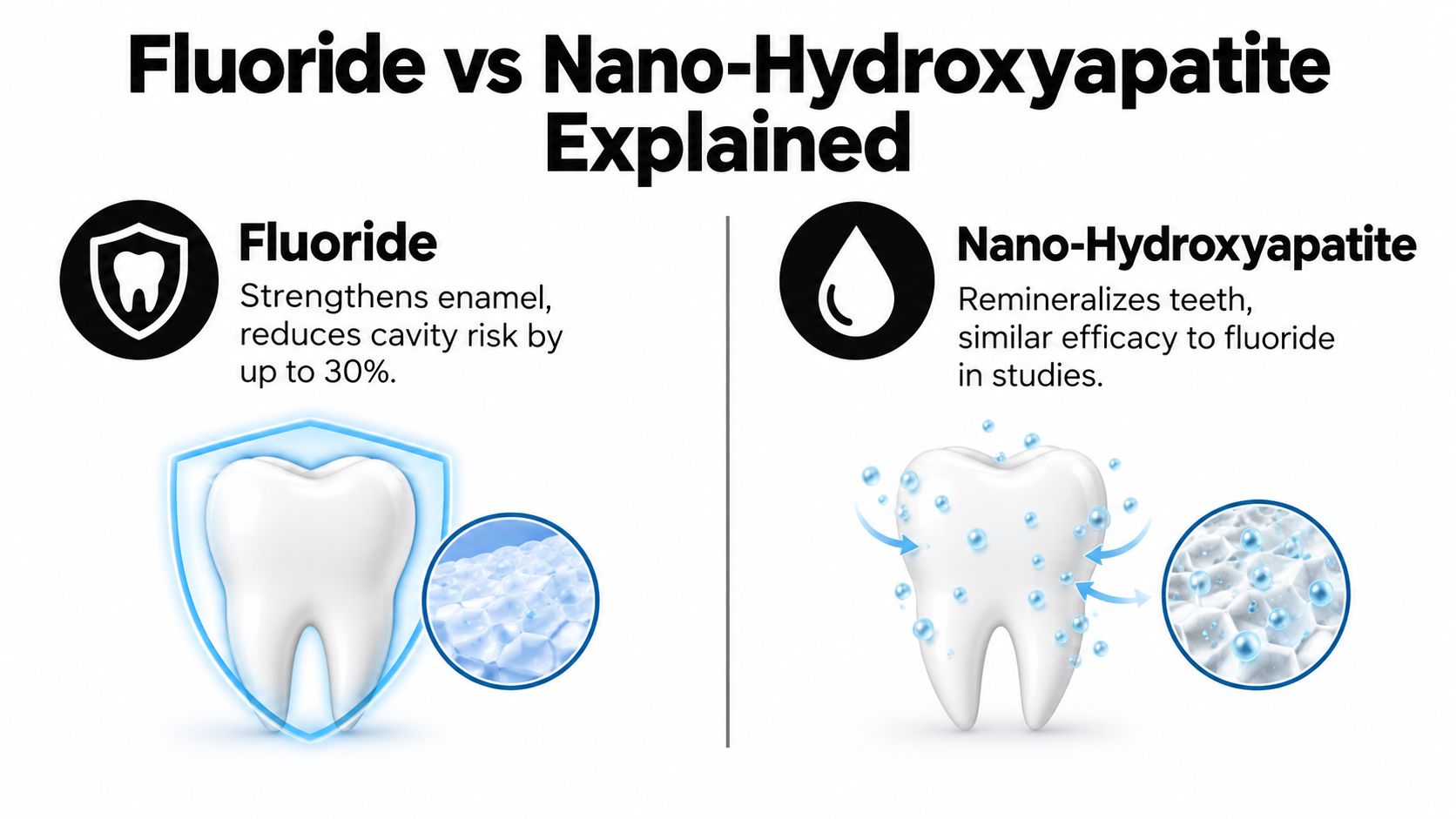
"Fluoride vs Nano-Hydroxyapatite Explained"
A toothpaste can have a sound ingredient profile and still fail at the sink. If a five-year-old swallows most of it, rushes through brushing, or leaves the molars untouched, the routine limits what stays on the enamel. Fluoride and nano-hydroxyapatite support the tooth surface in different ways, so the useful choice is the formula your child can use correctly and consistently.
Fluoride toothpaste remains the conventional recommendation in major pediatric and dental guidance. The NHS advises 1,000 ppm to 1,500 ppm fluoride toothpaste for children aged 3 to 6. Fluoride helps reduce the effects of acid attacks and supports stronger enamel, while careful dosing limits unnecessary swallowing. The American Academy of Pediatric Dentistry fluoride therapy guidance also describes pea-sized application as a way to control exposure for children in this age group.
Nano-hydroxyapatite, often shortened to nHA, is a mineral related to the structure naturally found in teeth and bones. Toothpaste formulas use very small particles intended to support the tooth surface. Some families select a fluoride-free option because of ingredient preferences, flavor tolerance, or concern about habitual swallowing. Adult supervision still applies. Fluoride-free paste should be spat out rather than treated like food.
How the trade-off works
| Consideration | Fluoride toothpaste | Nano-hydroxyapatite toothpaste |
|---|---|---|
| Primary appeal | Widely endorsed cavity-prevention ingredient | Fluoride-free mineral-based approach |
| Main routine requirement | Use the correct dose and limit swallowing | Use as directed and still supervise brushing |
| Best fit | Families following standard pediatric dental guidance | Families seeking a fluoride-free option and discussing it with a dental professional |
| What flavor changes | Acceptance and brushing cooperation | Acceptance and brushing cooperation |
Professional guidance supports age-appropriate fluoride use, while interest in fluoride-free and alternative-mineral formulations continues to grow. Evidence comparing real-world acceptance, compliance, and cavity prevention specifically in five-year-olds remains limited. Parents should therefore weigh the ingredient, the child's brushing behavior, and individualized dental advice rather than treating a label as a guarantee.
For a plain-language comparison, see Mouthology's guide to fluoride and nano-hydroxyapatite. If your child has a cavity history, enamel concerns, or specific guidance about fluoride exposure, follow the dental professional's recommendation. The product matters, but the routine determines whether its active ingredients remain on the teeth long enough to help.
"Building a Safe Brushing Routine"
At the sink, your five-year-old may squeeze a long ribbon of toothpaste onto the brush, rush through the back teeth, and reach for water before you can check. A reliable routine closes those gaps. The adult controls the paste, guides the sequence, and checks the finish.
A routine that works at the sink
- Apply the toothpaste yourself. Use a pea-sized amount, approximately 0.25 g per brushing, following age-appropriate fluoride guidance discussed earlier. More paste increases exposure without cleaning teeth better.
- Choose a soft toothbrush. A small head should reach the back teeth comfortably. Let your child choose between two suitable colors or flavors, while you make the final selection.
- Follow the same route every time. Brush the outer surfaces first, then the inner surfaces, and finish on the chewing surfaces. A fixed order helps prevent forgotten molars and makes it easier for you to check coverage.
- Brush for about two minutes, twice daily. Morning and bedtime sessions establish the routine. A timer, song, or visual sequence can keep a child engaged when attention fades.
- Teach spitting rather than rinsing. Spitting removes excess toothpaste while leaving more fluoride on the teeth. Stay close and watch for swallowing or an immediate request for a cup.
- Complete the areas your child misses. Let your child start to build independence, then take the brush and clean along the gumline, inner surfaces, and back teeth. The product only helps where it remains on the enamel long enough to work.
The proper teeth brushing technique guide offers a practical reference for movement and coverage. Set up the sink so your child can stand securely. If reaching the basin is difficult, a stable best toddler step stool may make brushing easier, with an adult nearby throughout.
Make supervision feel ordinary
Present assistance as a normal part of brushing, not a punishment. Try, “You brush first, then I check the tricky spots,” and use the same wording each time. Your child then knows what to expect, and the adult check feels like part of the routine.
Keep the toothpaste in an adult-controlled place, especially if your child treats it like a snack. If spitting is unfamiliar, practise with water at another time rather than during a rushed bedtime session. Praise the specific behavior you want, such as putting the paste in the sink, instead of turning swallowing into a confrontation.
"Why Supervision Matters More Than the Tube"
A child-friendly tube can still be used badly. A premium label can't stop a five-year-old from squeezing out extra paste, licking the brush, or hiding the tube in a bedroom. The dose and the child's behavior determine exposure far more directly than the cartoon on the package.
For a five-year-old, the key question is not, “Is this toothpaste safe?” Ask instead: Who applies it, where is the tube stored, and what happens after brushing? Those details reveal whether the product is being used as intended.
Swallowing is a routine issue
Guidance from Medsafe on fluoride toothpaste for children emphasizes supervision, teaching children to spit, and using an age-appropriate amount. Small accidental swallowing is generally different from repeatedly consuming large amounts, but neither fluoride nor fluoride-free toothpaste belongs in a child's stomach as a habit.
With fluoride toothpaste, repeated excessive ingestion can contribute to stomach upset and, over time, dental fluorosis. The issue is why professional guidance pairs fluoride with a controlled dose. The CDC's child oral-health guidance also describes a pea-sized amount for children aged 3 to 6, with no more than that amount until around age 6, when swallowing reflexes are more developed.
Remove the easy opportunities
Store the tube somewhere your child can't access it without you. Apply the paste before handing over the brush, and keep the cap closed while your child brushes. If your child repeatedly eats toothpaste, stop treating it as a minor quirk and discuss the behavior with a dentist or poison center for situation-specific advice.
The ingestion concern exists even when the paste contains no fluoride. A fluoride-free formulation may suit a family's preferences, but it still contains ingredients intended for brushing, not snacking. “Safe if swallowed in a small accidental amount” should never become permission to consume the tube.
This is also why choosing the most expensive or heavily marketed children's toothpaste doesn't solve the core problem. A simple formula, correctly measured and supervised, can support a better routine than a highly branded product that the child uses unsupervised.
Parents often feel pressure to make a perfect choice. You don't need to eliminate every uncertainty before starting. Control the tube, use a pea-sized amount, watch the brushing, and ask your child's dental professional for personalized guidance when swallowing remains frequent or oral-health concerns are present.
"What Parents Should Look For"
Once the routine is under control, product selection becomes much simpler. Turn the tube around and check the active ingredient, fluoride concentration where applicable, age guidance, flavor, and texture. The front label may feature characters and bright colors, but the back label tells you whether the product fits your plan.
A practical decision screen
For a standard fluoride choice, look for fluoride toothpaste in the 1,000 ppm to 1,500 ppm range recommended by the NHS for children aged 3 to 6. A product carrying the ADA Seal of Acceptance can provide a useful shortcut for families choosing among fluoride options, but it doesn't replace the pea-sized dose or adult oversight.
For a fluoride-free choice, examine the active mineral and the product's age guidance. Nano-hydroxyapatite is the ingredient many families encounter in modern fluoride-free formulations. Treat it as an alternative approach, not as a reason to abandon brushing discipline.
Flavor deserves real attention. If strong mint makes your child pull away from the brush, a mild mint or non-mint flavor may improve cooperation. Texture matters too. A child who dislikes heavy foam or a gritty feel may tolerate a smoother gel more readily, and a tolerated toothpaste is more useful than one that remains untouched in the cabinet.
A good buying test: Can your child tolerate the taste, can you control the dose, and can an adult supervise both brushing and spitting?
You can use this guide to children's toothpaste ingredients when comparing labels. Mouthology's Kids toothpaste is one fluoride-free, hydroxyapatite-based option marketed for children, but it still belongs inside the same supervised routine as any other product. The label and your child's dental history should guide the final decision.
Avoid choosing solely because a product says “natural,” “gentle,” or “training.” Those words don't tell you whether the toothpaste supports your child's needs or whether the flavor will be accepted. If your child has recurring cavities, enamel changes, significant sensitivity, or persistent resistance, bring the tube or a clear photo of its ingredient panel to a dental appointment.
"Final Thoughts on Kids Dental Care"
At the sink, the winning routine is usually less dramatic than parents expect. An adult applies a pea-sized amount, the child brushes with help, the child spits instead of rinsing, and the adult checks the back teeth before the toothbrush goes away.
Fluoride toothpaste remains the most widely endorsed option for this age when used in the recommended amount. Nano-hydroxyapatite offers a fluoride-free path for families who prefer it, but no formula removes the need for supervision or makes swallowing toothpaste a good habit.
If brushing feels chaotic, simplify the choices. Pick one tolerated flavor, store the tube out of reach, use the same brushing order every time, and keep helping until your child can clean thoroughly and spit reliably. You don't need to win every bathroom negotiation. You need to build a repeatable morning and bedtime habit that protects the teeth your child is using now and the habits they'll carry forward.
Tonight, apply the paste yourself, set a two-minute timer, let your child brush first, and finish the missed surfaces. If swallowing continues, your child has had cavities, or you're unsure whether fluoride or a fluoride-free option fits their needs, schedule a conversation with a pediatric dentist and take the toothpaste tube with you.
