

Posted by Sarah Collins
on September 23, 2026

You're standing at the bathroom sink, trying to get a four-year-old through the morning routine. Your child squeezes a long ribbon of toothpaste onto the brush, tastes it before brushing, then objects loudly when you ask them to spit. By bedtime, you're wondering whether the problem is the flavor, the fluoride, the amount, or just the fact that preschoolers have strong opinions about everything.
The best toothpaste for a 4 year old isn't one universal brand. It's a product that fits your child's age, swallowing habits, cavity risk, sensory preferences, and your family's approach to fluoride. The useful questions are practical: How much should go on the brush? What fluoride concentration is appropriate? How abrasive is the formula? Will your child tolerate the texture and flavor?
What Choosing a Toothpaste for a 4 Year Old Actually Involves
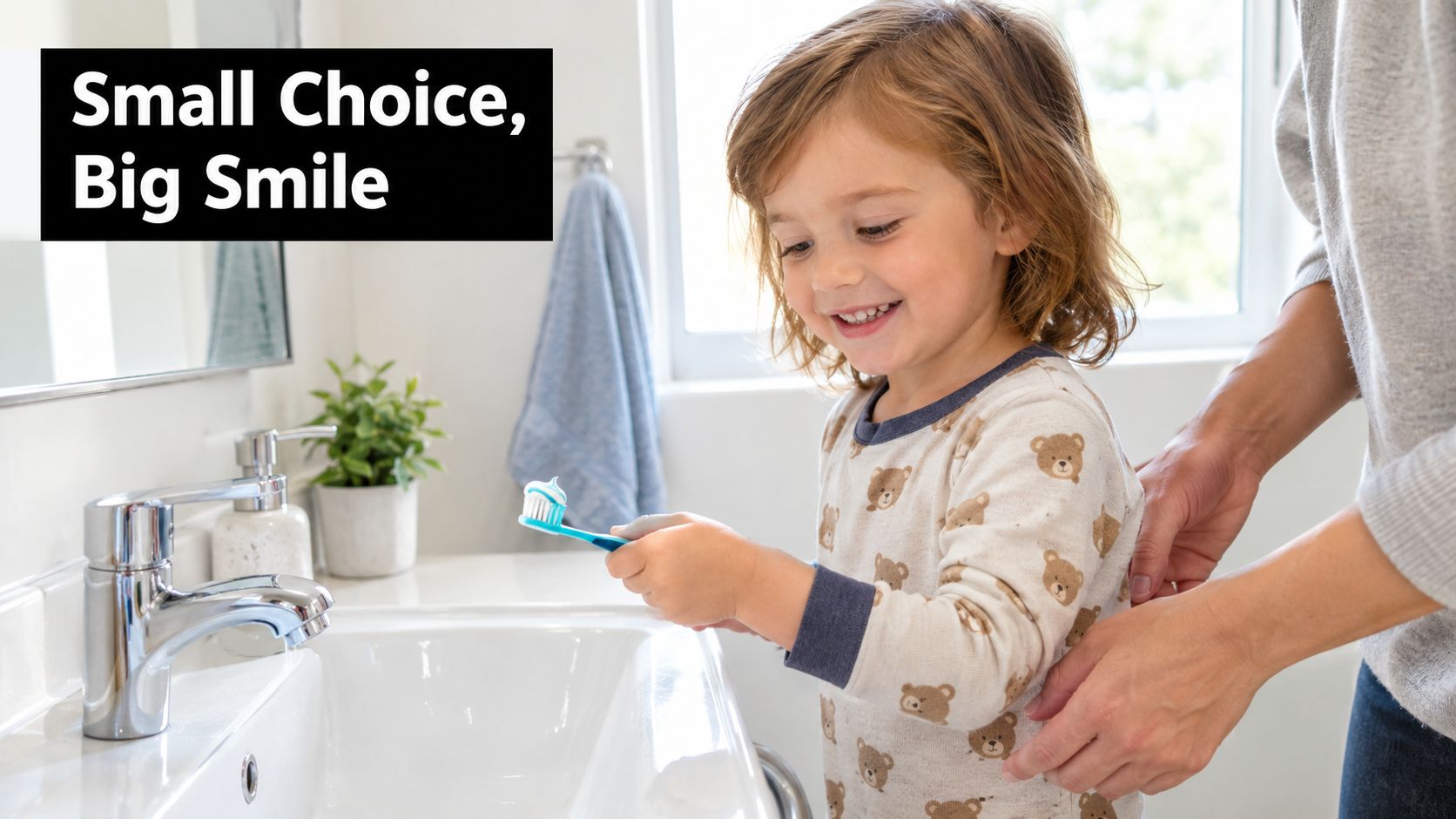
At the bathroom sink, a four-year-old may spit reliably one morning and swallow the foam the next. That difference matters because children aged 4 to 6 often swallow toothpaste while their swallowing reflex is still developing, as described in the European Commission's fluoride overview. Brushing should continue, with the dose, supervision, and formula matched to the child's habits.
Start with the whole fluoride picture. Drinking water and food prepared with that water can contribute fluoride alongside toothpaste. If you do not know whether your local supply is fluoridated, ask your dentist or water provider. A child with previous cavities may need different advice from a child without a decay history, even at the same age.
The decision also has a practical side. A toothpaste is useful only if your child will tolerate it twice a day. Strong mint can feel as though it burns, while a smooth, low-foam formula may suit a child who gags at froth. Texture, flavor, and foam level can determine whether the tube stays by the sink or untouched in the cabinet.
A guide to safe toothpaste for kids can help you check everyday safety details. The decision framework is simple: assess swallowing risk, fluoride exposure, cleaning strength, and your child's willingness to use the product. That approach lets you evaluate any tube on the shelf, including a fluoride-free nano-hydroxyapatite option when it fits your family's circumstances.
The Four Things That Matter Most in a Kids Toothpaste
Pediatric dental guidance usually comes down to four practical filters. Use them to compare any tube, whether it's from a supermarket, pharmacy, or a specialist oral-care brand.
Start with the active ingredient
Look for the active fluoride ingredient and its concentration. Common fluoride types include sodium fluoride, stannous fluoride, and sodium monofluorophosphate. For children in this age range, the technical benchmark is generally 1,000 to 1,500 ppm fluoride, with the NHS recommending that range for children aged 3 to 6 in its children's dental-care guidance.
Consider how the paste cleans
Abrasivity describes how much a toothpaste can polish away surface material. The Relative Dentin Abrasivity, or RDA, scale expresses this in a standardized way, although many packages don't display the value. A low-to-moderate abrasivity is a sensible preference for a young child, particularly when brushing technique is still developing.
Avoid treating “whitening” as a benefit for preschool teeth. Whitening formulas may rely on stronger polishing ingredients that add little value to a four-year-old's routine.
Read beyond the headline claims
A short, recognizable ingredient list can make it easier to identify a child's irritants. Families may prefer mild surfactants, limited sweeteners, and formulas without artificial dyes. If your child develops irritation, bring the tube or a photograph of its ingredient panel to a dental appointment.
Choose cooperation over sophistication
A mild fruit flavor, gentle mint, smooth gel, or low-foam texture may be decisive. The right flavor isn't a cosmetic detail if it determines whether your child brushes consistently.
| Criterion | What to look for | Why it matters at age 4 |
|---|---|---|
| Fluoride type and concentration | A clearly listed fluoride active and an age-appropriate ppm level | Supports enamel protection when used in the recommended dose |
| Abrasivity | Low-to-moderate abrasivity, with a low RDA when listed | Helps avoid unnecessarily aggressive polishing |
| Ingredient profile | Mild surfactants and recognizable additives | May suit children with taste or sensory sensitivities |
| Flavor and texture | A flavor your child accepts and a texture they can tolerate | Makes twice-daily brushing more achievable |
Products containing triclosan, microplastics, harsh whitening agents, or questionable essential oils may not fit your family's preferences. The next decision is whether fluoride belongs in your child's routine, and the answer depends on the trade-off between cavity prevention and swallowing control.
Fluoride or Fluoride-Free and How Much to Use
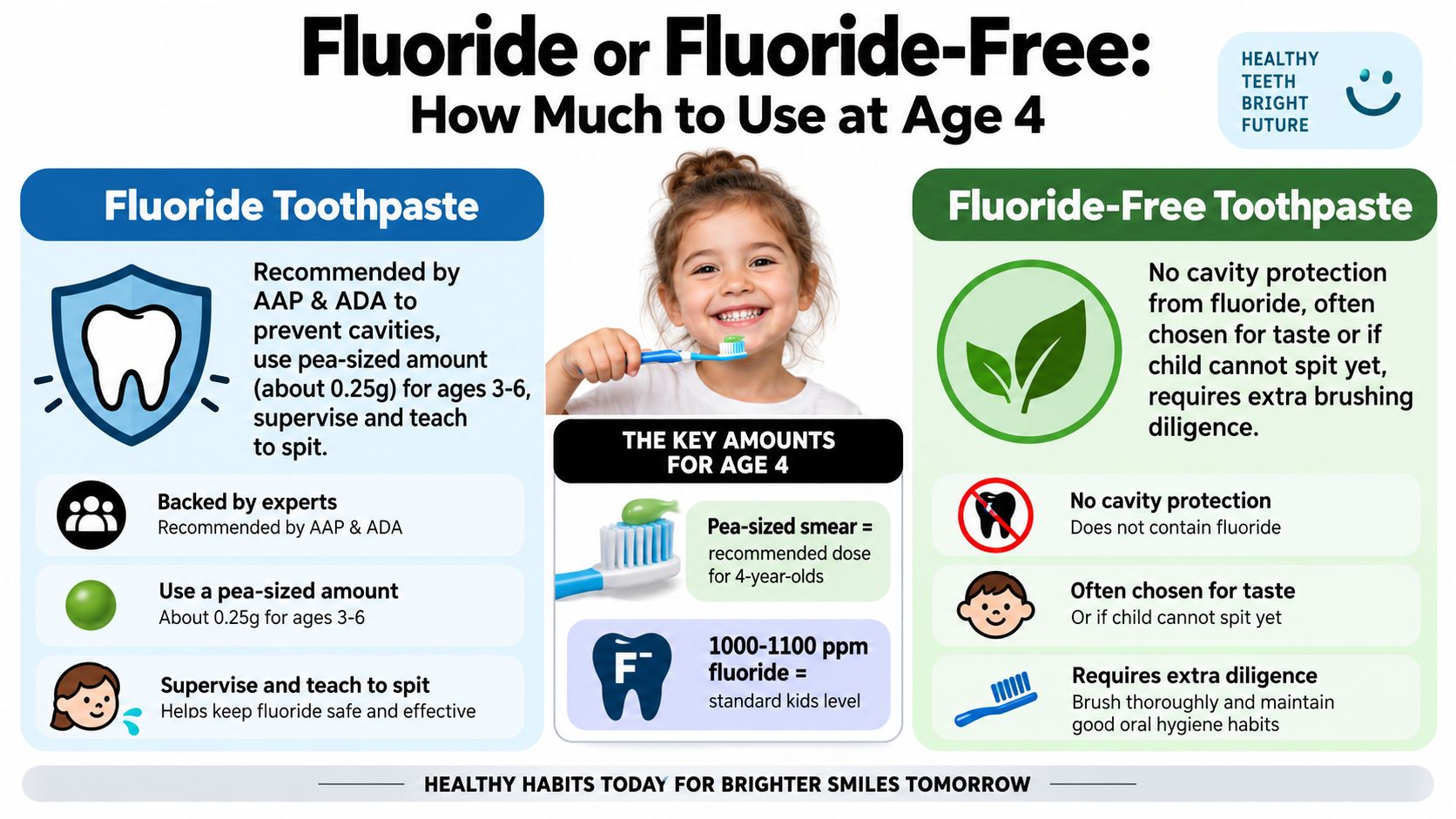
A four-year-old may brush enthusiastically, then swallow the paste before you can stop them. That everyday detail matters more than the brand name. For most children this age, major guidance supports fluoride toothpaste twice daily. The ADA recommends a pea-sized amount for children aged 3 to 6, while the CDC recommends fluoride toothpaste from age 2 onward. Its guidance on fluoride toothpaste use explains both the age-based approach and why the dose stays small.
A pea-sized amount is roughly 0.25 g. On the brush, it should resemble a small dab, not a strip covering the bristles. Use the 1,000 to 1,500 ppm fluoride range introduced earlier, applied as that pea-sized dose, and teach your child to spit rather than rinse. The ADA's toothpaste guidance also explains age-based amounts and supervised brushing.
Why parents hear mixed messages
Fluoride helps enamel withstand the acids produced during everyday plaque activity. The concern is repeated swallowing, particularly while teeth are developing. Excess exposure can contribute to dental fluorosis, visible changes in developing enamel. Controlled dosing and supervision address that concern without giving up fluoride's cavity-prevention role.
Use your child's behavior as part of the decision. Can they spit reliably? Are there other fluoride sources at home? Has a dental professional identified a higher cavity risk or a specific reason to limit fluoride?
Practical rule: Dispense the paste yourself and supervise the brush. A small, controlled portion is safer than letting a child squeeze out their own.
Fluoride-free toothpaste removes fluoride from the swallowing equation, but it also removes fluoride's cavity-prevention benefit. It may suit a child who consistently swallows paste, a family following a pediatric dentist's recommendation, or parents who accept the need for especially careful brushing. The fluoride-free toothpaste guide for toddlers provides further context for weighing that choice.
A small accidental swallow is usually not an emergency. Repeated overuse can upset the stomach, and excessive intake can raise fluorosis risk. Store toothpaste out of reach, dispense it yourself, and stay nearby while your child brushes. The goal is a measured routine that protects teeth while your child gradually learns to spit.
When a Fluoride-Free Nano-Hydroxyapatite Option Makes Sense
Nano-hydroxyapatite, often shortened to nHa, is a synthetic form of a mineral found in teeth and bone. In toothpaste, the particles are designed to interact with the tooth surface and the plaque biofilm during brushing. The ingredient has been studied for enamel-supporting and remineralization-related effects, but families should keep the claim proportionate. A fluoride-free nHa paste isn't a one-to-one substitute for fluoride in every high-cavity-risk situation.
A fluoride toothpaste may be the more straightforward choice for a child with a history of decay, frequent new cavities, or difficulty maintaining a thorough routine. A fluoride-free nHa formula may be reasonable when swallowing remains persistent, a pediatric dentist has advised a low-fluoride approach, or your family has a particular concern about fluoride exposure.
What to check in an nHa formula
Look for hydroxyapatite or nano-hydroxyapatite in the ingredient list rather than relying on front-of-pack language. If the manufacturer provides third-party testing or the product comes from a recognized pediatric oral-care brand, that can add useful transparency. Also check the rest of the formula. A gentle mineral ingredient can be undermined by a highly abrasive silica blend or a texture your child refuses.
Mouthology is one example of a brand offering a fluoride-free children's toothpaste with nano-hydroxyapatite. Treat it as one candidate to evaluate against the same questions used for any other product: ingredient identity, age directions, texture, dose control, and whether your child will brush thoroughly.
| Factor | Fluoride toothpaste | Fluoride-free nHa |
|---|---|---|
| Main preventive approach | Provides topical fluoride during brushing | Uses hydroxyapatite mineral particles during brushing |
| Swallowing consideration | Requires careful dosing and supervision | Avoids fluoride ingestion from the toothpaste |
| Fit for higher cavity risk | Often preferred within professional guidance | Needs individualized dental advice when risk is high |
| Label check | Active fluoride ingredient and ppm | Hydroxyapatite or nano-hydroxyapatite listed clearly |
| Family decision | Strong cavity-prevention focus | May suit families prioritizing a fluoride-free routine |
A dentist can help resolve the gray areas, especially if your child has confirmed fluorosis concerns, a diagnosed allergy, or repeatedly swallows nearly all the paste. Those situations deserve personalized advice rather than a shelf-side guess.
Teaching a 4 Year Old to Spit and Brush Properly
Spitting is a skill, not a character test. A four-year-old may understand the instruction but still struggle with the mouth coordination needed to move foam forward and release it into the sink.
Make the routine physical and predictable
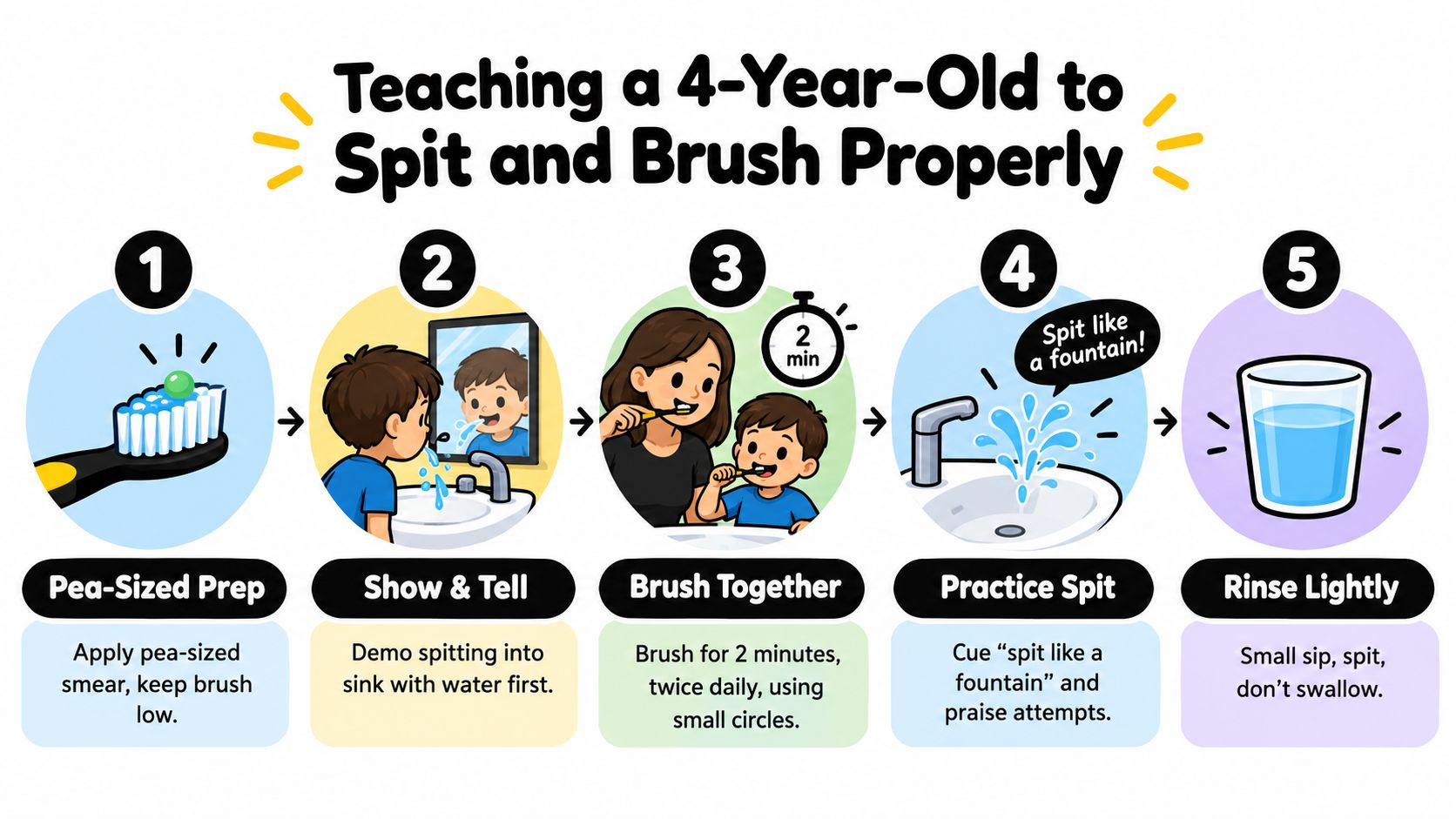
Dispense the toothpaste yourself. Use a soft-bristled, child-sized brush and guide it gently along the gumline. A visual timer or a familiar song can keep the session moving, while dividing the mouth into four areas helps you avoid repeatedly cleaning only the front teeth.
Show the action before asking your child to perform it. Lean forward, purse your lips, and say, “Push the toothpaste forward, then spit into the sink.” A playful cue such as “spit like a fountain” can work better than repeating “don't swallow.”
Try this progression:
- Early practice: Let your child watch you spit water into the sink.
- Controlled brushing: Keep the brush low and use only the amount appropriate for the chosen toothpaste.
- Forward movement: Ask your child to lean toward the sink before spitting.
- Reduced rinsing: Encourage a spit without vigorous rinsing so residue isn't immediately washed away.
- Parent finish: Let your child begin, then complete missed surfaces yourself.
“Brush first, spit second” is easier for a preschooler to remember than a long explanation about ingredients.
Respond to common objections
If foam causes gagging, try a lower-foam formula and reduce the amount rather than allowing the child to skip brushing. If flavor is the issue, offer two parent-approved options, such as a mild fruit flavor and a gentle mint. If your child still swallows nearly everything after steady practice, discuss a fluoride-free nHa paste or another option with a pediatric dentist.
Keep the bathroom calm. Praise the specific behavior you want to repeat, such as holding the brush correctly, leaning forward, or attempting to spit. Supervision remains important until your child can consistently brush all surfaces and spit effectively, not merely until they can recite the instruction.
How to Read Any Kids Toothpaste Label Before You Buy
The front of a toothpaste tube is designed to attract attention. The back tells you what you're buying. Read it in a fixed order so colorful characters and words such as “natural” or “gentle” don't make the decision for you.
Begin with the active panel
Find the active ingredient and its concentration. For a fluoride product, look for the named fluoride compound and the ppm information or equivalent concentration. The NHS age guidance supports 1,000 to 1,500 ppm fluoride for children aged 3 to 6, so a product that doesn't clearly identify its active ingredient deserves a closer look.
Next, check the directions. They should explain the amount for the relevant age group, remind parents to supervise, and tell the child to spit rather than swallow.
Scan the rest of the formula
Look for clues about abrasivity and texture. High-silica or baking-soda-heavy formulas may feel gritty, while a low RDA value, if provided, gives a more useful abrasivity reference than the word “gentle.” The label may also reveal ingredients your child reacts to, including SLS, artificial sweeteners, dyes, parabens, or propylene glycol.
“Natural” doesn't guarantee low abrasivity, and “gentle” isn't a tightly standardized technical term. If your family is also reviewing household products, this resource on choosing toxin free baby essentials provides a broader ingredient-checking perspective, though toothpaste still needs to be judged by its oral-care ingredients and age directions.
Use the children's toothpaste ingredients guide when you want a plain-language explanation of common formulation choices. Seals such as ADA Accepted, or an equivalent national dental approval, may offer an additional screening signal, but they don't replace checking whether your child can tolerate the product.
Save this phone-sized checklist
- Active ingredient: Identify fluoride or hydroxyapatite clearly.
- Concentration: Check the fluoride ppm or the stated nHa concentration.
- Age directions: Confirm the label suits a four-year-old and gives a dose.
- Safety wording: Look for supervision and spit-out instructions.
- Sensory fit: Choose a flavor and texture your child will accept.
- Formula preferences: Scan for SLS, dyes, allergens, and abrasive ingredients.
- Independent review: Look for a recognized dental seal where available.
Quick Parent Checklist and Final Thoughts
At the store, you don't need to compare every colorful tube. Start with the criteria that affect daily use and safety.
- Confirm the active approach: Choose an age-appropriate fluoride product, or verify that a fluoride-free option clearly lists hydroxyapatite or nano-hydroxyapatite.
- Check the concentration: For fluoride toothpaste, the NHS guidance for ages 3 to 6 supports 1,000 to 1,500 ppm.
- Keep abrasivity modest: Prefer a low RDA when the value is listed, and avoid products marketed around aggressive whitening.
- Read the inactive ingredients: Look for ingredients your child has reacted to, including SLS, dyes, artificial sweeteners, parabens, or propylene glycol.
- Match the sensory profile: Pick a flavor and texture your child won't fight.
- Control the dose: Dispense the paste yourself and use the age-appropriate amount.
- Plan supervision: Stay involved while your child learns to brush and spit.
The fluoride versus nHa decision isn't a contest between good and bad parenting. Fluoride toothpaste remains the standard preventive choice in major guidance for most children this age when used in a controlled amount. A fluoride-free nano-hydroxyapatite option can be a considered alternative for some families, especially when swallowing is persistent or a dental professional has recommended a fluoride-free routine.
Technique still matters more than packaging. Brush consistently, help your child reach the gumline and back teeth, practice spitting without turning it into a battle, and keep regular pediatric dental visits. If your child has cavities, enamel changes, repeated irritation, or ongoing swallowing concerns, take the toothpaste tube to the appointment and ask for a recommendation for your child.
Choose a toothpaste that matches your child's age and swallowing habits today, dispense the correct amount yourself, and begin a short, calm spit-practice routine at the next brushing session. If you're unsure whether fluoride or fluoride-free nano-hydroxyapatite fits your child's cavity risk, schedule a conversation with a pediatric dentist before changing the routine.
