

Posted by Sarah Collins
on August 02, 2026

You notice it at the sink first. A little pink on the toothbrush, a gum line that feels tender when you floss, maybe a slightly metallic taste that shows up after brushing. That's often the moment people start wondering whether an alcohol free mouthwash for gum disease could help, especially if regular mouthwash burns or leaves the mouth feeling dry.
That worry makes sense. Gum symptoms can feel small at first, but they're worth paying attention to because the same routine that keeps breath fresh also has to help manage plaque along the gum line. If you want a calm, plain-language starting point for what can help at home, Dr. Schneider's gum disease guide is a useful companion read, especially if you're trying to separate sensible home care from overpromises.
When Your Gums Try to Tell You Something
Many people first notice gum trouble at the sink. The toothbrush comes away with a little blood, floss feels uncomfortable, or a crunchy bite makes the gum line feel tender. Those signs do not automatically point to anything severe, but they do mean the gums are asking for attention.
The alcohol question usually comes up after that. If a rinse burns, leaves the mouth dry, or feels too harsh on already irritated tissue, a gentler option starts to make sense. An alcohol-free rinse can fit that role, but it still works best as part of a bigger routine, not as a fix on its own.
Gum care comes down to three basic jobs. Reduce plaque, calm inflammation, and keep the routine realistic enough that you repeat it. A useful way to see the bigger picture is to pair rinsing with the habits in Dr. Schneider's gum disease guide. That keeps the focus on what helps gums day to day, instead of treating mouthwash like the whole answer.
Practical rule: If your gums are talking, listen early. The goal is to respond before irritation becomes a pattern you keep trying to undo.
How Gum Disease Starts and Where Mouthwash Fits
A little gum trouble often starts without warning. Plaque is a sticky film that gathers along the gum line and between teeth, and when it sits there long enough, the gums react by becoming inflamed. Bleeding, puffiness, and tenderness are usually the first signs, because the tissue is responding before the problem feels obvious.
That is why mouthwash makes sense as an adjunct, not a stand-alone answer. Brushing and flossing do the mechanical cleaning, and a rinse can carry an active ingredient into spots a brush may miss. The 2021 review in BioMed Research International explains that mouth rinses are commonly used alongside mechanical oral hygiene, including after scaling and root planing, after periodontal surgery, and for people who need extra help with daily cleaning a 2021 review in BioMed Research International on mouth rinse adjuncts.
Why alcohol became the default
Alcohol has long been used in mouthwash because it helps dissolve ingredients and creates a strong sensory feel that many people read as “clean.” The tradeoff is easy to understand. The same formula can feel drying or stingy, especially when gums are already irritated or the mouth is dry.
The better question is not whether alcohol is present. It is which active ingredient is meant to do the actual gum-care work. If the rinse is built around ingredients that target plaque and inflammation, alcohol does not need to be the part that gets all the attention.
A simple way to keep the full picture in view is to follow gum disease prevention tips from This gum disease prevention guide. That approach keeps mouthwash in its proper place, as one piece of daily care alongside clean brushing, flossing, and regular professional cleanings.
What the Clinical Evidence Says
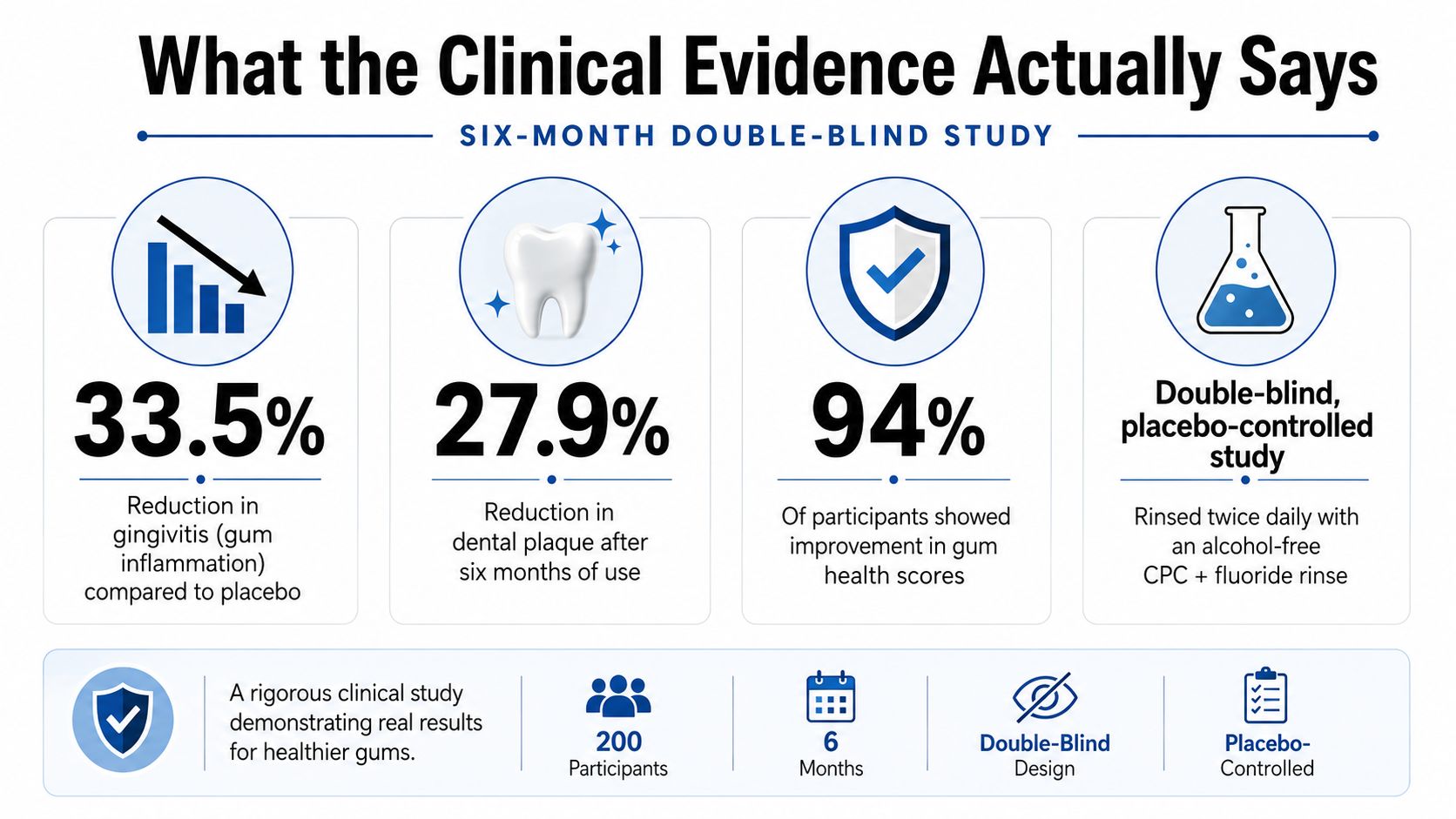
A worried parent standing in the pharmacy aisle usually wants the same answer: does this rinse do anything real for the gums, or is it just going to make the mouth feel fresher for a few minutes? The evidence is more useful than the label debate suggests. In a 6-month double-blind study of adults, an alcohol-free mouthwash with 0.075% cetylpyridinium chloride and 0.05% sodium fluoride produced statistically significant improvements from baseline, including a 33.5% drop in gingival index scores, a 34.5% drop in gingival interproximal scores, a 63.2% drop in gingival severity, a 33.6% drop in plaque scores, a 30.0% drop in plaque interproximal scores, and a 73.6% drop in plaque severity study.
The same study found that the alcohol-free CPC rinse outperformed a sodium fluoride control at 3 and 6 months. Between-group reductions reached 38.1% for gingival index, 37.1% for gingival interproximal, 63.6% for gingival severity, 36.5% for plaque, 33.2% for plaque interproximal, and 78.5% for plaque severity. That matters because the benefit was not just a stronger mint sensation. It was measurable change in the signs gum-conscious adults care about most, plaque buildup and irritated gums.
What the chlorhexidine data adds
A randomized clinical study of chlorhexidine mouthrinse found that both the alcohol-free and alcohol-containing groups significantly reduced gingival bleeding, plaque, and gingival inflammation versus brushing alone after 6 weeks. The treatment differences in gingival score were −0.061 for the alcohol-containing group and −0.070 for the alcohol-free group, both highly significant at p<0.0001 study. Adverse events were reported by 27.8% of the alcohol-containing group and 24.8% of the alcohol-free group, compared with 3.7% for brushing alone.
That pattern helps clear up a common misunderstanding. The point is not that alcohol automatically makes a rinse work better. The active ingredient is doing the heavy lifting, and alcohol mainly changes the feel, the formula, and sometimes the comfort level for people whose gums are already tender.
A separate gingivitis study found 0.2% chlorhexidine alcohol-free rinse was as effective as 0.2% chlorhexidine with alcohol for plaque and gingival inflammation, with the alcohol-free group showing a greater gingival-index change clinical study. Put together, the evidence supports a simple idea, alcohol-free does not mean weak. It means the question shifts to which ingredient is responsible for the gum benefit, and how well that rinse fits into a broader routine. For people trying to match a rinse with the rest of their care, the mouthwash that doesn't kill good bacteria conversation is part of the same decision. The rinse should support brushing, flossing, and professional care, not replace them.
The Active Ingredients That Actually Do the Work
The label question that matters most is not “Does it contain alcohol?” It's “Which active ingredient is supposed to help my gums, and for how long should I use it?” That shift makes the whole category easier to understand.
A quick comparison of common actives
| Active Ingredient | Best For | Typical Use Window | Things to Know |
|---|---|---|---|
| Chlorhexidine | Short-term, dentist-guided gum support | Short bursts | Strong antimicrobial action, but it's usually reserved for specific situations and can be a little too much for everyday, long-term use |
| Cetylpyridinium chloride, CPC | Daily plaque and gingivitis support | Ongoing use | Often found in alcohol-free formulas and backed by clinical evidence for gum-health support |
| Essential oils | General plaque and gingivitis control | Ongoing use | Can be useful in alcohol-free or alcohol-containing formulas, depending on the product |
| Fluoride | Enamel support and cavity-risk co-benefits | Ongoing use | Helpful when gum recession exposes root surfaces, which can make teeth more vulnerable |
| Peroxide | Short-term freshness and some gum-care routines | Short-term | Best understood as a situational ingredient, not the whole solution |
A useful place to learn more about fluoride's role is this overview of fluoride treatment benefits, especially if gum recession has made you think more about exposed tooth surfaces and sensitivity. Fluoride doesn't replace gum care, but it can be part of the broader picture.
One more ingredient comparison worth knowing is essential oils. A 2024 review reported that in a 2-week experimental gingivitis model, an alcohol-free essential-oil rinse was more effective than a 5% hydro-alcohol mouthwash without essential oils for reducing plaque and gingivitis, while also noting moderate certainty that both alcohol-containing and alcohol-free essential-oil mouthwashes can be recommended as adjuncts to toothbrushing review.
If you're trying to avoid disrupting the mouth's balance more than necessary, this internal read on mouthwash that doesn't kill good bacteria is worth a look. It's a good reminder that “stronger” isn't always “smarter.”
How to Choose a Mouthwash That Fits Your Gums
Start with the active ingredient, not the flavor. A rinse made for plaque control, a rinse made for dry mouth, and a prescription rinse for periodontal care all solve different problems, even if the bottles look similar on the shelf.
Next, look at how your mouth feels. If your gums are inflamed, if your mouth tends to feel dry, or if you don't like burning rinses, alcohol-free is often the more comfortable fit. Independent oral-health guidance also notes that alcohol-free formulas are commonly chosen for sensitive or inflamed gums and dry mouth, which matches how many people use them in real life oral health guide.
What to check on the label
- Active ingredient first: Look for CPC, chlorhexidine, essential oils, fluoride, or peroxide, then decide whether that ingredient matches your goal.
- Alcohol content: If the bottle includes alcohol and you already struggle with dryness or burning, it may not be the best daily choice.
- Fit for your goal: A rinse for gum support is different from one aimed at cavity support or short-term post-procedure use.
- Claims language: Be cautious with labels that promise to cure disease or replace dental care. Mouthwash supports a routine, it doesn't replace an exam.
- Family suitability: If a child can't reliably spit, the safety question matters more than the strongest possible sensory effect.
Useful boundary: If symptoms are persistent, or if you need care after periodontal treatment, a prescription rinse may be more appropriate than any over-the-counter option.
That distinction matters because some needs are more specialized. A rinse can support the routine, but it can't diagnose what's underneath the bleeding.
Using an Alcohol-Free Rinse the Right Way
The label matters, but timing matters too. If you brush with fluoride toothpaste and then swish a rinse right away, some of the fluoride can be washed off before it has time to stay on the teeth. A better habit is to separate those steps, or use the rinse at a different point in the day, depending on the product and your dentist's advice. For a clearer guide on timing, see our article on mouthwash before or after brushing.
For the average adult, the routine stays simple, use the amount listed on the bottle, swish for the full recommended time, and avoid rinsing with water afterward unless the label says to do so. The active ingredient is what does the work, so the goal is to give it enough contact time to reach the gumline and the spaces between teeth. More active rinses, especially chlorhexidine, are usually used for a limited window rather than as an everyday habit.
A parent may use that routine differently from an adult who is trying to calm gum tenderness. The adult might keep the rinse separate from brushing so the fluoride toothpaste can stay on the teeth, while the parent may choose an alcohol-free option that is easier to keep in the home routine because it feels less harsh and is simpler to repeat day after day.
The best routine is the one you can keep doing. If the rinse burns, dries the mouth, or feels confusing to use, the habit usually fades quickly. A rinse helps most when it fits into a wider gum-care routine instead of sitting there by itself.
Building a Complete Gum-Care Routine Around Your Rinse
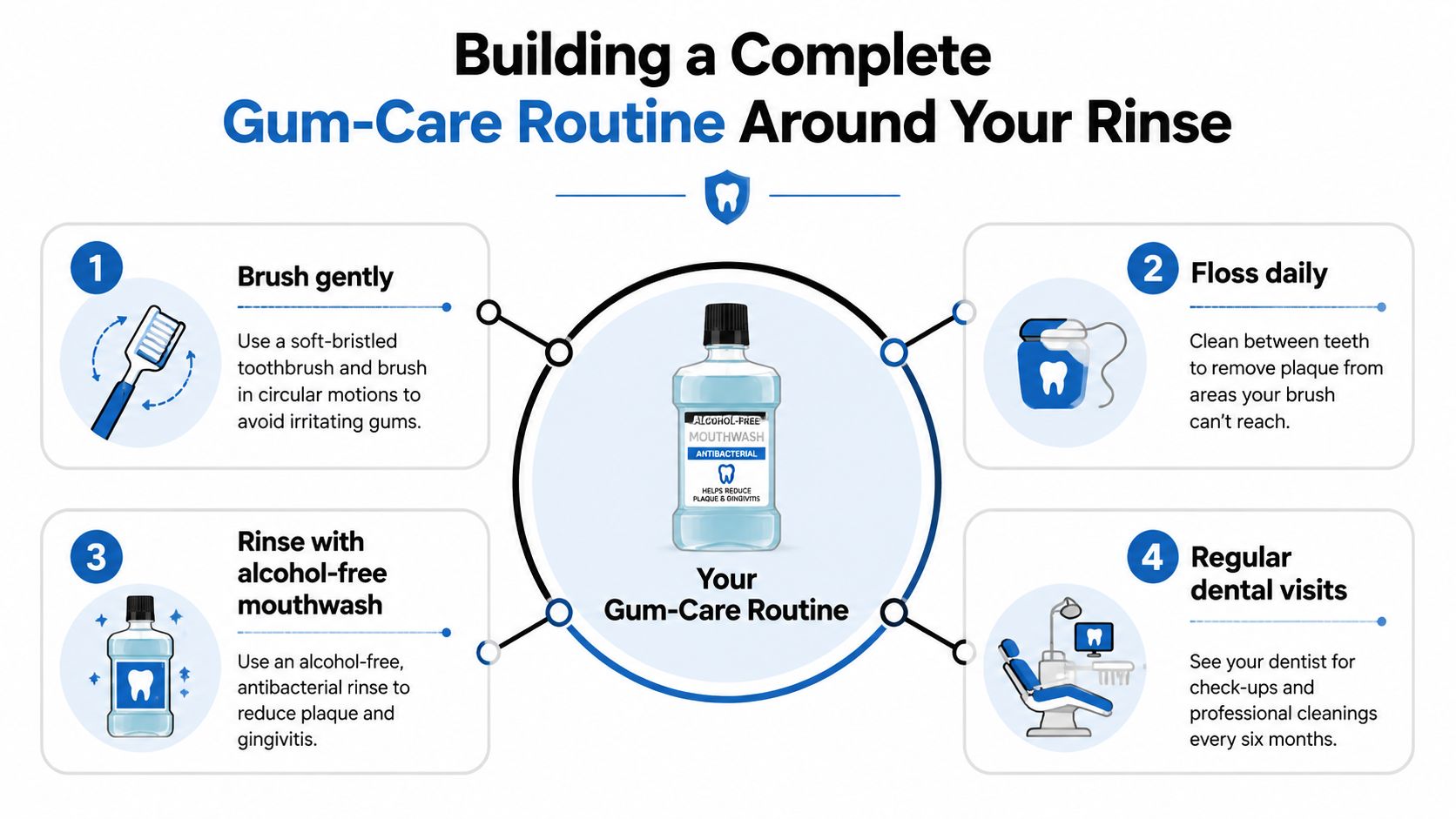
A rinse helps most when the rest of the routine is pulling its weight too. Brushing gently with a soft brush lowers the risk of irritating already sensitive gums, and flossing or interdental cleaning removes plaque from the places bristles can't fully reach. A tongue scraper can be useful too, because the tongue collects film quickly and can affect how clean the whole mouth feels.
Think of the rinse as the middle of the routine, not the whole story. The order is less important than consistency, but the pieces need to work together. If your toothpaste leaves your mouth feeling stripped or your brush feels too hard, the rinse has to work against that discomfort instead of alongside a calm routine.
A routine that's easy to live with
- Brush gently: Use a soft-bristled toothbrush and small circular motions.
- Clean between teeth: Floss, picks, or another interdental tool can remove buildup the brush misses.
- Rinse with purpose: Choose an alcohol-free formula that matches your goal, not just your taste preference.
- Clean the tongue: A scraper can help reduce that coated feeling some people notice by evening.
- Keep dental visits on schedule: Professional cleanings still matter, especially when gums have already been irritated.
If you like a fluoride-free, science-led toothpaste in the background of that routine, a product such as Mouthology's 10% nano-hydroxyapatite toothpaste is positioned as a complementary upgrade for people who want a gentle, family-friendly feel without building the whole routine around alcohol or harshness. The key is to treat it as part of a broader system, not as a cure-all.
Red Flags and Quick Answers You Shouldn't Skip
A mouthwash isn't the next step if your gums are clearly asking for a dentist. Persistent bleeding, gum recession, loose teeth, pain when chewing, swelling, or bad breath that doesn't improve with better hygiene all deserve a professional look. A rinse may help support comfort, but it can't solve deeper problems on its own.
That's also true if the mouth feels sore for no obvious reason, or if you've already tried a better routine and the symptoms keep coming back. At that point, the question isn't which bottle to buy next. It's what's happening under the surface.
Quick answers people usually want
Is alcohol-free mouthwash safe during pregnancy?
Many people prefer it because it skips the burning and drying feeling that can be hard to tolerate. The safer choice still depends on the active ingredient and your dentist or clinician's advice, especially if you're already dealing with nausea, dryness, or gum tenderness.
Can kids use it?
Some alcohol-free rinses are easier for children to use because they feel gentler, but swallowing risk matters. If a child can't spit reliably, ask a dentist which products make sense for that age and routine.
What if I already have dry mouth?
Alcohol-free is usually the better fit because dryness tends to make irritation feel worse. If dry mouth is a constant issue, the rinse should support comfort without becoming the thing that makes the mouth feel tighter.
How long before I notice a change?
That depends on the ingredient and the consistency of the routine. The studies above looked at changes over weeks and months, not overnight, which is a good reminder that gum care is a habit, not a single action.
If your rinse burns every time you use it, this explanation of why mouthwash burns may help you figure out whether the problem is the formula, the active ingredient, or just a mismatch for your mouth. The calmest next step is often the most useful one.
If you're trying to build a gentler, more effective routine for your gums, pick one alcohol-free rinse that matches your real goal, then pair it with brushing, flossing, and a professional exam if symptoms keep showing up. If you want a fluoride-free toothpaste and family-friendly tools that fit that same thoughtful approach, explore Mouthology and build a routine that feels comfortable enough to keep.
