

Posted by Sarah Collins
on September 17, 2026

Could a sweetener help protect teeth, even though it isn't a toothpaste, a mineral, or a medicine? That's the question behind xylitol cavity prevention, and the honest answer is more nuanced than many product labels suggest.
Xylitol may help lower the conditions that allow cavity-associated bacteria to thrive, especially when people use it repeatedly in chewing gum or lozenges. But it doesn't clean teeth, rebuild enamel, or replace brushing, interdental cleaning, fluoride, dental care, or other well-established habits. The strongest signal appears with structured, repeated exposure, while evidence for xylitol toothpaste and broad long-term claims remains limited or inconsistent.
What Xylitol Actually Does for Your Teeth
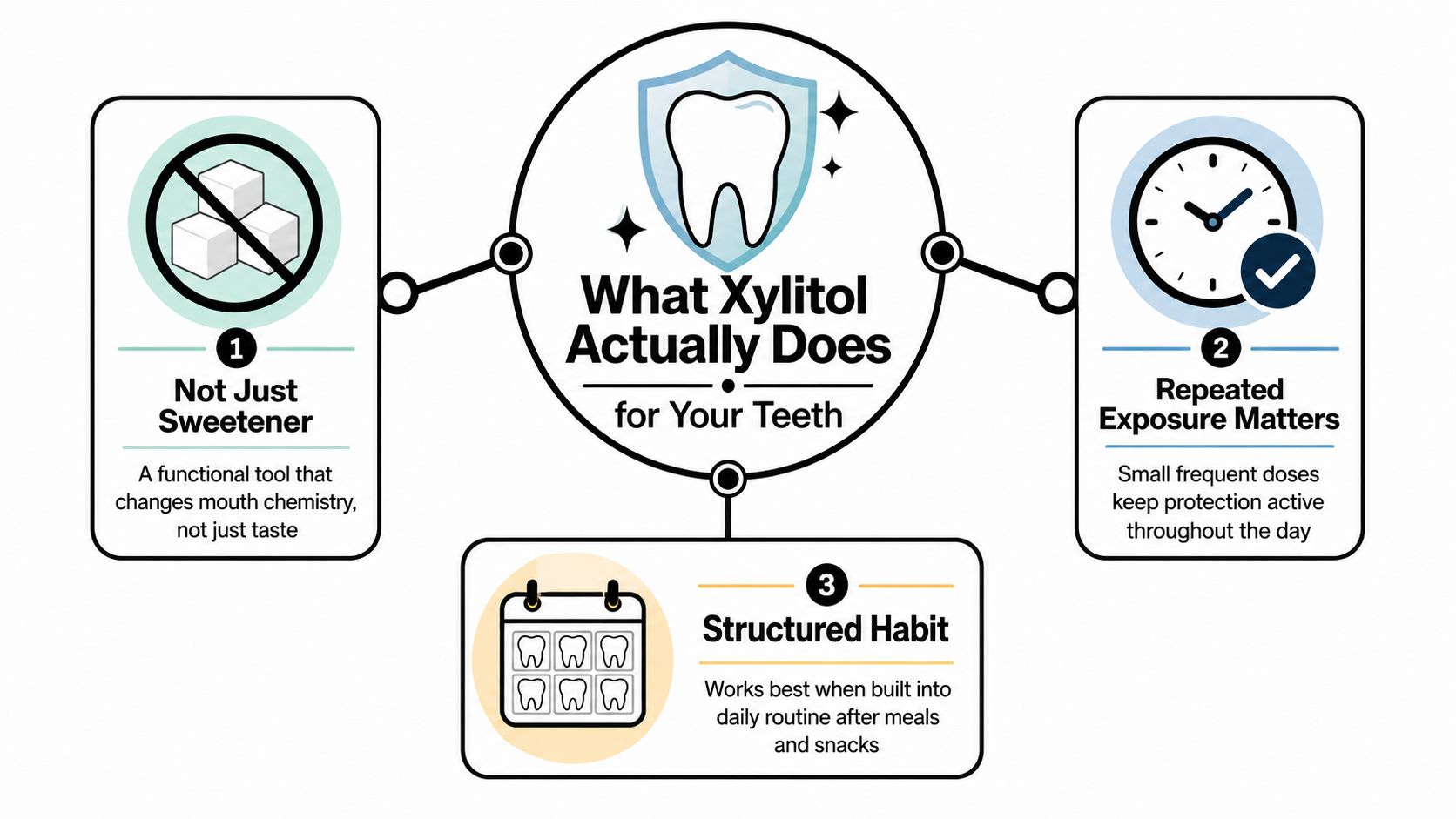
Xylitol is often introduced as a sugar substitute, but its more interesting role happens inside the mouth. Unlike ordinary sugar, it isn't fermented by oral bacteria into the same acids that contribute to enamel demineralization. That gives it a useful supporting role after meals, when bacterial activity and acid exposure can challenge teeth.
The practical answer is simple: xylitol works best as a repeated habit alongside daily brushing and flossing, not instead of them. Chewing xylitol gum can also increase saliva flow, and saliva helps dilute acids and move food particles away. Still, xylitol isn't a scrubber. It won't remove established plaque the way brushing and interdental cleaning do, and it won't repair a formed cavity.
Its value is more indirect. Regular exposure may reduce acid production and discourage the activity of cavity-associated bacteria such as Streptococcus mutans. That can make the mouth less favorable to the processes that contribute to decay, but it's a gradual support strategy rather than an instant shield. The mechanism and practical role are summarized accessibly by the University of Colorado Anschutz explanation of xylitol and dental health.
The role it can play
Think of xylitol as a between-meal tool. A xylitol gum or lozenge can fit after breakfast, lunch, or a snack, while brushing remains the habit that physically removes plaque and delivers toothpaste ingredients to the tooth surface.
For broader, practical guidance on reducing cavity risk, the Seven Oaks Dentistry cavity-prevention resource offers useful context. The key point is that xylitol belongs inside a complete routine, not above it.
How Xylitol Disarms Cavity-Causing Bacteria
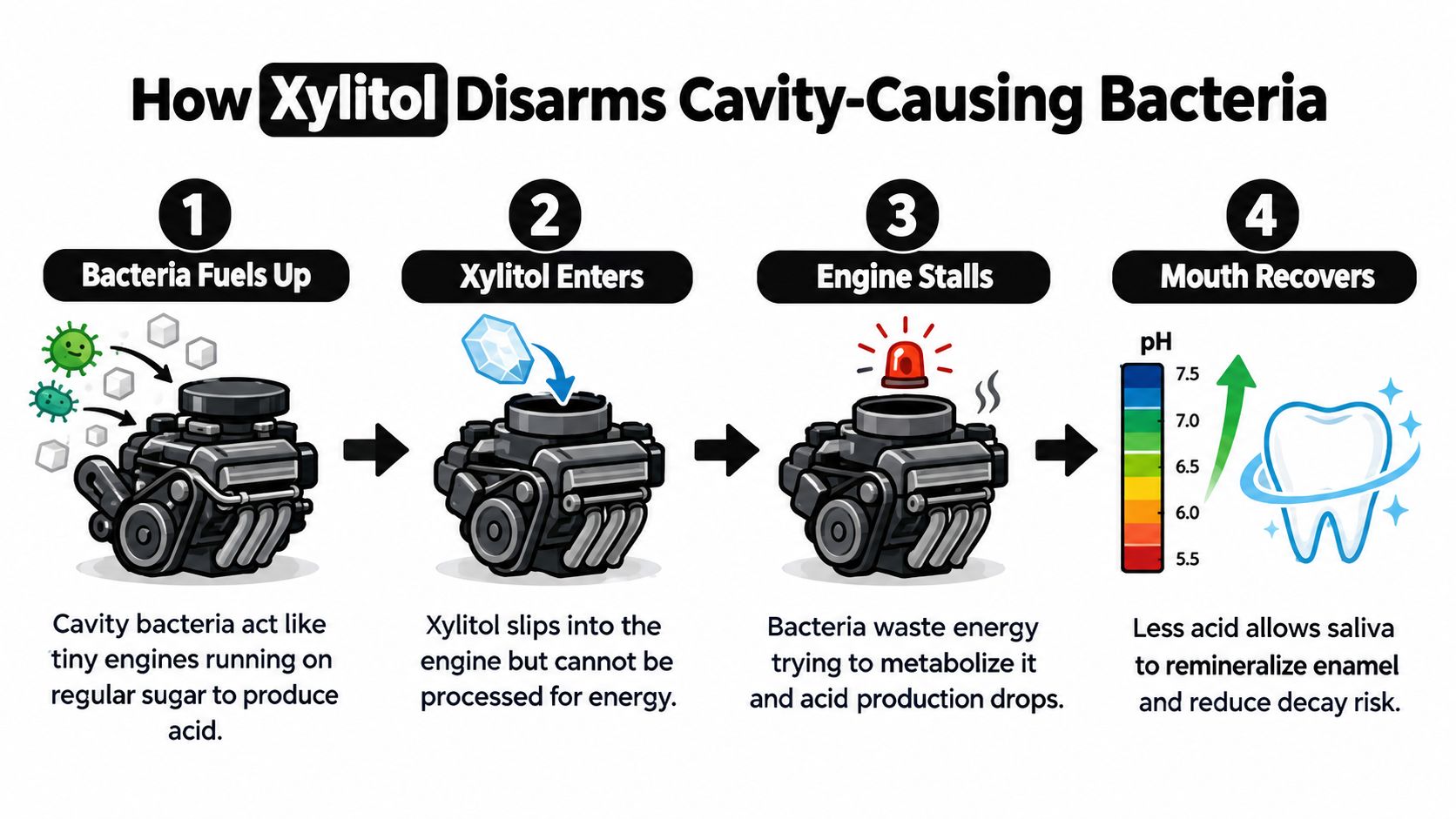
Cavity-associated bacteria behave a little like tiny engines. They take fermentable sugars from food, process those sugars, and release acids. Repeated acid exposure can pull minerals from enamel and shift the mouth toward decay.
Xylitol enters that process but doesn't provide the same usable fuel. Mutans streptococci can take xylitol up through a sugar-transport pathway called the fructose phosphotransferase system. Inside the bacterial cell, xylitol becomes xylitol-5-phosphate, a form the bacteria can't effectively metabolize for energy. The result is an energy-wasting loop, much like an engine repeatedly trying to run on fuel it can't use.
That disruption can reduce lactic acid output and interfere with the sticky biofilm structure that helps bacteria adhere to teeth. Xylitol's proposed dental value therefore isn't just that it tastes sweet without behaving like sugar. It may change how certain bacteria behave and how firmly plaque-associated material attaches.
Why repeated exposure matters
Chewing also stimulates saliva. A fuller saliva response can help buffer acids, rinse the mouth, and return minerals to the tooth environment. Some clinical explanations describe a small rise in salivary pH after chewing, but the main practical lesson is broader: xylitol works through repeated contact and saliva stimulation, not through a single sweet taste.
Over time, repeated exposure may reduce plaque adhesion and suppress the growth or activity of S. mutans. That doesn't mean every xylitol product produces the same result. Dose, frequency, delivery format, chewing time, and the rest of the person's oral routine all matter.
What the Research Actually Shows
Could xylitol help prevent cavities, or has its reputation run ahead of the evidence? The answer is encouraging but qualified. A 2017 systematic review and meta-analysis found a statistically significant reduction in DMF/dmf outcomes with xylitol compared with controls. The standardized mean difference was −1.09, with a 95% confidence interval of −1.34 to −0.83 (systematic review and meta-analysis). Across the included studies, that supports measurable anti-caries activity.
A separate synthesis reported a protective fraction of around 30%. It found the clearest signal in products containing 100% xylitol, used after meals 3 to 5 times daily (clinical synthesis of xylitol research). The practical lesson resembles watering a plant regularly rather than flooding it once: repeated exposure, especially through gum, appears more relevant than occasional use.
The weaker point is consistency. A 2015 Cochrane review examined evidence involving 4,216 children over 2.5 to 3 years. Fluoride toothpaste containing 10% xylitol may have reduced caries by 13% compared with fluoride-only toothpaste, but the evidence was rated low quality. The review found little high-quality evidence that xylitol products clearly prevent decay across children and adults. Most studies tested gum, not toothpaste, lozenges, or tablets (Cochrane review).
| Study | Format & Dose | Duration | Result |
|---|---|---|---|
| 2015 Cochrane review | Fluoride toothpaste containing 10% xylitol | 2.5 to 3 years | Possible 13% caries reduction versus fluoride-only toothpaste, with low-quality evidence |
| 2017 systematic review and meta-analysis | Xylitol products across included studies | Varied | DMF/dmf reduction, standardized mean difference −1.09, 95% CI −1.34 to −0.83 |
| Review of randomized trials in children | Xylitol products, varied formats | Varied | Small effect, standardized mean difference −0.24, 95% CI −0.48 to 0.01, very low-quality evidence (AAPD review) |
That final confidence interval crosses no effect, so the benefit remains uncertain in that analysis. Gum and frequent dosing have the most useful signals. Toothpaste and long-term population claims need more cautious interpretation. Xylitol can complement a sound oral-care routine, but the evidence does not support treating every xylitol product as equally effective.
How Much Xylitol You Need and How to Take It
Could a small amount of xylitol help, or does the timing matter more? Clinical guidance commonly places a practical target at 5 to 10 grams per day, divided into at least 3 consumption periods (independent review and clinical guidance). For children age 5 and older, the American Dental Association advises that 5 to 8 grams per day, split into 2 to 3 doses of xylitol gum or lozenges, may reduce coronal caries.
Another commonly cited plan uses 6 to 10 grams daily across at least 3 periods. An American Academy of Pediatric Dentistry review describes a study in which 3.5 grams of xylitol gum three times daily, totaling 10.5 grams per day, significantly reduced caries incidence. By comparison, 7 to 9 grams per day taken fewer than three times daily did not show a significant reduction (AAPD clinical review).
The practical lesson is simple: the daily total and the number of exposures both matter. Xylitol works more like repeated practice than a single large dose. A product may list xylitol prominently yet provide too little per piece to resemble the quantities studied.
| Format | Xylitol per serving | Daily exposures | Evidence strength | Best for |
|---|---|---|---|---|
| Chewing gum | Check the label and calculate the total | Commonly after meals | Strongest evidence base among formats | Adults and children who can chew safely |
| Lozenges or mints | Check grams per piece or serving | Several separate periods | Moderate or limited, depending on product | People who do not want gum |
| Xylitol toothpaste | Often difficult to compare directly | Usually linked to brushing | Limited standalone evidence | Adding xylitol to a brushing routine |
| Mouthwash or nasal spray | Product-specific | Product-specific | Niche and weaker for cavity prevention | Specific preferences or professional guidance |
A usable routine
Read the label first. Multiply the grams of xylitol per piece by the number of pieces needed to approach your chosen daily target, then spread that amount across at least three moments. After meals provide an easy cue, since chewing can stimulate saliva after food has entered the mouth.
Check the sweetener blend, too. A product containing sorbitol may not provide the same xylitol exposure as one sweetened primarily with xylitol. For children, select an age-appropriate product and supervise use, particularly when gum might be swallowed. Lozenges suit some families better, although gum has the clearer evidence base. Xylitol is therefore a practical add-on, not a reason to replace established brushing and preventive care.
Xylitol vs Fluoride vs Nano-Hydroxyapatite
These ingredients aren't interchangeable competitors. They act at different points in the oral-care process.
Fluoride supports remineralization and helps make enamel more resistant to acid. It has the deepest population-level evidence among the three options discussed here. Nano-hydroxyapatite is a biomimetic mineral designed to resemble the mineral component of teeth, and clinical support for it is growing but still emerging. Xylitol works upstream by influencing bacterial metabolism, acid production, plaque adhesion, and saliva stimulation.
| Ingredient | Mechanism | Evidence strength | Primary benefit | Best use case | Combines well with |
|---|---|---|---|---|---|
| Xylitol | Limits usable bacterial fuel and supports saliva flow | Mixed, with stronger signals for gum | Repeated antibacterial and acid-challenge support | Between meals | Brushing, fluoride, nano-hydroxyapatite |
| Fluoride | Supports enamel remineralization and acid resistance | Strongest established evidence | Foundation of cavity prevention | Twice-daily toothpaste use | Xylitol and routine cleaning |
| Nano-hydroxyapatite | Biomimetic mineral support at the tooth surface | Growing, emerging clinical support | Mineral-focused care and sensitivity support | Fluoride-free households or sensitivity routines | Xylitol and careful brushing |
A practical stack might use fluoride toothpaste twice daily, then add xylitol gum or lozenges between meals. People who prefer fluoride-free care may consider nano-hydroxyapatite, while recognizing that the evidence base differs from fluoride. Mouthology's explanation of fluoride versus nano-hydroxyapatite provides additional ingredient-level context.
The safest recommendation depends on age, cavity history, sensitivity, swallowing ability, and professional advice. Xylitol shouldn't be framed as a repair ingredient, and nano-hydroxyapatite shouldn't be treated as a reason to abandon dental visits or plaque removal.
Building a Daily Xylitol Routine That Works
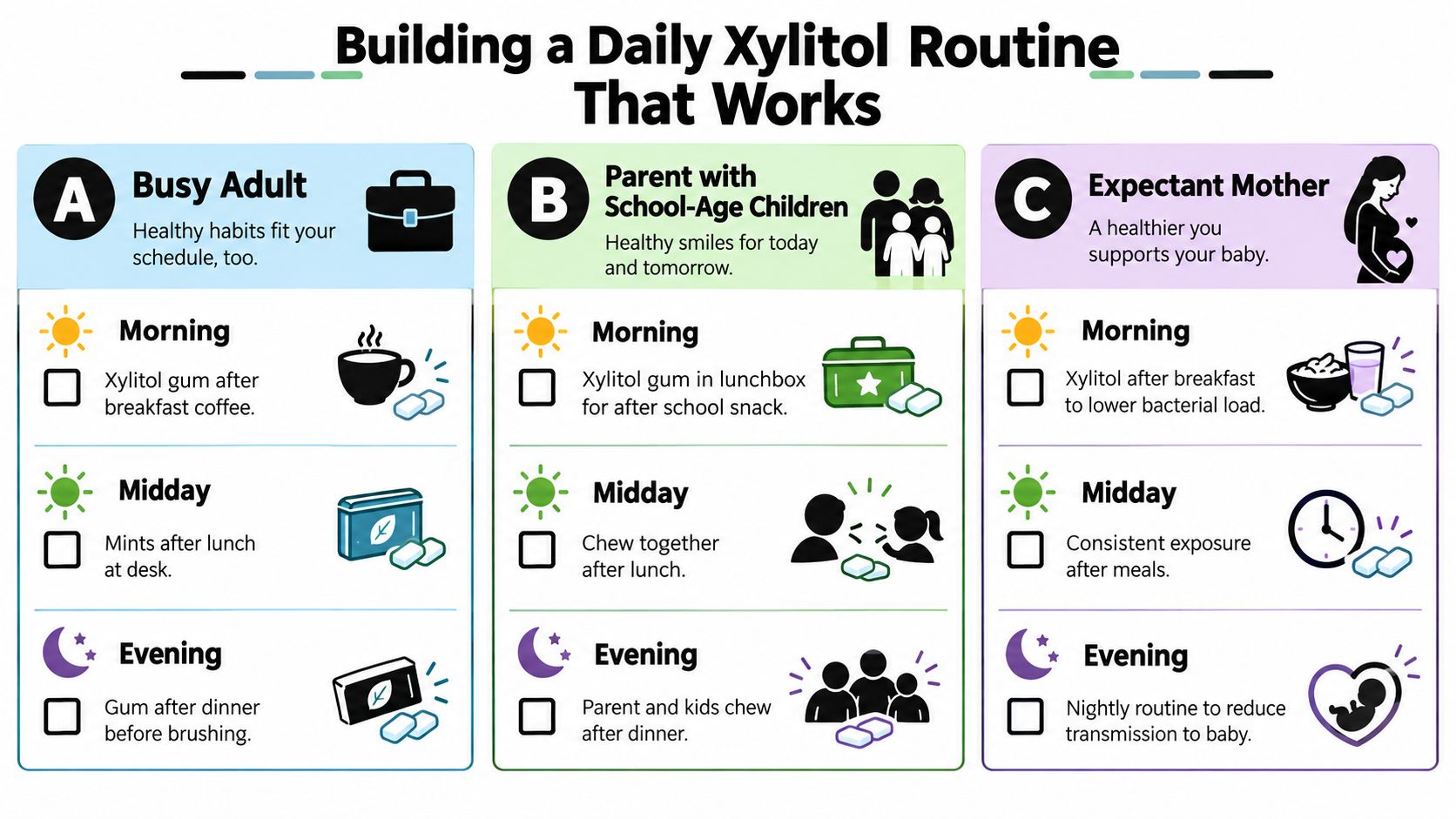
A routine succeeds when it attaches to something you already do. The most useful cue isn't a perfect schedule. It's a repeatable moment, such as finishing coffee, leaving school pickup, or clearing the dinner table.
Three realistic profiles
The busy adult can keep xylitol gum beside the coffee supplies and use it after breakfast. A desk drawer can hold a labeled xylitol mint for after lunch, while a final piece of gum after dinner can sit before the evening brushing routine.
The parent of a school-age child might pack an age-appropriate product for the period after an afternoon snack, supervise use when needed, and make post-dinner chewing a family cue. Children should only use products suitable for their age and chewing ability.
An expectant mother may use xylitol after breakfast and lunch as part of a consistent oral-care routine. Pregnancy can change oral-health needs, so a dentist or healthcare professional should help personalize the plan. Xylitol can be considered a supportive habit, not a guarantee against bacterial transmission or future dental problems.
For toothpaste choices, Mouthology's information on toothpaste with xylitol explains how xylitol may be included alongside other oral-care ingredients. Toothpaste remains a brushing product, not a substitute for the repeated gum or lozenge exposure used in many studies.
Troubleshooting the habit
- Dry mouth: Use water and discuss persistent dryness with a dental professional, since reduced saliva can change cavity risk.
- Jaw fatigue: Alternate gum with a suitable lozenge if chewing becomes uncomfortable.
- Taste fatigue: Use different formats or neutral flavors, while checking the actual xylitol amount.
- Travel days: Store a small supply in a sealed container, away from children who shouldn't use it unsupervised and away from pets.
A gentle first week can look like this:
- Start with two exposures on the first days.
- Add a third exposure after a meal once your stomach and routine feel comfortable.
- Build toward the structured daily pattern supported by the clinical literature.
- Keep brushing and interdental cleaning unchanged throughout the trial.
- Review sensitivity, plaque concerns, or recurring problems with your dentist rather than judging success by taste alone.
Safety, Side Effects, and Common Misconceptions
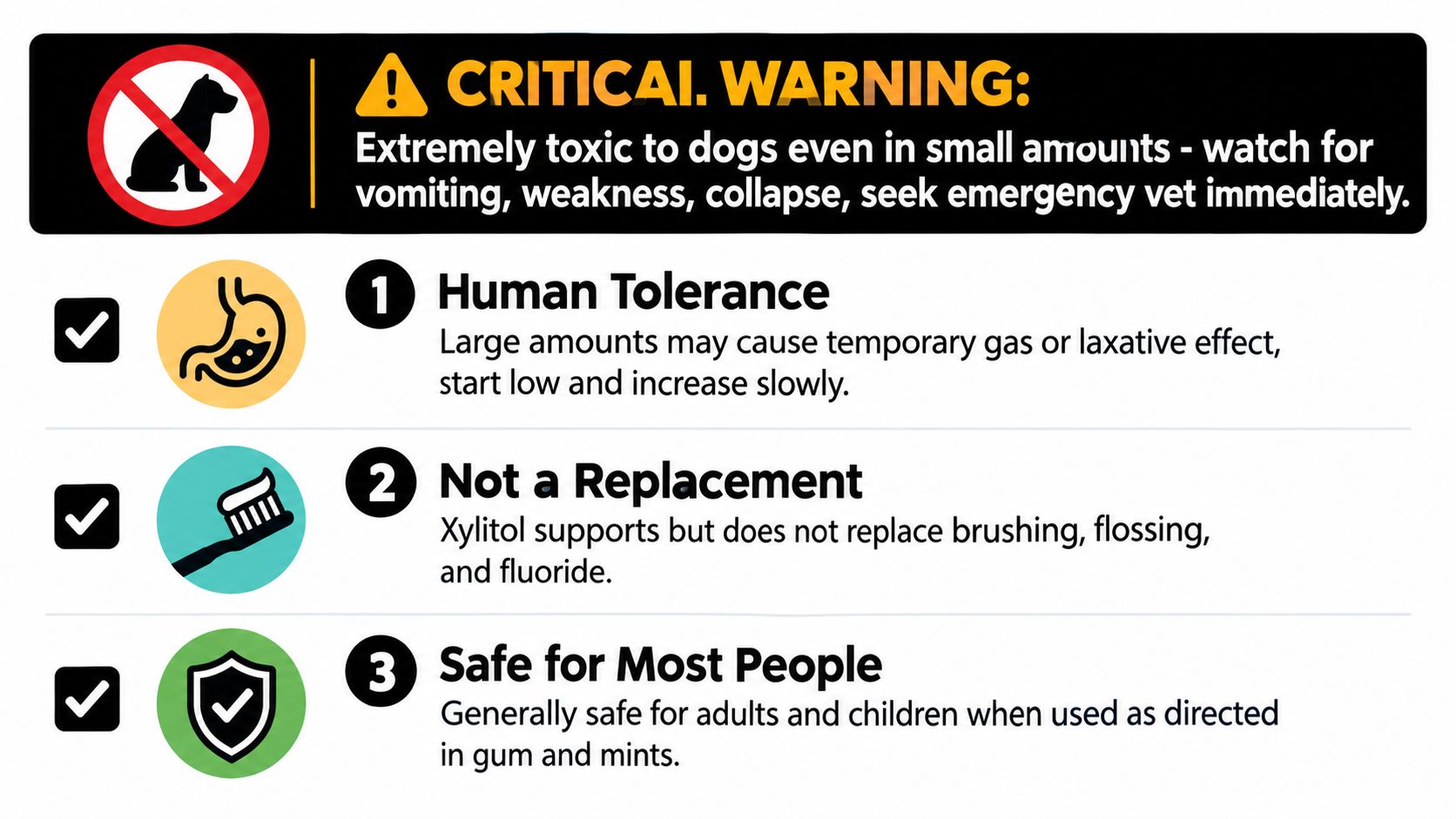
The most urgent safety fact concerns dogs. Xylitol is extremely toxic to dogs, even in small amounts. If a dog may have eaten gum, mints, toothpaste, or another xylitol-containing product, watch for vomiting, weakness, or collapse and seek emergency veterinary care immediately. Store every xylitol product in a closed location pets can't access.
Human tolerance is different. Amounts above roughly 30 to 40 grams per day may cause bloating, gas, or osmotic diarrhea, so a gradual introduction is sensible. Starting around 5 grams and increasing slowly can help you identify your personal tolerance, although individual responses vary.
Three myths to leave behind
Myth one, any product containing xylitol protects teeth. A chocolate bar, baked product, or peanut butter can contain xylitol without delivering the repeated oral exposure used in dental research. Check the product's xylitol amount and intended use.
Myth two, xylitol replaces fluoride toothpaste. It doesn't. Xylitol supports the oral environment, while brushing physically disrupts plaque and toothpaste provides its own active ingredients.
Myth three, swallowing gum gives the same exposure as chewing it. It doesn't. Chewing provides contact with the mouth and stimulates saliva. Swallowing also creates a choking or digestion concern for some children, so supervision matters.
Gum has the clearest delivery evidence for children, while mints, toothpaste, and mouthwash have weaker support for cavity prevention. People who are pregnant can discuss xylitol with their healthcare professional, especially if they're adding a new product or have digestive sensitivity. For context on xylitol and blood-sugar-related product choices, see this guide to xylitol for people with diabetes.
Key Takeaways and What to Do Next
Could xylitol help prevent cavities without replacing the habits that already protect teeth? Yes, as an evidence-aligned add-on, especially when gum or lozenges provide repeated exposure between meals. Brushing, interdental cleaning, dental visits, and suitable toothpaste remain the foundation.
Use this practical plan:
- Choose a structured amount: Research and clinical guidance commonly discuss 6 to 10 grams per day, divided across 3 to 5 exposures. Follow product directions and introduce it gradually.
- Keep brushing central: Xylitol does not replace fluoride toothpaste or the physical removal of plaque.
- Assess mineral options carefully: Nano-hydroxyapatite may appeal to people seeking fluoride-free or sensitivity-focused care, but its cavity-prevention evidence is still developing.
- Watch digestive tolerance: Start with less, then increase only if your body handles it comfortably.
- Protect pets: Store gum, mints, toothpaste, and other xylitol products away from dogs.
Several questions remain open. Researchers need clearer answers about dosing for children under six, whether toothpaste containing 5% or higher xylitol meaningfully reduces cavities, and whether xylitol creates lasting oral-microbiome changes beyond documented reductions involving S. mutans. A recent evidence review found insufficient or very low-certainty evidence for many real-world groups and products.
For the first week, try xylitol gum after a mid-morning and mid-afternoon eating occasion, then add a post-lunch mint if appropriate. Keep your usual brushing and flossing routine. At your next dental visit, ask about plaque, sensitivity, and cavity risk instead of using a product label as your progress measure.
Choose an age-appropriate gum or lozenge, check grams per serving, keep it away from pets, and set three consistent after-meal exposure points. Ask your dentist about children, pregnancy, sensitivity, or recurring decay.
