

Posted by Sarah Collins
on October 07, 2026

The toothbrush is ready, the bath is finished, and bedtime is already late. Your child clamps their mouth shut, runs behind the sofa, or announces that they brushed earlier, despite the suspiciously dry toothbrush. You're left wondering whether to negotiate, threaten, bribe, or just give up for tonight.
Learning how to get kids to brush teeth isn't mainly about finding a more exciting toothbrush. It's about building a routine that matches your child's development, reducing the parts that feel overwhelming, and keeping an adult involved until the child can clean effectively. Independence should follow reliable technique, not replace it.
The Daily Brushing Standoff
Most brushing battles start the same way. A parent hands over the toothbrush, the child grips it like a weapon, and a two-minute health routine becomes a negotiation about pajamas, stories, snacks, and who gets to stand where in the bathroom.
That resistance doesn't automatically mean your child is stubborn. Brushing combines an unfamiliar taste, repetitive movement, close contact around the mouth, and a transition away from something more enjoyable. If the timing changes every day, your child has to decide from scratch whether brushing is happening. That uncertainty creates another opportunity to object.
Treat the routine as a design problem
I've seen children cooperate more readily when adults stop trying to win the argument and start making the sequence predictable. The same bathroom cue, the same short instructions, and the same adult follow-through remove much of the debate. A child can still dislike brushing, but they no longer have to negotiate whether it will happen.
The need for structure is clear in U.S. data. Among children aged 3–15 years, only 60.5% brushed twice daily, meaning nearly four in ten didn't consistently meet the twice-daily target, according to a CDC analysis of nationally representative 2013–2016 data. Nearly 80% began brushing at age 1 year or later, although professional guidance recommends beginning when teeth erupt. The same analysis found that more than 38% of children aged 3–6 used more toothpaste than recommended, which can increase the chance of swallowing excessive fluoride when fluoridated toothpaste is used.
Practical rule: Don't ask whether your child feels like brushing. Make brushing the calm, expected next step.
Start by attaching brushing to something that already happens. In the morning, it might follow getting dressed. At night, it might come after the bath and before the bedtime story. Use a brief phrase such as, “First teeth, then books,” and repeat it without adding a lecture.
Let your child choose between two acceptable toothbrushes or decide whether to brush before or after pajamas. The choice gives them control, but both paths still lead to brushing. That balance, predictable structure with limited autonomy, works better than repeated persuasion.
Age-Specific Brushing Routines
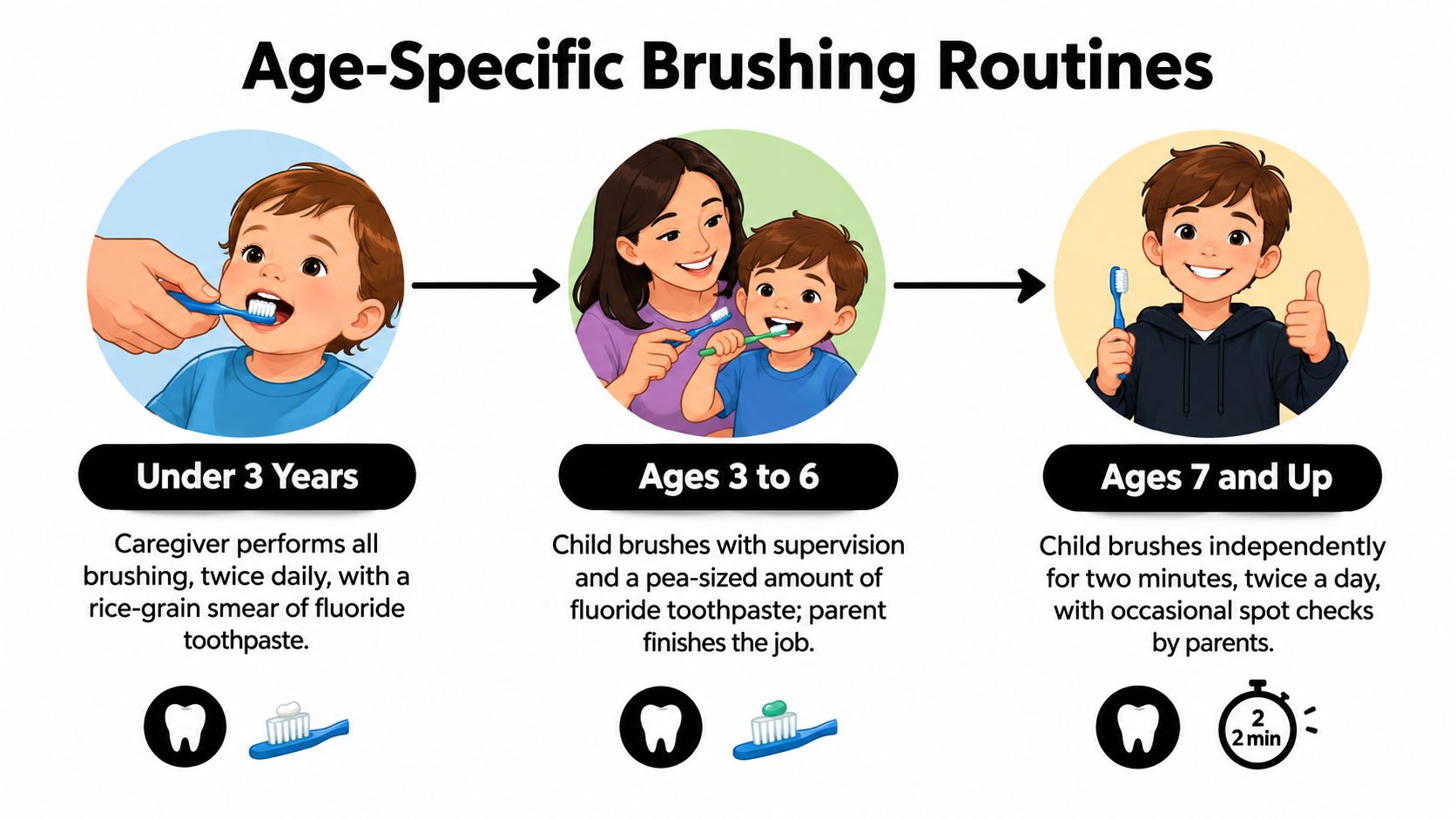
A child's ability to hold a toothbrush doesn't tell you whether they can clean every surface. Hand control, attention, sequencing, and willingness to reach the back teeth develop gradually, so the adult role should change in stages.
Under age 3
Begin brushing as soon as teeth erupt. The caregiver should perform the brushing twice daily with a rice-grain-sized smear of toothpaste, including a fluoridated formula where recommended by local dental guidance. The child can hold a second toothbrush or imitate you, but their practice doesn't replace the adult's brushing.
Keep the instructions short. Sit the child on your lap, support the head, and use a soft, age-appropriate brush. A consistent order, such as outside surfaces, inside surfaces, then chewing surfaces, helps you cover the mouth even when the child moves.
Ages 3 to 6
At this stage, let the child brush first, then make the adult finish part of the routine. Use no more than a pea-sized amount of toothpaste and dispense it yourself. The child is practicing coordination and ownership, while you're protecting the quality of the cleaning.
The World Health Organization guidance on fluoride toothpaste supports twice-daily brushing under parental or caregiver supervision, with a rice-grain smear for children younger than 3 and a pea-sized amount for ages 3–6. After brushing, avoid vigorous rinsing unless your dental professional advises otherwise, so topical fluoride can remain in contact with the teeth.
School age and beyond
A school-age child may be ready to do more of the routine, but independence should be earned through evidence of adequate coverage. The American Academy of Pediatric Dentistry recommends parental assistance for preschool children and supervision of school-age children until approximately age 7 or 8.
Use this age-based guide to oral care for kids to keep expectations aligned with development. If dental treatment ever requires sedation or you're trying to understand how insurance may apply to pediatric care, a practical child sedation and insurance guide can help you prepare useful questions for the dental office.
| Age group | Toothpaste quantity | Supervision level |
|---|---|---|
| Under 3 | Rice-grain-sized smear | Caregiver performs brushing |
| Ages 3 to 6 | No more than a pea-sized amount | Child practices, caregiver assists and finishes |
| Around age 7 and up | Age-appropriate amount | Child takes more control, adult checks technique and coverage |
The milestone isn't a child holding the brush without help. It's reliable coverage, the correct amount of toothpaste, and a routine that happens twice each day.
Building Routines That Stick
Motivation is unreliable at bedtime. A predictable cue is stronger because it tells the child what happens next before resistance has time to build.
Choose one morning anchor and one evening anchor. “After breakfast” and “before the bedtime story” are useful because they already belong to the family schedule. If your child brushes at random times, move the routine gradually toward those anchors rather than expecting a perfect change overnight.
Use a two-stage brushing routine
The most practical arrangement for preschoolers is simple:
- The child brushes first, while you provide one short reminder such as “top, bottom, inside, outside.”
- The caregiver takes over and completes the missed areas systematically.
This gives the child meaningful practice without pretending that practice equals mastery. You can make the handover predictable by saying, “Your turn, then my turn,” every time.
A visual timer, a short song, or a simple sequence card can mark the beginning and end. These tools support the routine, but they don't perform the brushing. A timer won't correct a child who spends the whole session on the front teeth, and a sticker chart won't remove plaque. Use them to support follow-through, not to replace supervision.
Make cooperation easier
Offer choices that don't undermine the routine. Your child can select the blue or green brush, choose the song, or stand on a step stool. Avoid offering a choice between brushing and not brushing, because that frames the nonnegotiable part as optional.
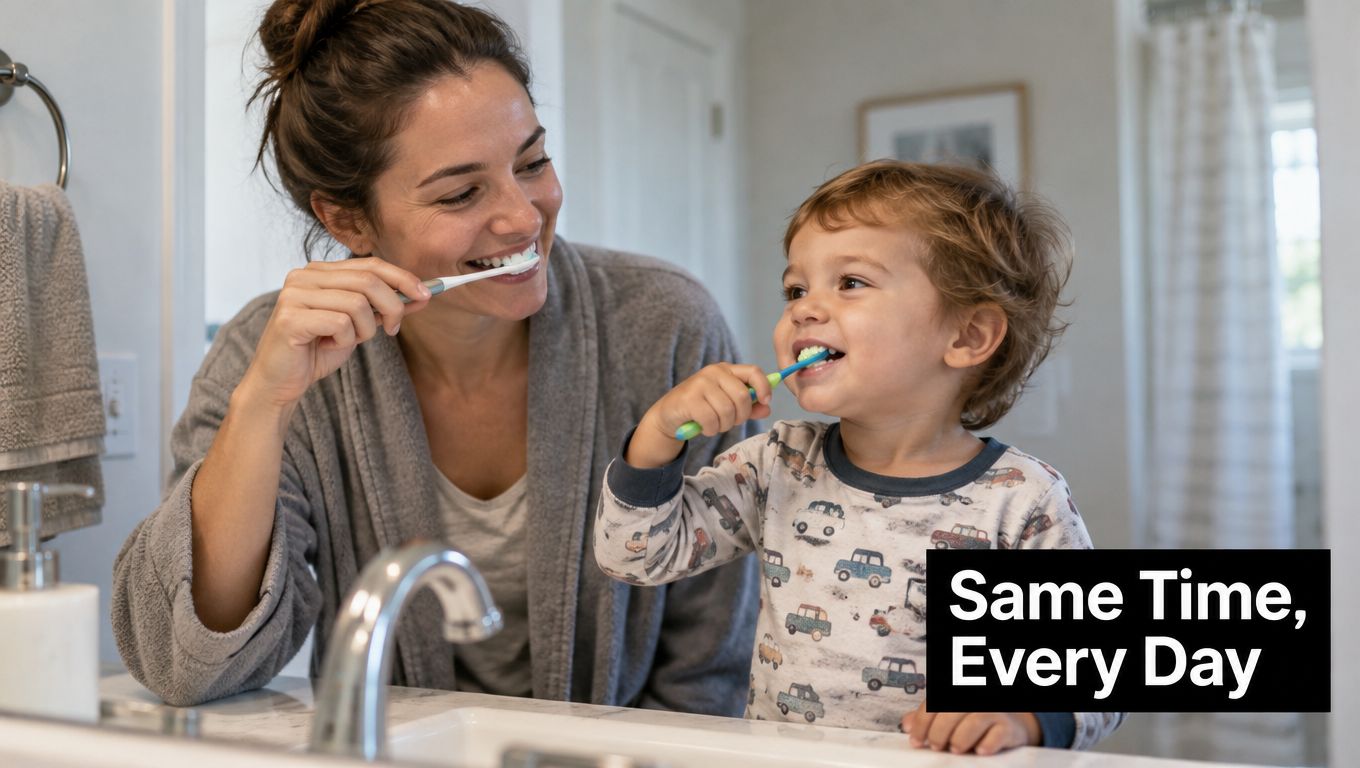
Model the behavior by brushing alongside your child. Use specific praise, such as “You opened wide so I could reach the back,” instead of general approval. If the routine starts slipping, look for the earliest weak point: a later bedtime, a missing toothbrush, a toothpaste flavor your child now dislikes, or an adult who has stopped completing the second stage.
Digital reminders can support adults, especially when mornings and evenings are crowded. In a 24-month randomized parent-focused text-messaging study, the group receiving messages focused on oral health had higher odds of children meeting toothbrushing guidelines, with OR 1.77 and 95% CI 1.13–2.78, and improved fluoride-toothpaste use, with OR 1.46 and 95% CI 1.06–2.01. Message response rates were approximately 68%–70%, as reported in the randomized study published in JAMA Network Open.
The useful lesson isn't that every family needs text messages. It's that reminders work best when they prompt a specific action: supervise, finish, and record completion. Short-term enthusiasm can fade, so keep the cues even after the routine feels easier.
Choosing Toothpaste for Young Children
Toothpaste choice matters, but quantity and supervision matter just as much. A formula that tastes pleasant won't help if a child uses a large amount, swallows it repeatedly, or brushes without an adult checking the missed surfaces.
For children younger than 3, use a rice-grain smear. For ages 3–6, use no more than a pea-sized amount. Dispense it yourself, because a child squeezing the tube often turns a small routine into a mound of paste.
Fluoride and fluoride-free options
Fluoridated toothpaste has established professional guidance for reducing the risk of tooth decay when used in age-appropriate quantities. Fluoride-free options, including products featuring nano-hydroxyapatite or xylitol, may fit a family's preferences, but parents should discuss product choice with a dentist who understands the child's exposure, dental history, and local recommendations.
Nano-hydroxyapatite is a mineral ingredient studied for its relationship to the mineral structure of teeth. Xylitol is a sweetener used in some oral-care products. Neither ingredient makes brushing technique, twice-daily consistency, or professional risk assessment unnecessary.
| Age group | Toothpaste quantity | Supervision level |
|---|---|---|
| Younger than 3 | Rice-grain-sized smear | Adult dispenses and performs brushing |
| Ages 3–6 | No more than a pea-sized amount | Child practices, adult assists and finishes |
| School age | Follow product and dental guidance | Adult verifies coverage until brushing is dependable |
Mouthology offers a fluoride-free children's toothpaste with 10% nano-hydroxyapatite in strawberry and watermelon flavors. It's one possible option for families considering a mineral-based formula, but the same age-appropriate quantity and supervision principles still apply.
Keep the tube out of reach, especially for young children. If your child has a history of frequent cavities, persistent plaque, sensitivity, or unusual fluoride exposure, ask a pediatric dentist to help you select the formula and routine rather than relying on packaging alone. You can also review kids' toothpaste guidance by age before making a change.
Handling Brushing Resistance
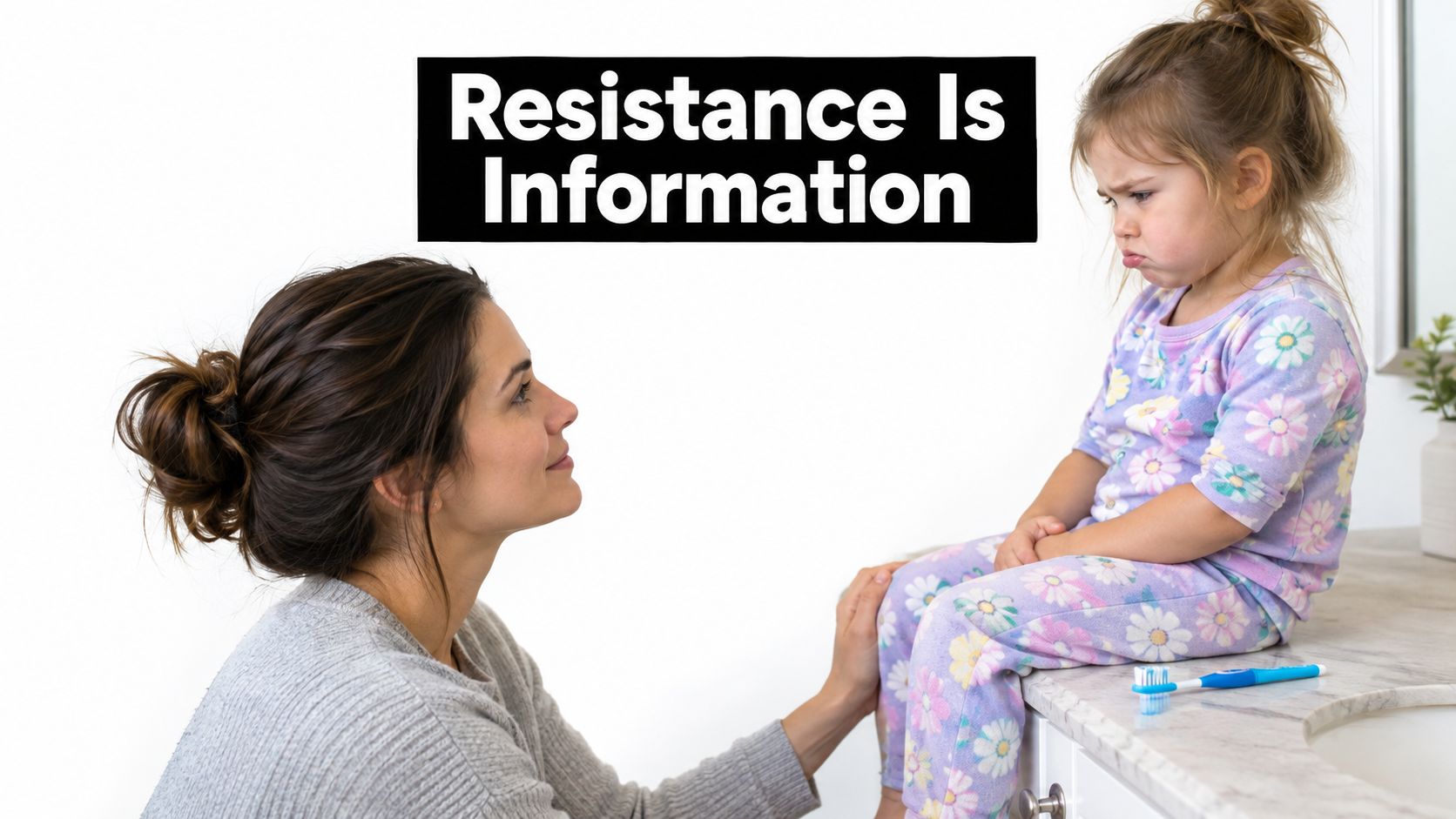
Rewards and songs can help, but they aren't a complete answer when a child gags at the toothpaste, covers their ears at the electric brush, or panics when an adult touches the gums. Resistance is information. Your job is to identify what the child is reacting to and change one variable at a time.
Match the adaptation to the trigger
Taste, smell, texture, noise, touch, gagging, transitions, and loss of control can each require a different response. If mint causes refusal, try a milder flavor. If foam is the problem, compare a lower-foaming formula with your dental professional. If the brush vibration is upsetting, return to a soft manual brush and build tolerance before revisiting an electric option.
A visual sequence can help a child who struggles with transitions. Show four simple pictures: toothpaste, brush, adult finish, bedtime story. For a child who dislikes touch, start by allowing them to touch the brush to their hand, then their lips, before expecting a full brushing session. Gradual exposure should remain calm and brief. Don't turn desensitization into a contest.
A 2024 study found that 60% of children with autism brushed twice daily, while 70% of parents reported difficulty brushing their child's teeth. Sensory sensitivities, language barriers, learning disabilities, medication effects, and difficulty generalizing learned behaviors can interfere with oral care. A 2025 cross-sectional study also found that autistic children were less likely to brush independently, more likely to need supervision, and sometimes used their fingers instead of a toothbrush, according to the study on oral care and developmental differences.
Replace escalation with a calm plan
Avoid adding more explanations when your child is already overwhelmed. Use a low, steady voice: “You don't like this feeling. I'll help you, and we'll do the next step.” Keep the order consistent and reduce unnecessary conversation.
If brushing triggers repeated distress, or you notice gagging, pain, bleeding, or strong sensory reactions, consult a pediatric dentist or an occupational therapist familiar with sensory accommodations. Families dealing with broader emotional outbursts may also find a practical resource on managing meltdowns in 6 year olds useful, particularly when brushing is one part of a larger transition challenge.
For flavor-related refusal, this guide to kids' toothpaste flavors can help you think through a controlled product change. Don't change the brush, toothpaste, timing, and adult technique all at once. One adjustment tells you what helped.
The Independence Transition
A child saying, “I can do it myself,” deserves respect. It doesn't mean the adult should immediately stop checking. Brushing independence is a gradual transfer of responsibility, not a single birthday milestone.
Stage one means the caregiver does the work
For very young children, the adult performs the brushing. The child can watch, hold a second brush, or imitate the movement, but the caregiver controls the toothpaste and makes sure the teeth are covered.
Stage two combines practice with a caregiver finish
The child brushes first, then the adult takes over. Keep your finishing pattern consistent: move along the outer surfaces, inner surfaces, chewing surfaces, and gumline. You don't need to criticize the child's attempt. Say, “I'm checking the places that are easy to miss,” and complete the job.
Stage three adds verification
When an older child brushes alone, ask them to follow the same route and then let an adult check. Verification might mean looking briefly in the mirror, asking the child to show the brush path, or doing occasional supervised sessions. If the check repeatedly shows missed areas, return to assisted brushing without presenting it as punishment.
The American Academy of Pediatric Dentistry recommends that parents perform or assist with preschool brushing and supervise school-age children until approximately age 7 or 8, around the age when many children can tie their shoelaces, according to its parent guidance on brushing. That comparison is useful because coordination for everyday tasks develops over time, and brushing requires more than moving a handle back and forth.
Independence is a developmental goal. Adequate cleaning is the immediate responsibility.
Step in more often if you see persistent plaque, bleeding, pain, frequent cavities, or a child consistently avoiding one part of the mouth. Fatigue, time pressure, early bedtimes, stress, lack of family cooperation, and challenging behavior can make the ideal routine difficult. A short caregiver finish on a chaotic night is more useful than an argument about why the child should already manage alone.
Making It Work in Real Life
A routine that only works on calm evenings isn't a family routine yet. Travel, illness, school events, late meals, and exhausted parents will disrupt brushing. The answer isn't to create a complicated system. It's to protect the two daily anchors and make the fallback version easy.
On a normal day, use the full sequence: toothpaste dispensed by an adult, child practice, caregiver finish, and a brief check. On a difficult day, keep the same order but remove extras. Skip the chart, shorten the conversation, and brush together at the sink or wherever the child can be safely positioned.
Use a weekly reset
At the end of the week, ask yourself four practical questions:
- Timing: Did morning and bedtime brushing happen at predictable anchors?
- Coverage: Which surfaces or areas did your child repeatedly miss?
- Sensory fit: Did taste, texture, noise, gagging, or touch create resistance?
- Adult follow-through: Did someone finish the brushing when the child's attempt was incomplete?
Change one weak point first. Move bedtime brushing earlier if fatigue is the trigger. Put the toothbrush beside the pajamas if the family forgets it. Replace a distracting routine with a short visual sequence if your child loses track of the steps.
For travel, pack the familiar brush and toothpaste rather than introducing a new product in an unfamiliar bathroom. During illness, follow your dental professional's advice and preserve oral care as comfortably as possible. After a disrupted stretch, restart at the next morning or bedtime anchor instead of waiting for a perfect Monday.
The routine doesn't need to feel exciting every night. It needs to be clear enough to survive an ordinary difficult night.
Praise the behaviors you want repeated: coming to the bathroom, opening wide, letting the adult finish, or trying a new sensory accommodation. Avoid turning missed sessions into a character judgment. A setback tells you that the system needs adjustment, not that your child can't learn.
You're building a skill through repeated practice. Keep the adult role firm, the language brief, and the expectations age-appropriate. Over time, your child can take more control while you continue verifying that “I brushed” also means the teeth were adequately cleaned.
Tonight, choose one morning cue and one bedtime cue, put the toothpaste where you can dispense it, and use the “your turn, then my turn” routine. If resistance continues, write down the trigger you observe and discuss it with your pediatric dentist, who can help you adapt the brush, toothpaste, positioning, or supervision plan.
