

Posted by Sarah Collins
on September 18, 2026

A child clamps their mouth shut when the mint hits. An adult rinses early because the taste lingers long after brushing. Someone dealing with pregnancy-related nausea discovers that even a familiar toothpaste flavor can suddenly feel unbearable. These moments look small, but they can shorten brushing, reduce the amount of toothpaste used, or turn the entire routine into a daily negotiation.
That's why flavorless fluoride toothpaste deserves to be treated as more than a novelty. Flavor is a usability factor. If a person can tolerate the paste, keep it in place, and brush for the needed time, the formula has a better chance of supporting a consistent routine. A neutral option can be especially helpful when strong mint, fruit flavor, sweetness, or foaming creates a sensory barrier. Fragrance-free toothpaste guidance from Mouthology offers useful context for people trying to simplify oral-care sensations.
The practical questions are straightforward. What does flavorless fluoride toothpaste contain? Who tends to benefit from it? What trade-offs should you expect? How do dosing and supervision work, where can you find it, and how does it compare with fluoride-free mineral options such as nano-hydroxyapatite? The answers start with separating the sensory experience from the active ingredient.
Why Some People Reach for Flavorless Toothpaste
A child tastes mint and closes their mouth. An adult brushes, then rinses almost immediately to escape the cooling sensation. In both cases, the toothpaste may be suitable on paper, yet the person cannot comfortably use it as directed.
That distinction matters because flavor affects routine behavior. A strong taste can trigger gagging, refusal, nausea, or an urge to spit. A mild or neutral paste may make it easier to keep brushing and leave the fluoride-containing foam or slurry in place longer. The fluoride has not become more potent. The person may use the product more consistently.
Practical rule: The most effective toothpaste is the one the user can tolerate and use correctly on a regular basis.
Flavor can also change how much toothpaste reaches the brush. A child who dislikes the taste may wipe much of it away before brushing. Another may add extra because sweetness or fruit flavor makes the product seem edible. The American Dental Association notes that flavoring agents are common, while its discussion of a 2018 systematic review and meta-analysis found that dentifrice flavoring did not increase toothpaste ingestion by children. Flavor alone therefore does not solve swallowing concerns. Safe use still depends on the full formulation, the amount applied, and appropriate supervision.
A flavorless formula removes one source of friction, much like removing a rough edge from a tool that someone must handle every day. It does not automatically suit every user. Some people enjoy a fresh mint finish and use it as a cue that brushing is complete. Others need little taste, limited foam, or no cooling sensation before brushing feels manageable. Guidance on fragrance-free toothpaste and simpler oral-care sensations can help families compare those preferences with practical product features.
The choice is therefore about usability and dosing, not appearance. A neutral flavor may support better brushing habits, while the fluoride active still provides the formula's intended structure and function benefits. Mineral alternatives such as nano-hydroxyapatite address the active-ingredient question differently, so flavor tolerance should be considered alongside, rather than confused with, the toothpaste's mineral system.
What Flavorless Fluoride Toothpaste Actually Is
Flavorless fluoride toothpaste is toothpaste with a fluoride active but without the flavor system common in mint, fruit, cinnamon, or bubblegum formulas. Typical fluoride actives include sodium fluoride and stannous fluoride. Removing flavor oils does not remove the fluoride's intended role.
A conventional tube may contain peppermint or spearmint oil, menthol, cinnamon or fruit flavor, and sweeteners. A flavorless formula omits some or all of these cues and may also leave out strong cooling agents that cause the familiar tingling after brushing. That difference matters because flavor can affect whether someone accepts the product, uses the intended amount, and completes the routine.
The rest of the formula still needs to function as toothpaste. Depending on the product, it may include:
- Mild abrasives, such as silica or hydrated silica, to help lift surface deposits during brushing.
- Humectants, including glycerol, propylene glycol, or sorbitol, to reduce water loss and maintain a workable texture.
- Thickeners, such as xanthan gum, to keep the paste from separating or becoming runny.
- Water and cleansing agents, which help form the paste and spread it across the teeth.
An “unflavored” product may still have a faint chalky, salty, bitter, or mildly sweet taste from its base ingredients. Some manufacturers add a small amount of masking material, so the ingredient panel matters when even subtle taste is difficult to tolerate. A closer look at how fluoride works in toothpaste can also help separate the active ingredient from the sensory features surrounding it.
The fluoride concentration is the important label detail
The U.S. OTC anticaries monograph lists permitted fluoride actives, including sodium fluoride at 0.22% w/w, sodium monofluorophosphate at 0.76% w/w, and stannous fluoride at 0.15% w/w. These amounts provide about 1,000 ppm fluoride ion under the cited regulatory framework. The federal anticaries monograph states that products above 1,100 ppm require an NDA rather than relying on OTC monograph compliance.
Broader clinical guidance places effective fluoride toothpaste around 1,000 to 1,500 ppm fluoride. Fluoride supports remineralization, limits demineralization, and helps form more acid-resistant fluorapatite. The fluoride toothpaste mechanism review describes topical activity that can lower enamel's critical demineralization pH from about 5.5 to about 4.5. Flavor removal does not change that fluoride function.
Who Tends to Choose an Unflavored Option
A neutral toothpaste often becomes appealing when sensory tolerance determines whether brushing happens at all. Existing oral-health guidance identifies taste and foaming as barriers for some children, particularly children with sensory sensitivities, autism, or learning disabilities. That makes flavorless toothpaste relevant to compliance, not just personal preference. Updated guidance on fluoride, brushing, and sensory barriers also emphasizes supervision, spitting rather than swallowing, and appropriate dosing.
Children who resist strong sensations
Children between 2 and 6 years old often depend on a caregiver to place the correct amount of toothpaste on the brush and supervise the routine. A strong mint or fruit flavor can lead to gagging, refusal, or an association between brushing and discomfort. If the child accepts a neutral paste more readily, the caregiver may spend less time persuading and more time brushing the teeth thoroughly.
Flavorless toothpaste can also help when a child dislikes foam or the combination of taste and texture. In that situation, a low-foam or nonfoaming formula may be as important as the absence of flavor. The product still needs an age-appropriate fluoride concentration and clear dosing directions.
Sensory-sensitive adults
Adults with autism, ADHD-related oral aversion, or broader sensory-processing differences may prefer a toothpaste that doesn't add a strong cooling or sweet sensation to the mouth. People experiencing post-treatment taste changes can also find familiar flavors unexpectedly unpleasant. A neutral formula may reduce the number of sensory inputs competing with the brushing task.
Pregnant people dealing with nausea may have a similar experience. A flavor that was comfortable before pregnancy can become difficult to tolerate, particularly during morning brushing. Flavorless toothpaste doesn't address nausea itself, but it can remove one avoidable trigger from the routine.
People trying to manage overuse
Some caregivers worry that a sweet or highly flavored paste encourages children to use too much. That concern should be handled through storage, supervision, and portion control rather than by assuming an unflavored tube is harmless to swallow. The ADA's cited review did not find that flavoring increased children's ingestion, and FDA labeling still requires safe handling regardless of taste.
People who prefer minimal-ingredient routines, avoid strong flavors, or don't want toothpaste to affect the taste of coffee and meals may also choose an unflavored product. Their reason is less about sensitivity and more about keeping oral care neutral and predictable.
Pros and Cons of Flavorless Fluoride Toothpaste
The useful comparison is between daily usability and active-ingredient performance. Flavor can act like a dosing signal for behavior: if mint, sweetness, or menthol makes someone stop brushing, the problem is missed routine time. If the paste feels too mild, the user may instead apply extra product or brush more aggressively, even though taste does not measure fluoride delivery or cleaning.
Where the neutral format helps
A neutral taste may reduce gagging, refusal, or lingering discomfort for people who react to mint, fruit, cinnamon, sweetness, or menthol. That matters when a sensory-sensitive child or adult otherwise avoids brushing. The practical benefit is behavioral. A person who accepts the formula may keep the brush moving and complete the routine more consistently.
The absence of added flavoring can also suit ingredient-conscious shoppers. The ADA says ADA-Accepted toothpaste cannot contain sugar or other cariogenic ingredients, so sweetness is not required for that standard. Humectants such as glycerol, propylene glycol, and sorbitol help maintain texture and moisture, but they serve a different formulation role from flavor.
Fluoride remains the active ingredient that supports enamel's mineral balance. A review of fluoride dentifrices reports that fluoride formulations outperformed non-fluoride products in enamel-repair testing under pH-cycling conditions, with the fluoride compounds tested improving remineralization in vitro. The compounds did not all rank alike in that experiment, so the active ingredient and concentration on the label still deserve attention.
Where it can feel disappointing
Flavorless toothpaste may feel less satisfying. Without menthol or mint oils, there may be no lasting cooling sensation. A formula with limited foaming can also leave the mouth feeling less dramatically refreshed. Some users read that quiet experience as a sign that the paste is not working, although foam and flavor do not determine cleaning quality.
A quiet mouthfeel can still accompany a well-executed brushing routine.
Taste fatigue can develop too. A neutral product may suit a minimalist routine, while another person misses variety or familiar post-brushing freshness. The practical trade-off is consistency. A theoretically ideal toothpaste left in the cabinet cannot support fluoride exposure as well as a simpler formula the user accepts, measures appropriately, and uses regularly.
Safe Use, Dosing, and Supervision
Flavorless toothpaste still contains fluoride, so the handling rules don't change because the tube lacks mint or sweetness. The FDA requires OTC fluoride toothpaste labeling to say, “Keep out of reach of children under 6 years of age.” The FDA OTC fluoride monograph also provides the regulatory basis for age-appropriate directions and supervision.
| Age Group | Amount | Frequency | Supervision |
|---|---|---|---|
| Under 3 | A smear no larger than a grain of rice | Twice daily | Caregiver applies and brushes |
| Ages 3 to 6 | A pea-sized amount | Twice daily | Actively supervise spitting and rinsing |
| Ages 6 and up | A pea-sized amount | Twice daily | Continue oversight until reliable spitting is established |
For children under 3, a caregiver should apply a smear no larger than a grain of rice and brush the teeth. Children ages 3 to 6 should use a pea-sized amount, with an adult watching to reduce repeated swallowing. From age 6 onward, the pea-sized amount remains practical, while supervision can continue until the child reliably spits rather than swallows.
The “it's flavorless, so it's safer” assumption is incorrect. The fluoride dose still matters, whether the paste tastes like mint or almost nothing.
Keep the tube out of sight between brushings and store it where toddlers can't reach it. Accidental small swallowing is generally not dangerous, but larger ingestion can cause nausea, abdominal pain, vomiting, or diarrhea, so contact a poison-control service or medical professional if a significant amount has been swallowed.
Adults should also avoid treating toothpaste like an unlimited-use product. A pea-sized amount is sufficient for routine brushing. People managing dry mouth or frequent oral sensations may be tempted to apply more often, but vigorous water rinsing immediately after brushing can remove residual fluoride before it has time to remain in saliva and plaque.
Where to Find It and What It Costs
Flavorless fluoride toothpaste is less visible than mint toothpaste, but it isn't limited to one type of retailer. Specialty pediatric and sensitive-mouth brands are the most likely places to find unflavored formulas. Some products are marketed for autism, sensory processing differences, gag sensitivity, or recovery from illness, while others use “unflavored” or “original” on the package.
Mainstream pharmacy and store-brand cavity-protection lines may also carry neutral versions beside their mint products. Online dental retailers and marketplace listings expand the selection, although shipping weight can affect the final per-tube price. Product pages deserve careful reading because “mild mint,” “natural flavor,” and “no artificial flavor” don't necessarily mean flavorless.
The price ranges below are practical shopping benchmarks rather than universal prices. They can vary by retailer, package size, subscription arrangement, and whether the product is sold as a specialty sensory formula.
| Category | Typical Price | Where to Buy | Stock Reliability |
|---|---|---|---|
| Store-brand neutral toothpaste | $2–$4 per tube | Pharmacies, supermarkets, online retailers | Variable in stores, generally reliable online |
| Mainstream sensitive line | $5–$8 per tube | Pharmacies, mass retailers, brand websites | Usually available, but neutral versions may be limited |
| Specialty sensory formula | $8–$14 per tube | Pediatric dental suppliers, specialty websites, online marketplaces | More reliable online than in brick-and-mortar stores |
Insurance, flexible spending accounts, and HSA cards generally don't cover ordinary toothpaste. If you need a pediatric size or a particular formula, call the store before traveling. Online availability is usually more dependable, but check the active ingredient, fluoride concentration, flavoring list, and directions before adding the product to your cart.
Fluoride-Free Mineral Alternatives Worth Knowing
For some people, the brushing problem has two parts: mint feels unpleasant, and fluoride is not their preferred active ingredient. A flavorless formula can make the routine usable, while a fluoride-free mineral formula changes the protection strategy. Keeping those decisions separate helps prevent a sensory solution from being mistaken for an equivalent anticavity option.
The mineral alternative discussed most often is nano-hydroxyapatite, or nHa. It uses synthetic, enamel-like particles intended to interact with the tooth surface, fill microscopic irregularities, and support its mineral structure. These statements describe structure and function. They do not promise to cure a dental condition.
Nano-hydroxyapatite appears in oral-care products across a range of concentrations, commonly 5% to 15%. Mouthology, for example, offers a fluoride-free toothpaste with 10% nano-hydroxyapatite, using a biomimetic mineral approach instead of fluoride as the active ingredient. For a clearer comparison of how the two formulations work, see hydroxyapatite versus fluoride toothpaste.
Fluoride has the longer-established evidence base for cavity prevention. A fluoride-free mineral product therefore represents an ingredient preference, not a reason to overlook personal risk, brushing technique, or dental advice. People who skip fluoride at the dentist can use that choice as a starting point for a more specific discussion with a dental professional.
Other mineral approaches include calcium phosphate systems and arginine-containing formulas. Their intended roles may include supporting the tooth surface or influencing the oral environment, but results depend on the formulation and the person using it. They should not automatically be treated as equivalent to fluoride for decay-prevention evidence.
| Option | Active & Range | Mechanism | Evidence Strength | Best Fit |
|---|---|---|---|---|
| Fluoride toothpaste | About 1,000–1,500 ppm for common OTC ranges | Supports remineralization, limits demineralization, and promotes acid-resistant fluorapatite | Most established for cavity prevention | People prioritizing fluoride certainty |
| Nano-hydroxyapatite | Commonly 5%–15% in oral-care products | Enamel-like particles interact with and support the tooth surface | Growing evidence, with less established cavity-prevention history than fluoride | People seeking a fluoride-free mineral approach |
| Calcium phosphate | Product-dependent mineral system | Supplies calcium and phosphate to the tooth-surface environment | Formulation-specific | People considering supplementary mineral support |
| Arginine formulas | Product-dependent arginine and mineral system | Can influence the oral environment and mineral interaction | Formulation-specific | People following dentist-guided sensitive or mineral-support routines |
The practical choice is a tradeoff between established fluoride evidence, a mineral-based ingredient preference, and a formula that someone will tolerate well enough to use consistently. A product that stays on the shelf cannot support a daily brushing routine.
Choosing the Right Fit for Your Routine
A useful decision starts with the problem you're trying to solve, not the most attractive package. Three questions usually narrow the choice quickly.
Start with fluoride certainty
If your priority is a conventional anticavity active, look for a fluoride toothpaste in the broadly used 1,000–1,500 ppm range, and check the label rather than relying on words such as “natural,” “gentle,” or “original.” The ADA Seal of Acceptance can be one useful screening signal, although you should still confirm the active ingredient and directions. A common mistake is assuming that flavorless means fluoride-free. It doesn't.
For a child who tolerates flavor but needs an established fluoride routine, a standard low-foam fluoride gel may be more comfortable than a thick paste. For a person at high caries risk, ask a dentist whether a prescription-strength product, including 5,000 ppm fluoride toothpaste, is appropriate rather than making that change independently.
Put sensory tolerance first when brushing is failing
If mint triggers gagging, refusal, nausea, or sensory overload, choose flavorless fluoride toothpaste before assuming the product needs a stronger clean sensation. A low-foam fluoride gel may suit someone who dislikes both flavor and lather. Examine the texture as carefully as the flavor. Paste, gel, foam, and aftertaste can each determine whether the routine lasts.
Caregivers looking for more specialized guidance can review these children's dental formula options and then confirm the final choice with a pediatric dentist. The frequent error here is selecting a heavily flavored formula because it feels more “fresh,” even though the child refuses to use it.
Choose a mineral approach deliberately
If your priority is avoiding fluoride and using an enamel-like mineral, a 10% nano-hydroxyapatite paste may fit that ingredient philosophy. It shouldn't be treated as a universal substitute for professional risk assessment, particularly for children with recurring dental concerns or adults with a high-risk history.
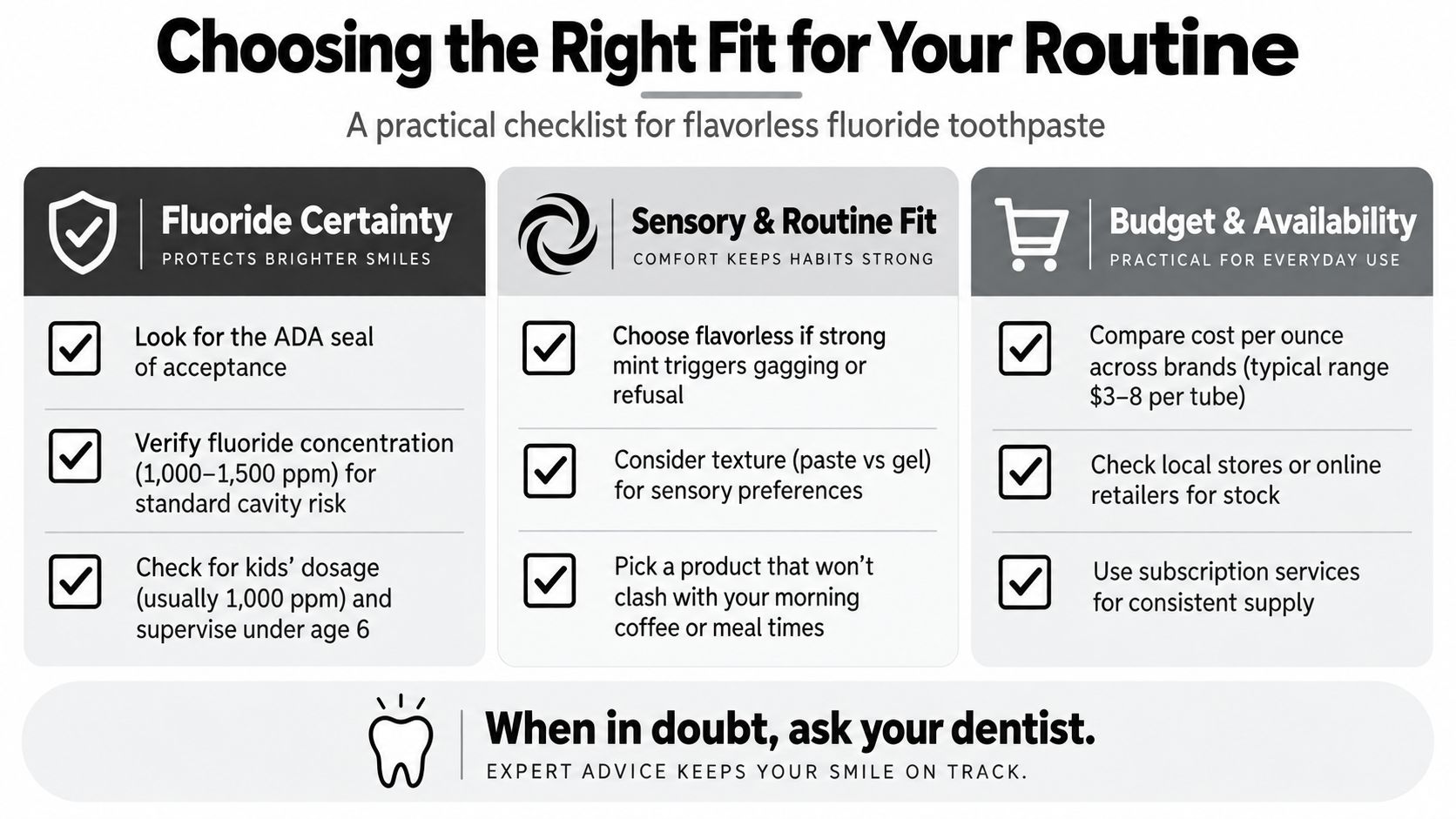
A simple rule of thumb is this: choose the formula that matches your fluoride preference and removes the biggest barrier to brushing, then use the correct amount consistently. If you're unsure, bring the tube or a photograph of its ingredient panel to your dentist and ask about the active, concentration, and dosing directions.
Try the comparison at your next brushing session. Read the fluoride label, check whether the flavor or foam creates resistance, and measure the amount instead of guessing. If a flavorless fluoride toothpaste makes brushing more comfortable and consistent, discuss the switch with your dentist and use the product according to its age-based directions.
