

Posted by Sarah Collins
on August 30, 2026

You can only arrest or partially reverse very early enamel demineralization at home. Once a true cavity has formed, home care can't rebuild the missing tooth structure, and a dentist is required.
So why do people still ask, “Can you get rid of cavities naturally?” The confusion usually starts with the word cavity. A faint white mark on intact enamel and a visible hole in a tooth are both described casually as cavities, but biologically they're different problems. One may respond to improved conditions in the mouth. The other involves structural loss.
That distinction matters because dental caries affects about 2.5 billion people worldwide, including roughly 2.0 billion people with caries in permanent teeth and about 510 million children with caries in primary teeth, according to the World Health Organization's oral health report. Untreated caries remains the single most common health condition globally, so understanding the earliest stage isn't a niche concern. It's a practical way to protect teeth before damage becomes harder to manage.
Can You Get Rid of Cavities Naturally
The honest answer depends on what you mean by “cavity.”
A white-spot lesion is an early area of mineral loss. The enamel may look chalky or opaque, but its outer surface is still intact. Dentists may call this incipient decay or a noncavitated lesion. At this stage, the tooth can sometimes regain minerals and the lesion can become inactive.
An established cavity is different. Acid has weakened the enamel enough for the surface to collapse, creating a physical defect. If decay has reached dentin, the softer layer beneath enamel, home care can't reconstruct the missing tissue.
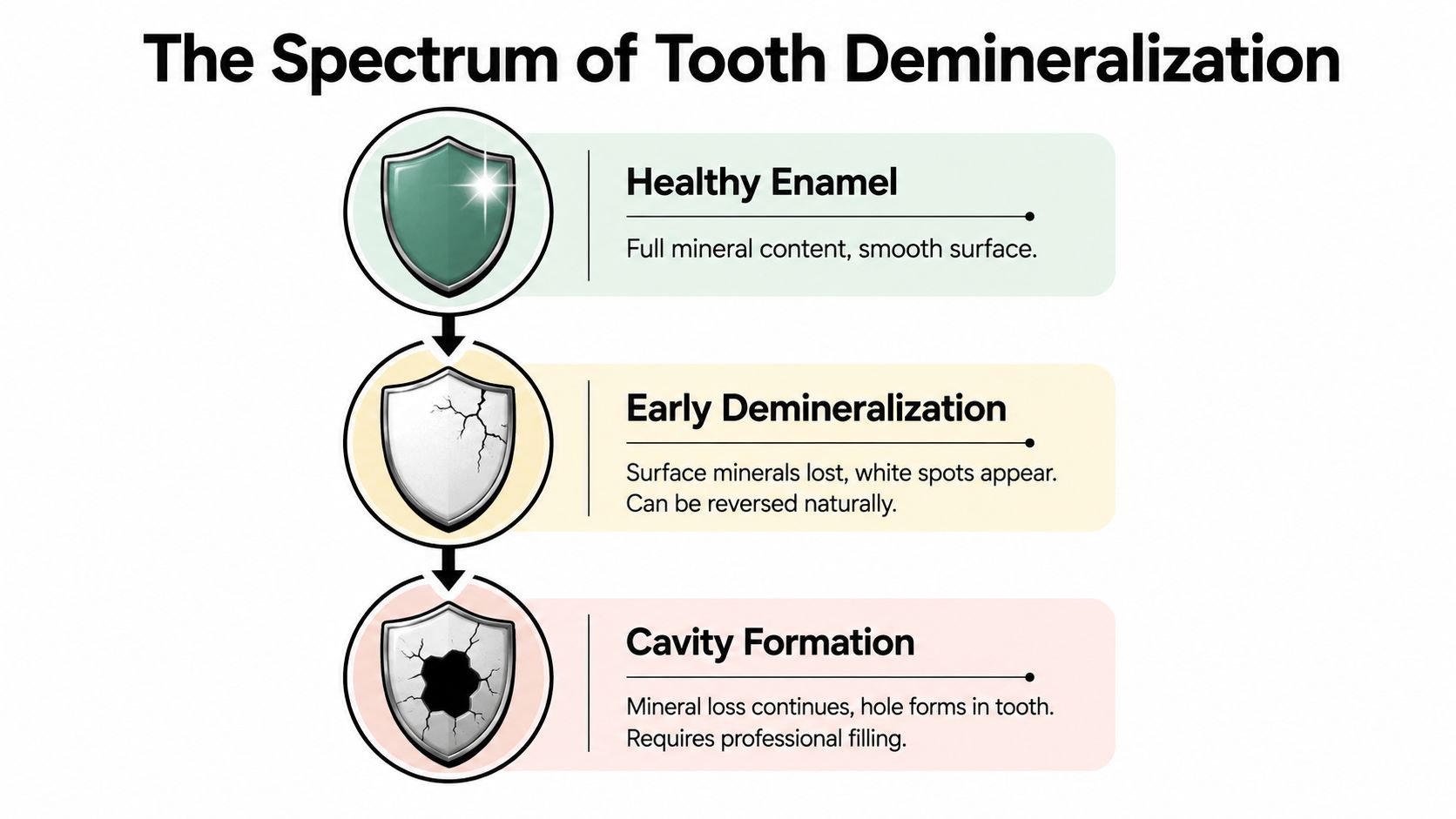
The important dividing line
Early enamel demineralization involves mineral loss beneath a surface that remains at least partly intact. Saliva, fluoride, calcium, phosphate, plaque control, and fewer acid-producing exposures can shift the balance back toward mineral gain.
A true cavity has crossed a structural threshold. The enamel surface has broken down, or dentin has become exposed. A toothpaste, oil, rinse, or dietary change may help protect the surrounding tooth, but it won't fill that hole.
The practical question isn't “Which natural remedy cures cavities?” It's “Is the tooth surface still intact?”
A systematic review of human trials found that 10 of 18 studies reported carious lesions being minimized through remineralization, but the pooled evidence didn't show dependable clinical proof overall. The analysis reported a standard mean difference of -0.18, a 95% confidence interval of -0.48 to 0.12, and P = 0.23 in the systematic review of remineralization approaches. In other words, early lesions may be biologically modifiable, but “natural reversal” is not a reliable promise for every lesion.
The rest of the answer comes down to chemistry, lesion stage, daily habits, and knowing when professional care is necessary.
How Cavities Form
Could a sugary snack damage a tooth by itself? Not directly. Bacteria in dental plaque ferment sugars and other fermentable carbohydrates, producing acids that draw calcium and phosphate out of enamel. The key distinction is the tooth's stage: early mineral loss can occur beneath an intact surface, while a true cavity involves structural breakdown that home care cannot fill.
One important organism is Streptococcus mutans, but it acts alongside other acid-producing bacteria in the plaque biofilm. After you eat or drink sugar, these bacteria use the carbohydrates and release organic acids. As plaque becomes more acidic, enamel starts losing minerals when its pH falls below about 5.5, the widely cited critical pH described in this overview of cavity formation.
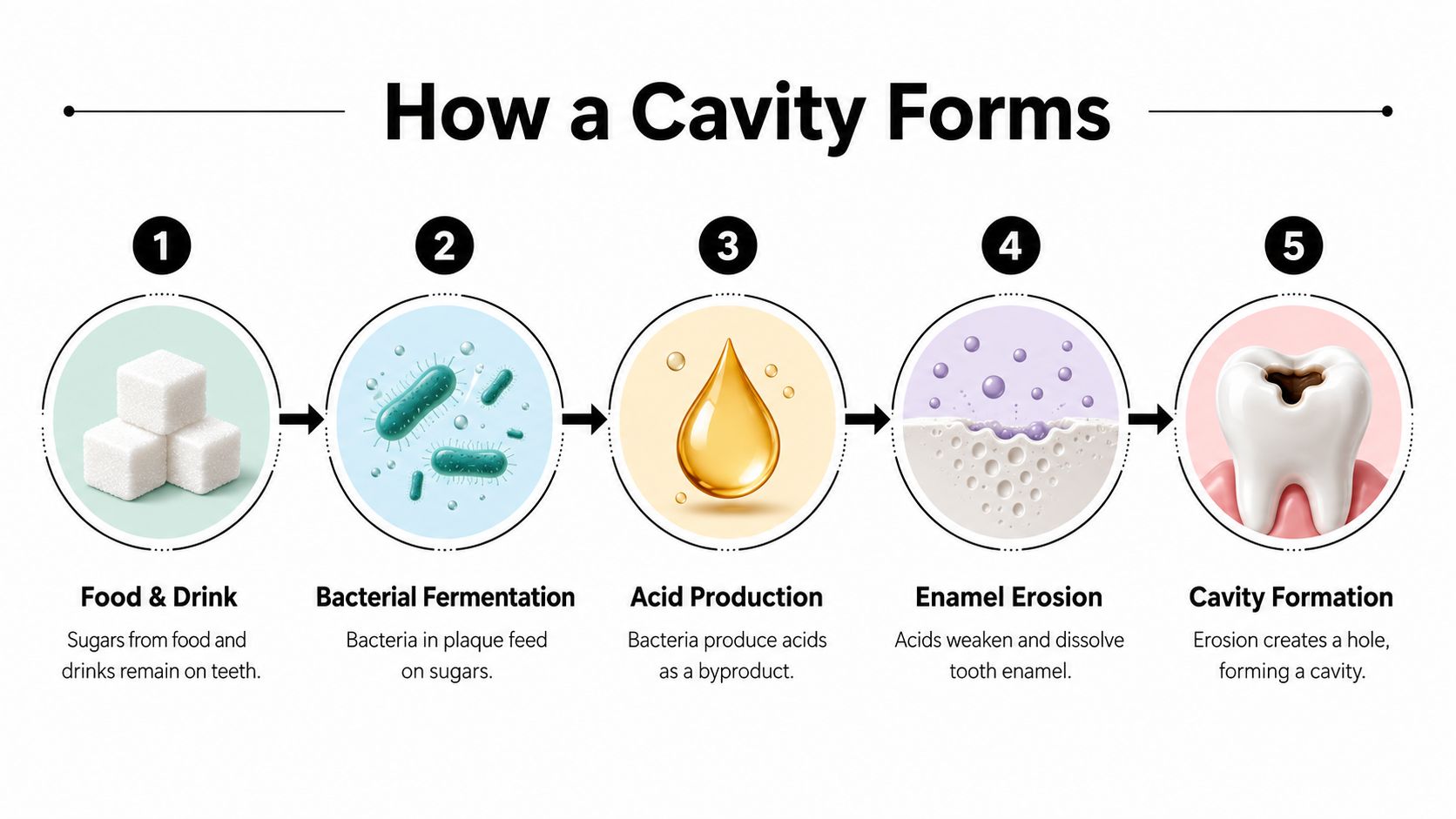
One acid attack, step by step
The timing shows why repeated exposure matters.
- Exposure: After a glucose rinse, plaque pH can fall below enamel's critical level within 5–10 minutes, according to the source's detailed breakdown of the acid-demineralization cascade.
- Acidic period: Plaque can remain acidic for about 20 minutes before the mouth begins returning toward its resting state.
- Recovery: It can take 30–60 minutes for pH to move back toward resting levels after the exposure.
During acidity, minerals leave enamel. As saliva dilutes and buffers the acids, calcium and phosphate can move toward the tooth surface, creating a repeating balance between demineralization and remineralization. This balance can support an early lesion while its outer surface remains intact. Once that surface collapses or decay reaches dentin, mineral replacement cannot rebuild the missing structure.
Each sip or snack can restart the cycle. A dessert eaten with a meal gives saliva a longer uninterrupted recovery period than repeatedly sipping a sweetened drink. Plaque maturity, saliva flow, dry mouth, deep grooves, crowding, and tooth anatomy also affect how long acids stay against enamel.
Prevention therefore depends on reducing repeated acid attacks and giving saliva time to support mineral recovery, not on avoiding one food alone.
The Biology of Remineralization
Remineralization is the mouth's natural process for returning minerals to weakened enamel. Saliva carries calcium and phosphate through the mouth, and those ions can settle into areas where acid has opened microscopic spaces within the enamel crystal structure.
The process works best when the tooth's outer surface still provides a scaffold. Acid first removes some mineral from enamel crystals. The remaining crystal framework creates pathways where dissolved calcium and phosphate can move. When the surrounding conditions become favorable, those minerals can precipitate onto existing crystal remnants rather than rebuilding a completely missing surface.
Saliva does more than transport minerals. It buffers acids, washes away loose food particles, and helps maintain an environment where enamel can recover. The thin protein layer called the pellicle also sits on the tooth and can help organize the interaction between the tooth surface, saliva, and mineral ions.
What fluoride and hydroxyapatite add
Fluoride supports remineralization locally, in saliva and plaque fluid. It needs to be present when acids are produced or soon after plaque is removed. Under suitable pH conditions, enamel hydroxyapatite can dissolve while more acid-resistant fluorapatite forms, as explained in this technical review of fluoride's local action.
Nano-hydroxyapatite takes a biomimetic approach. Hydroxyapatite is the main mineral in enamel, and small particles can provide mineral material at the tooth surface. Reviews have studied 10% nano-hydroxyapatite for early caries and enamel remineralization. A 2019 in situ comparison found 10% hydroxyapatite had comparable efficacy to 500 ppm fluoride toothpaste for remineralizing initial caries and limiting demineralization, according to this review of nano-hydroxyapatite in oral care.
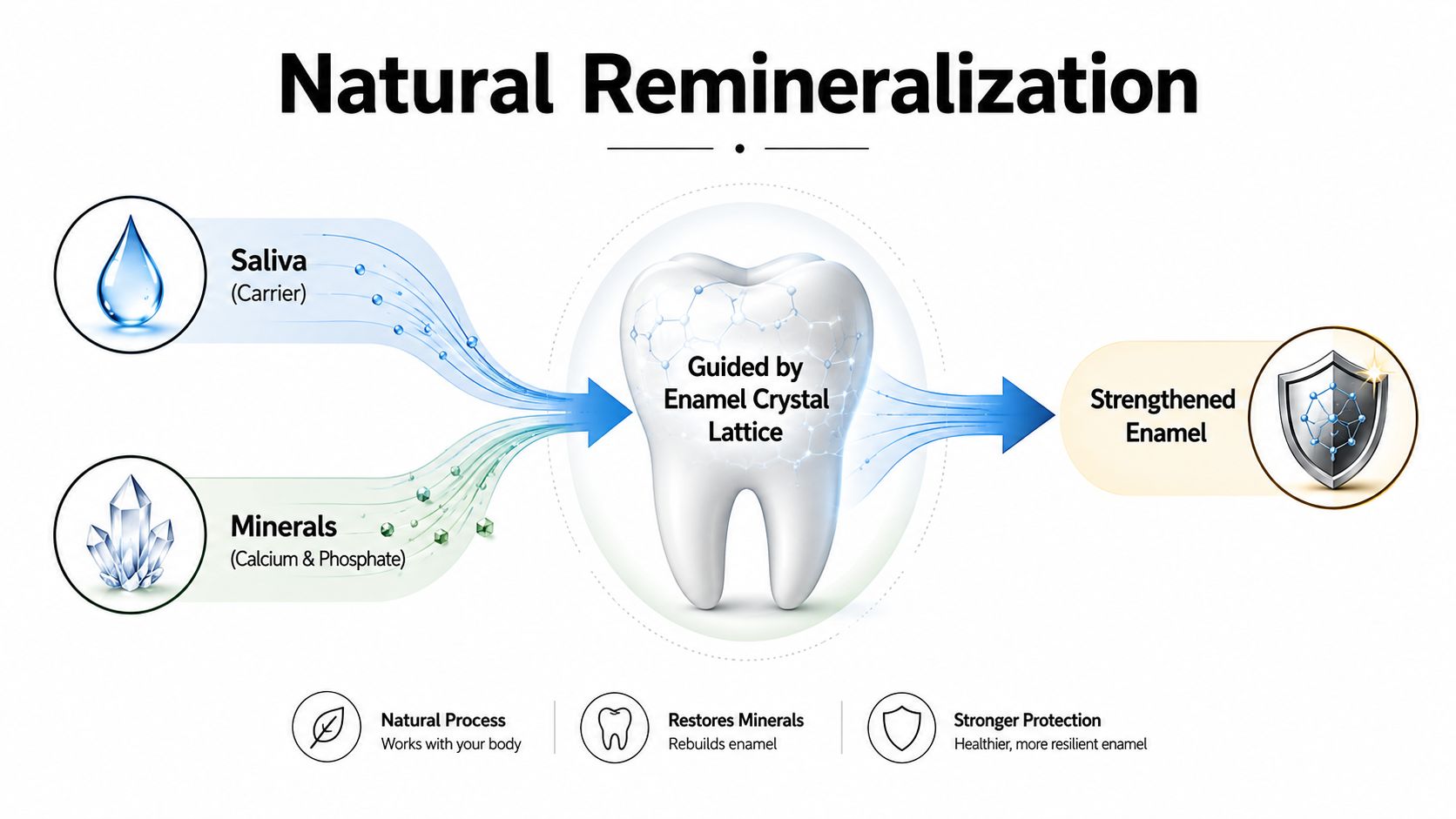
For a deeper explanation of this process, see what remineralization of teeth means. The central limitation remains the same: remineralization can strengthen weakened, intact enamel, but it can't replace enamel that has already fallen away.
Nano-Hydroxyapatite vs Fluoride
Nano-hydroxyapatite and fluoride both support early enamel management, but they do so through different mechanisms and don't have identical evidence behind them.
Fluoride has the more established research base. It helps reduce mineral loss and supports the formation of acid-resistant mineral at the lesion surface. Network meta-analysis data show especially strong nonrestorative effects for 5,000-ppm fluoride toothpaste or gel and 5% sodium fluoride varnish when arresting or reversing noncavitated lesions, according to this clinical network meta-analysis.
Nano-hydroxyapatite is a fluoride-free, biomimetic option that supplies a mineral similar to the one already found in enamel. Independent reviews report improvements in white-spot lesions, but the clinical evidence base is smaller and less definitive than fluoride's. Recent reviews describe hydroxyapatite as a credible fluoride-free alternative for supporting remineralization and preventing progression, while some analyses rate the certainty of evidence as low. It shouldn't be presented as superior to fluoride.
| Feature | Nano-Hydroxyapatite (10%) | Fluoride (1450 ppm) |
|---|---|---|
| Main action | Supplies enamel-like mineral to the tooth surface | Supports remineralization and acid-resistant fluorapatite formation |
| Best fit | Early enamel changes, fluoride-free routines, and sensitivity-focused care | Broad cavity prevention and higher-risk situations |
| Evidence position | Promising, but smaller and less certain clinical evidence base | Stronger and more extensively replicated evidence base |
| What it can't do | Fill a physical cavity or replace lost tooth structure | Fill a physical cavity or replace lost tooth structure |
Age, cavity risk, dietary frequency, saliva flow, and personal tolerance for ingredients all matter. Parents may prefer a fluoride-free routine for a child who regularly swallows toothpaste, but that choice should be discussed with a dental professional if the child has high cavity risk.
For a more detailed ingredient comparison, read fluoride versus nano-hydroxyapatite. The useful takeaway is simple: both ingredients belong in a prevention and early-lesion conversation, not in a promise to erase an established hole.
Home Care Steps That Help
Can daily care stop a cavity from growing? It depends on whether the enamel surface is still intact. Home routines can support mineral repair in an early, pre-cavitated area, while a true hole requires dental assessment. The practical goal is to reduce plaque activity, limit acid attacks, and give saliva and toothpaste more time to support the enamel that remains.
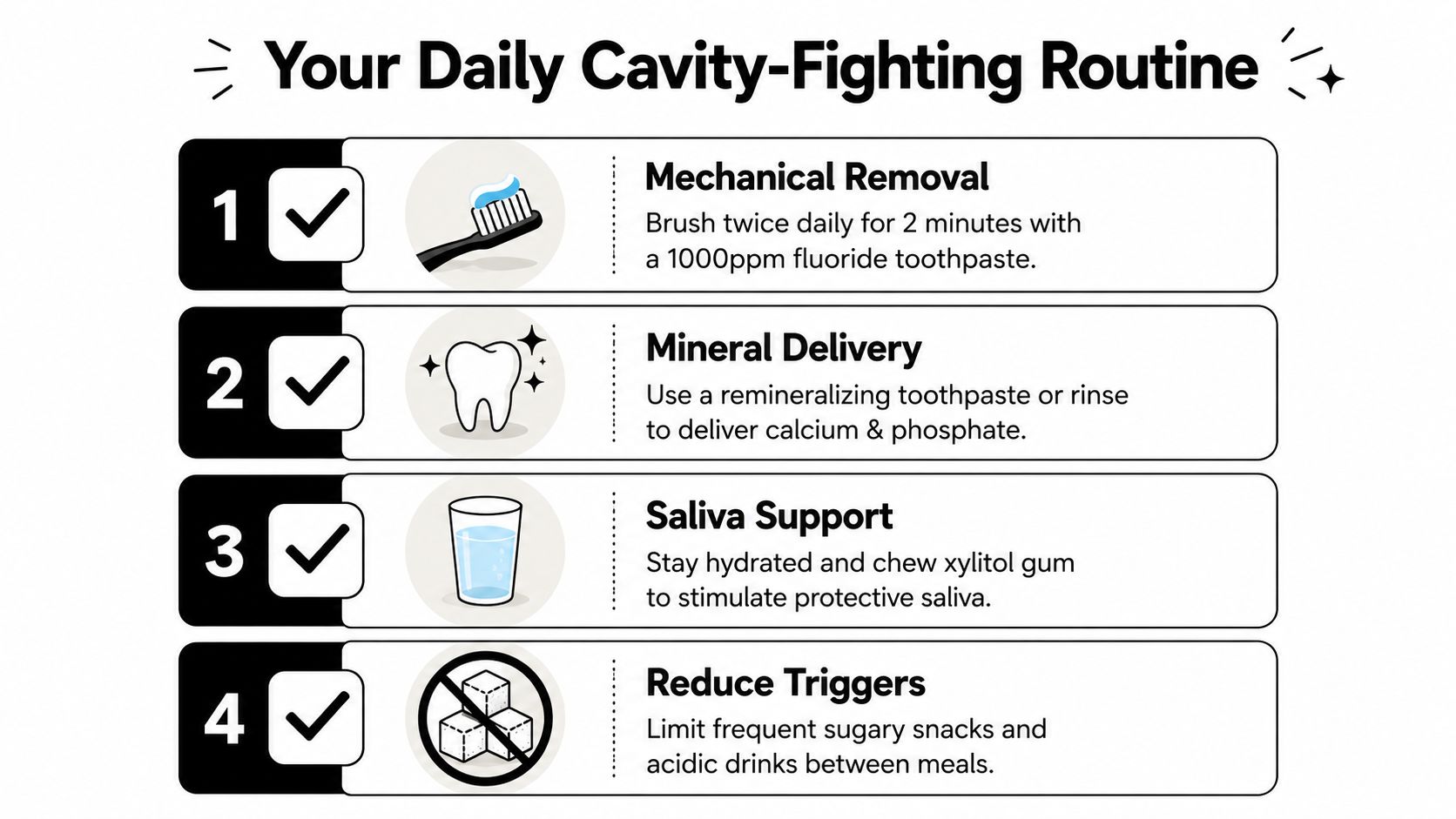
Remove plaque consistently
Brush twice a day with a soft-bristled brush and remineralizing toothpaste. A 10% nano-hydroxyapatite formula may suit a fluoride-free routine, while fluoride toothpaste has stronger evidence for controlling early lesions. Neither ingredient can replace tooth structure after a cavity has formed.
Clean between the teeth each night with floss or interdental brushes. Bristles cannot reliably reach contact points and other narrow areas where plaque can remain undisturbed.
If a dental professional recommends it, avoid rinsing immediately after brushing. Leaving a thin toothpaste residue in place gives its active ingredients more contact with enamel.
Limit repeated acid exposure
Frequency matters more than treating every sweet food as forbidden.
- Group exposures with meals: Having sugary foods with a meal is generally more favorable than eating small amounts repeatedly.
- Choose water between meals: Water helps clear food residue and dilute acids when brushing is not practical.
- Rinse after acidic drinks: A water rinse offers a useful short-term measure. Delay brushing after acid exposure because softened enamel is more vulnerable to abrasion.
- Support saliva: Hydration and xylitol gum can increase saliva flow, helping the mouth return toward a less acidic state.
People with higher cavity risk can ask a dentist about calcium-phosphate mouthrinses or other mineral-delivery products. These may support an intact enamel surface, but they cannot confirm whether a suspected lesion is already cavitated.
Choose tools you can use regularly, including mouthwash and toothbrushes. For practical guidance on how to rebuild enamel naturally, focus on steady daily habits rather than occasional intensive treatment.
The Limits of Natural Cavity Repair
The phrase “reverse cavities naturally” becomes misleading when it treats every stage of decay as reversible.
Home care can influence a shallow, noncavitated lesion. The enamel surface must remain intact enough for saliva and minerals to interact with the existing crystal framework. Dentists may describe the goal as arresting the lesion, meaning the decay process has stopped progressing, even if the tooth doesn't return to its original appearance.
A visible hole is another matter. Once enamel has collapsed, the missing structure doesn't grow back through diet, toothpaste, or oil. Adult enamel-forming cells don't rebuild lost enamel, and the body doesn't meaningfully redeposit missing enamel or dentin after the tooth has developed.
Popular remedies and what they can't prove
Oil pulling, charcoal pastes, and homemade mineral mixtures are often marketed as cavity solutions. They may change how the mouth feels or remove some surface debris, but there isn't dependable clinical evidence that they fill established cavities. Some abrasive products may also wear the surface or make it harder to judge whether a lesion is changing.
Fluoride-free remineralization has a real but limited role. A review found fluoridated agents produced greater lesion-depth reduction than no treatment and generally outperformed calcium-phosphate, hydroxyapatite, arginine, and xylitol-only approaches for early lesions, as summarized in this systematic review of remineralizing agents.
That doesn't make hydroxyapatite useless, and it doesn't make fluoride-free care dishonest. It means the claim must stay within its evidence. A mineral toothpaste may support healthy enamel and early lesion management. It can't rebuild a tooth after structural breakdown.
When You Need a Dentist
Book a dental appointment rather than relying on home care if you notice a visible pit or hole, especially if food repeatedly catches in it. A cavity may also appear as a dark brown or black area that doesn't brush away, although only an examination can distinguish decay from staining or other changes.
Sensitivity provides another clue, but the pattern matters. Brief sensitivity to cold, heat, or sweets can occur when dentin becomes exposed or enamel is weakened. Sensation that lingers beyond a few seconds, appears without a trigger, or becomes spontaneous can indicate deeper irritation and deserves prompt assessment.
Other signs should move you out of “wait and see” territory:
- Broken structure: A chip, fracture, or rough edge can expose vulnerable inner tooth layers.
- Swelling: Swelling around the gum may signal inflammation near the tooth.
- A pimple-like bump: A bump near the root can indicate an infection that home products can't resolve.
- Persistent discomfort: Pain that interferes with sleep, eating, or concentration needs professional evaluation.
Why an appointment matters
A dentist doesn't judge lesion depth from symptoms alone. Clinical assessment may include a visual inspection, bite-wing radiographs, and, in some practices, laser fluorescence. These tools help identify decay between teeth or beneath a surface that looks relatively normal.
The earlier a dentist confirms an intact, noncavitated lesion, the more options may exist for nonrestorative management. Once the enamel has collapsed into a true cavity or decay has progressed into dentin, restorative care becomes the evidence-based way to protect the tooth.
Don't wait for pain before seeking help. Cavities can progress without dramatic symptoms, and a routine examination can clarify whether you're looking at a stain, an early white-spot lesion, or structural decay that needs treatment.
If you're considering a fluoride-free routine, bring the exact toothpaste or product label to your appointment and ask whether it fits your cavity risk, age, saliva flow, and dental history.
If you've noticed a white spot, persistent sensitivity, discoloration, or a suspected hole, schedule a dental examination before trying to manage it at home. For everyday enamel support after you understand your risk, explore Mouthology's 10% nano-hydroxyapatite oral-care range and choose a routine you can follow consistently.
