

Posted by Sarah Collins
on August 10, 2026

You wake up with a dry mouth, a sticky tongue, and maybe a little bad breath. It's the kind of morning feeling a lot of people brush off, but it can point to something worth paying attention to, especially if it keeps happening night after night. Mouth breathing doesn't usually make cavities out of nowhere, but it can change the mouth's environment in a way that makes decay more likely.
That's why the better question isn't just can mouth breathing cause cavities, it's how much it can raise the risk by drying the mouth and lowering saliva's protective power. If snoring, blocked nasal breathing, or restless sleep are part of the picture, it's worth looking at the whole airway story too, including resources like understanding sleep apnea when mouth breathing seems tied to sleep issues.
For a related read on that morning dry-mouth feeling, see what causes bad breath in the morning. The short version is simple, your mouth likes moisture, and saliva is one of its quiet defenders.
That Dry Morning Mouth Might Mean More Than You Think
Waking up with a dry mouth can feel minor, almost normal, until it starts happening often. Then it becomes a clue. If you're sleeping with your mouth open, air keeps moving across your teeth and gums, and that airflow can leave the mouth parched by morning.
Why the habit matters
Mouth breathing is not the same as poor brushing or flossing. Someone can care for their teeth well and still spend hours overnight with less saliva doing its job. That matters because saliva is part of the mouth's built-in defense system, and when it is reduced, enamel gets less support between meals, snacks, and sleep.
A 2024 review in BMC Oral Health found that in children and adolescents, mouth breathing may be associated with dental caries, with the evidence strongest for initial and advanced lesions rather than all caries categories overall. The review does not show that every mouth breather develops cavities, but it does show the pattern is worth taking seriously (PubMed). That fits with what many people notice in everyday life. A drier mouth often feels rough, and rougher conditions are less friendly to enamel.
Practical rule: If a dry mouth keeps showing up, treat it as a signal, not just a nuisance.
The most useful way to understand it is this. Mouth breathing usually acts as a risk amplifier, not a direct cause by itself. It changes the mouth's environment. A dry mouth gives cavity-causing bacteria more time to work, while saliva has less chance to rinse, buffer acids, and help the mouth return to balance. For a related look at that morning dry-mouth feeling, see what causes bad breath in the morning. When the terrain is dry and less protected, decay becomes more likely.
Why Saliva Is Your Mouths Natural Superpower
Saliva does far more than keep your mouth from feeling sticky. Think of it as the mouth's natural rinsing and repair system. It clears debris, softens the blow from acids, and helps enamel recover after meals and snacks.

The three jobs saliva quietly handles
First, saliva helps neutralize acids. After you eat or drink, especially if the food is sugary or acidic, acids can linger on the tooth surface. Saliva helps bring the mouth back toward balance, which is one reason a well-hydrated mouth is less likely to stay in an acidic state for long.
Second, saliva washes away food particles. Bits of food are like fuel left on the floor after cooking. If they sit there, bacteria can use them more easily. A moist mouth is better at clearing that debris before it becomes a bigger problem.
Third, saliva supports enamel protection. The mouth needs time and conditions that let enamel stay strong between exposures. When saliva is flowing normally, it helps the mouth recover after meals and snacks. When it's reduced, plaque can build up more easily, acids can linger longer, and enamel has fewer opportunities to recover between meals and snacks, as noted in this oral health overview.
Saliva is the difference between a quick rinse and a long soak in acid.
That's why dry mouth isn't just uncomfortable. It changes the balance between protection and wear. When mouth breathing cuts down that protection, the whole system has less room to recover.
How Mouth Breathing Changes Your Oral Environment
The chain reaction is easier to understand than it sounds. Airflow dries the mouth. Less moisture means less effective saliva. Less saliva means less buffering, less cleansing, and a friendlier environment for decay.
What happens when the mouth stays open
When you breathe through your mouth during sleep, the oral tissues dry out. That dryness removes part of the protective salivary barrier, which is one reason chronic mouth breathing can matter even if daytime habits are fine. The mouth becomes stickier, and plaque can cling more easily to teeth and gums.
A useful detail comes from experimental work from the University of Otago. During forced mouth breathing in sleep, oral pH dropped to as low as 3.6, far below the commonly cited enamel demineralization threshold of 5.5 (SBS News). That matters because enamel starts dissolving when the mouth becomes too acidic, and saliva normally helps buffer that acid.
Why pH matters so much
pH is just a measure of how acidic or neutral something is. Teeth don't like staying in an acidic environment. If the mouth spends more time too acidic, enamel gets fewer chances to recover, and that raises the odds of wear and decay.
That's why mouth breathing can be a cavity risk even though it doesn't “create” cavities by itself. It changes the conditions. In the same body of research, investigators concluded that mouth breathing during sleep lowers intraoral pH compared with normal breathing and has been proposed as a causal factor for erosion and caries.
If dry mouth is becoming part of your daily routine, xerostomia management can give you a practical starting point for thinking about moisture support. If sleep breathing seems to be a bigger issue, effects of mouth breathing on sleep quality is a helpful companion resource.
Dry mouth doesn't just feel dry. It changes the chemistry around your teeth.
Signs of Mouth Breathing and Who Is Most at Risk
A child who sleeps with the mouth open, wakes with a dry mouth, or has repeated morning breath may be showing a breathing pattern that changes the mouth's environment. Adults can show the same pattern in smaller ways, such as resting with parted lips or feeling parched soon after waking. These clues matter because they point to less saliva contact, and less saliva means the teeth get less buffering and less natural cleansing.

Common clues to look for
- Morning dryness: The mouth feels sticky or parched soon after waking.
- Snoring or noisy sleep: Mouth breathing often shows up alongside open-mouth sleeping.
- Chapped lips: Dry air moving through the mouth can leave lips and oral tissues irritated.
- Frequent waking: Sleep can feel fragmented when breathing isn't smooth.
- Visible open-mouth posture: Some children and adults rest with the lips apart even when relaxed.
Some children are especially likely to need a closer look. Their mouths and jaws are still developing, so a breathing pattern that keeps the lips apart can affect the environment around the teeth for longer stretches of time. In a preschool study, mouth breathing was linked to more anterior caries after adjustment, which fits the idea that it works as a risk amplifier rather than a stand-alone cause.
People with chronic allergies or a blocked nose can also drift into mouth breathing because nasal airflow is harder to maintain. Orthodontic appliances may make full lip closure more difficult in some cases, so breathing deserves attention during treatment as well. Parents and caregivers often notice the pattern first at night, then again in the morning when the mouth feels dry or the lips look irritated.
If you are trying to tell whether the pattern is occasional or something more persistent, the day-to-day trend matters more than one night. Repeated dryness, snoring, and open-mouth posture are the signals that deserve follow-up. For readers who want a broader look at sleep-related breathing habits, Lucidoura's insights on sleep wellness can add helpful context.
Practical Steps to Protect Your Smile
The smartest response is not panic, it's a better routine. Since mouth breathing is one risk factor among several, the goal is to reduce the overall load on the teeth and make the mouth less vulnerable, especially overnight. In one study, mouth breathing was associated with a higher prevalence of anterior caries, while high sucrose intake had a much larger association, with a prevalence ratio of 4.02 (PMC). That's a strong reminder that cavity prevention works best when it's multi-layered.
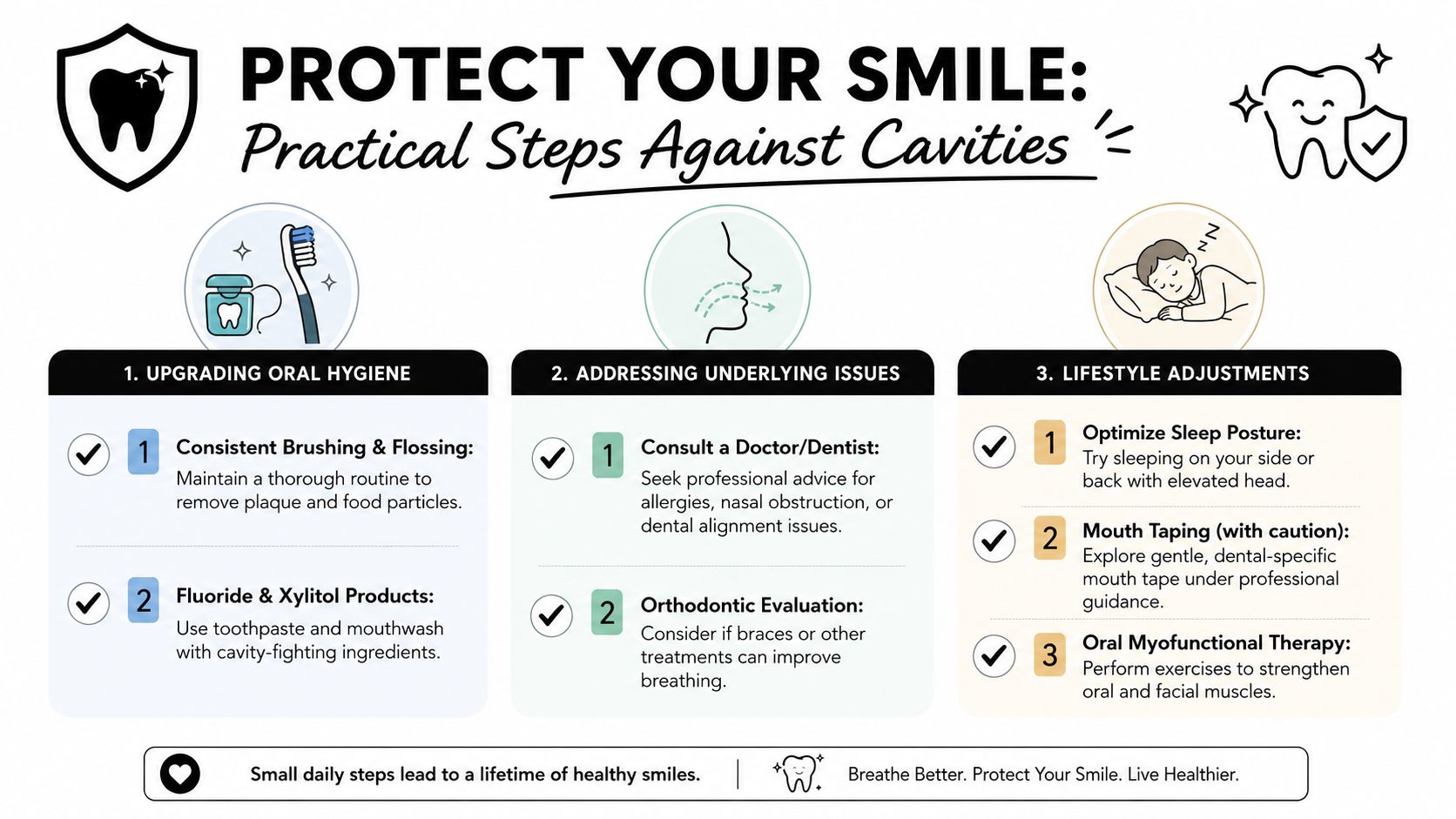
Upgrade the daily basics
Start with consistent brushing and flossing. In a drier mouth, plaque can cling more stubbornly, so removal matters even more. For families looking at mineral support, nano-hydroxyapatite toothpaste is one option people choose as part of a modern oral care routine, and Mouthology makes a 10% nano-hydroxyapatite toothpaste designed for everyday use.
Support saliva flow where you can
Hydration helps. So does paying attention to sleep habits, nasal comfort, and the foods that leave less residue on teeth. Chewing sugar-free gum after meals can also encourage saliva flow, which is helpful when the mouth tends to run dry.
Address the root cause
If mouth breathing is tied to allergies, congestion, orthodontic issues, or sleep-disordered breathing, a dentist or doctor can help sort out the source. That's the part many people miss, because cleaning up the mouth helps, but the breathing pattern still matters.
For a simple prevention checklist that pairs well with this routine, see how to prevent cavities. The main idea is to protect the teeth from both sides, reduce acid exposure and support the body's natural defenses.
Best next move: Treat the breathing pattern and the brushing routine as teammates, not separate problems.
Building a Healthier Breathing and Brushing Routine
Mouth breathing doesn't cause cavities directly, but it can alter the mouth's environment by reducing saliva's protective effect and drying oral tissues, which makes cavity-causing bacteria more effective (CNMA). This is the key insight. It's a meaningful risk factor, not a guarantee of dental problems.
A calmer, more useful response is to notice the pattern, protect the teeth, and pay attention to what might be driving the breathing habit in the first place. If dry mouth, snoring, or open-mouth sleeping keeps showing up, bring it up with your dentist or medical professional instead of trying to guess your way through it.
For a broader look at sleep and breathing habits, Lucidoura's insights on sleep wellness can be a helpful extra resource. The goal isn't perfection. It's a routine that supports your mouth, your sleep, and your family's long-term oral health.
If you've been waking up dry, snoring, or noticing more plaque than usual, make a dental appointment and ask about the breathing pattern behind it. A simple conversation can help you build a plan that supports both your smile and your sleep.
